-
Oak Brook
📍📞 630-705-99992625 Butterfield Rd. Suite 102E
Oak Brook, IL 60523📠 Fax: 630-705-1422✉️ inquiry@vervecollege.edu 🗺️ Open in Google Maps 🍎 Open in Apple Maps🕒Office HoursMon–Fri: 9:30 AM – 6:00 PM
Sat: 8:00 AM – 12:00 PM
Sun: Closed -
Chicago
📍📞 312-920-8822216 W. Jackson Blvd. Suite 900
Chicago, IL 60606📠 Fax: 630-705-1422✉️ inquiry@vervecollege.edu 🗺️ Open in Google Maps 🍎 Open in Apple Maps🕒Office HoursMon–Fri: 9:30 AM – 6:00 PM
Sat: 8:00 AM – 12:00 PM
Sun: Closed - Email:inquiry@vervecollege.edu
- Make a Payment
 Sign up
 Login
Login
- Home
- Programs
- Admission
- Resources
- ATI Entrance Exam Resources
- New E-Digital Library
- Refer a Friend
- School Newsletter
- Events
- Employers
- Job-Network
- Alpha Beta Kappa Candidates
- Verve College Library
- Graduation and Pinning Ceremony Photo Galleries
- Textbook Information
- Career Services
- Tutoring
- School Catalog
- FAQ
- Constitution Day Program
- Alumni
- Verve College Plans
- Financial Aid
- HEERF Reporting
- Satisfactory Academic Progress
- Apply For Financial Aid
- Net Price Calculator
- Return of Title IV Funds (R2T4)
- Financial Aid Office Code of Conduct
- Contact
- FAQs
- Verification Policy
- Vaccination Policy
- Student Right-to-Know Act
- Misrepresentation
- Information Security Program
- Academic Award Year
- Availability of Employee
- Cost of Attendance
- Health & Safety Exemption Requirement
- Students Rights and Responsibilities
- Leave of Absence
- Pell Formula
- Military Students
- Grants/ Scholarship Policy
- Contact Us
- Testimonials
- Blog
Is a Nursing Career Right For You?
Take The Free Quiz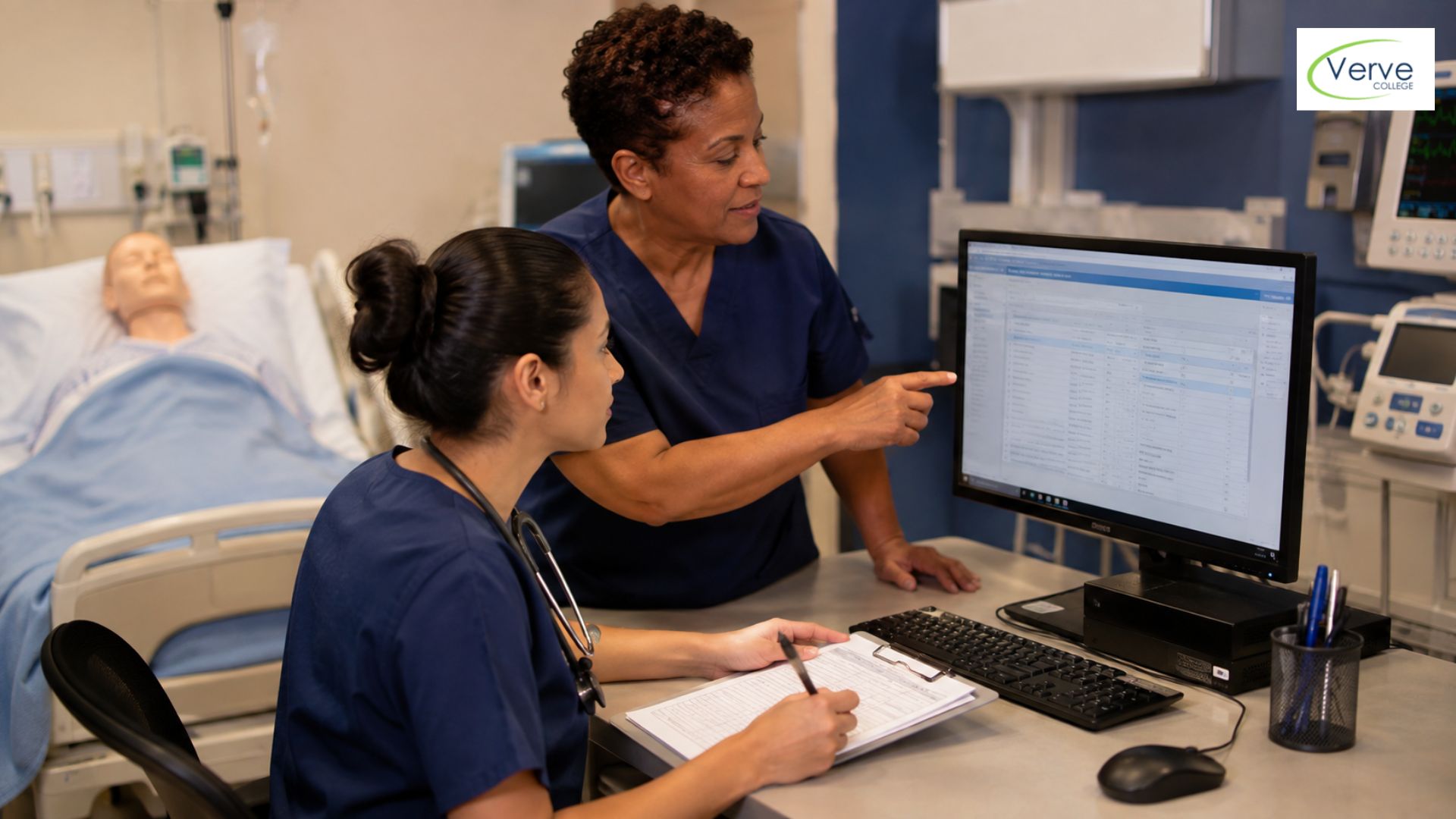
Nursing Care Documentation: What Students Should Know
Nursing Care Documentation: What Students Should Know
You’ve assessed your patient, administered medications, performed procedures, and provided care. But here’s what many new nursing students don’t realize: if you didn’t document it, legally it didn’t happen. Nursing documentation is far more than paperwork. It’s the official record of your patient’s care, their condition, your assessments, your interventions, and how they responded. Documentation creates the communication system that ensures all healthcare providers understand what’s happening with each patient. It protects patients by creating a complete care record. It protects you by documenting the care you provided. This article explains what nursing documentation is, why it matters, how to document effectively, and why developing strong documentation skills now will serve you throughout your career.
Key Takeaways
- Nursing documentation is the written (or electronic) record of patient assessments, nursing interventions, patient responses, and relevant communication that forms the official medical record.
- Accurate, timely, and complete nursing documentation supports patient safety, continuity of care, communication among healthcare team members, and legal accountability.
- Effective nursing documentation includes objective observations, specific findings, time-sensitive information, patient responses, and interventions performed, avoiding vague language or unsupported assumptions.
- If you’re researching best nursing schools in Illinois, ask how programs teach documentation skills and what practice opportunities students have with electronic health records.
- Common documentation mistakes include charting care not performed, delaying documentation, using unclear language, including personal opinions, and failing to follow facility policies.
- Strong documentation skills are a nursing competency that develops through classroom learning, simulation practice, and supervised clinical experience.
What Is Nursing Documentation?
Nursing documentation is the written or electronic record of everything related to a patient’s care. It includes your patient assessments, the interventions you performed, how the patient responded to care, communication with other healthcare providers, and any changes you observed in the patient’s condition. This documentation becomes part of the patient’s permanent medical record.
Think of nursing documentation as the official story of your patient’s hospital or clinical experience. Weeks or months later, if someone needs to know what happened during your shift, they read your documentation. If a patient has a question about their care, the documentation provides evidence of what was done. If a legal dispute arises, your documentation is often the primary evidence of what care was provided and how the patient responded.
Nursing documentation isn’t optional. It’s a professional and legal requirement. Every patient interaction, assessment, intervention, and patient response that’s significant enough to affect care must be documented. This is how the healthcare team communicates, how continuity of care is maintained, and how patient safety is protected.
The Main Purposes of Nursing Documentation
Nursing documentation serves multiple critical purposes. Understanding these purposes helps you appreciate why documentation is taken seriously and why accuracy matters.
Communicating Patient Information
Documentation is how you communicate with other healthcare providers about your patient. When you leave your shift, the night shift nurse reads your documentation to understand what happened during the day. Your physician reviews your documentation to decide what treatment to order. Specialists read your documentation to understand the patient’s history and current status. Without clear, accurate documentation, this communication breaks down.
Supporting Continuity of Care
As patients move through the healthcare system, they encounter different nurses, doctors, and providers. Documentation creates continuity by providing everyone with the complete story of the patient’s care, condition, and response to treatment. Without documentation, each new provider would start from scratch, potentially repeating assessments or missing important information.
Recording Patient Assessments
Your nursing assessments (vital signs, physical findings, patient observations, patient reports) become part of the medical record. These assessments guide clinical decision-making and treatment. If an assessment isn’t documented, there’s no official record that it was performed.
Tracking Changes in Patient Condition
Documentation allows providers to see patterns and trends in patient condition over time. Is the patient improving or declining? Are vital signs getting better or worse? Is pain medication effectively controlling pain? These trends, visible through documentation, guide treatment decisions.
Documenting Nursing Interventions
Everything you do for patients must be documented: medications administered, procedures performed, patient education provided, comfort measures offered, wound care completed, and any other interventions. This creates a record of your professional nursing actions.
Recording Patient Responses
How did the patient respond to the medication you gave? Did the pain decrease? Did the patient tolerate the procedure? Did the patient understand the education you provided? Patient responses are important clinical information that must be documented.
Supporting Patient Safety
Accurate documentation is a critical patient safety tool. It communicates important patient information, allergies, adverse reactions, and changes in condition. It creates accountability. It helps prevent medication errors, wrong-site procedures, and other adverse events.
Facilitating Communication Among Healthcare Professionals
Your documentation is how you communicate with the entire healthcare team. Physicians, nurses, therapists, dietitians, and others all read your documentation to understand the patient and coordinate care.
Creating a Legal and Professional Record
Your documentation is a legal document. In court, it serves as evidence of the care you provided and the clinical reasoning behind your actions. It protects you by showing that you provided appropriate care. It also creates professional accountability, showing that you met professional standards.
The Nursing Documentation Process: Step by Step
Understanding the documentation process helps you approach this task systematically. While specific documentation formats vary by facility, this general process applies to most nursing settings.
Step 1: Review the Patient Information
Before you document, understand your patient’s current condition, care plan, diagnoses, relevant history, and any current problems. Know what the patient came in for, what treatments have been started, and what the current clinical picture is. This context helps you recognize what’s significant and needs documentation.
Step 2: Record Objective Findings
Document what you observe. Objective findings are facts you can verify: vital signs, physical findings, observable behaviors, specific patient statements, and measurable data. For example, “Temperature 101.5 degrees Fahrenheit orally” is objective. “Patient seems feverish” is subjective. Include both, but label them clearly.
Step 3: Document Nursing Assessments
Record your assessment findings: what you observed during your examination, what the patient told you, and what you think it means. For example, “Patient reports sharp chest pain rated 8/10, located in the left anterior chest, radiating to the left arm. Took aspirin at 2 PM. Pain decreased to 4/10 at 2:45 PM. Monitored for cardiac changes.
Step 4: Document Interventions
Write down the care you provided. Include the time, what you did, how you did it, and any special considerations. For example, “Administered 2 grams of acetaminophen orally at 3 PM with a full glass of water. Patient tolerated well.” Don’t just say “pain management” or “comfort measures.” Be specific about what you actually did.
Step 5: Record the Patient’s Response
After any intervention, document how the patient responded. This is clinically important information. “Patient reported pain decreased from 8/10 to 4/10 after medication. Rested quietly for 1 hour. Vital signs stable.”
Step 6: Document Relevant Communication
Record significant communication with healthcare providers and team members. If you called the physician about a patient change, document what you reported and what was ordered. If you communicated concerns to your supervisor, document it. This creates a record of communication and care coordination.
Step 7: Review Your Documentation
Before finalizing, review what you’ve written. Is it accurate? Is it complete? Is it clear? Is it timely? Are abbreviations approved? Does it reflect the actual care provided? Make corrections if needed. Once documentation is finalized in an electronic system, it’s usually permanent (though most systems allow you to add addenda if you need to add information later).
What Good Nursing Documentation Should Include
Effective nursing documentation has specific characteristics. Understanding these characteristics helps you develop documentation skills that meet professional standards.
Accurate and Objective
Documentation should reflect exactly what you observed, not what you assumed. Write “Patient lying down with eyes closed,” not “Patient sleeping” (you can’t be sure if they’re sleeping). Write specific vital signs, specific patient statements, and specific findings.
Clear and Concise
Use clear language that other providers can understand. Avoid vague terms like “appears fine” or “doing okay.” Instead, write “Ambulating without assistance. No complaints of pain. Vital signs stable. Alert and oriented to person, place, and time.”
Complete and Relevant
Include all information necessary to understand the patient’s care and condition. Don’t document irrelevant information, but don’t leave out important details. If a patient has chest pain and you’re caring for a cardiac patient, document the chest pain. If a patient had breakfast without complaint, you might not document that unless appetite is a clinical concern.
Timely
Document as soon as possible after care is provided. Don’t chart hours later when details are hazy. Timely documentation is more accurate and reflects real-time patient status.
Professional
Use professional language. Avoid personal opinions, judgmental statements, or emotional language. Write “Patient stated he doesn’t want visitors,” not “Patient is being difficult about visiting hours.” Write factually and professionally.
Consistent with Actual Care
Documentation should match what actually happened. Don’t chart care that wasn’t performed. Don’t document interventions you planned but didn’t complete. Don’t copy yesterday’s assessment if the patient’s condition has changed.
Using Approved Abbreviations
Many abbreviations are standard and facility-approved. Use them. But never use unapproved abbreviations. When in doubt, spell it out. Some abbreviations (like “U” for units or “IU” for international units) are on “do not use” lists because they’ve caused medication errors.
Common Nursing Documentation Mistakes to Avoid
Learning from others’ mistakes helps you develop better documentation habits. Here are documentation mistakes students should avoid.
Documenting Care That Was Not Performed
Never chart care you didn’t provide. This is falsification of medical records, a serious ethical and legal violation. If you ran out of time to give a bed bath you planned, don’t chart it. Chart what you actually did. If care wasn’t completed, document why not.
Delaying Documentation Unnecessarily
The sooner you document after providing care, the more accurate your documentation. Delaying documentation leads to forgotten details and inaccurate information. Make documentation a priority throughout your shift.
Using Unclear or Ambiguous Language
Terms like “fine,” “good,” “normal,” or “okay” don’t provide enough information. Other providers can’t understand exactly what the patient’s status is. Be specific. Write “Alert and oriented to person, place, time, and date. Speech clear. No complaints of pain. Vital signs within normal limits.”
Including Personal Opinions
Documentation should be factual, not opinionated. Don’t write “Patient is a frequent complainer” or “Patient doesn’t follow instructions.” Write factually: “Patient requested pain medication four times during shift. Pain medication provided each time as ordered.” This is objective and documents facts without judgment.
Omitting Relevant Patient Responses
If you gave a medication for pain, you must document whether pain decreased. If you provided education, you must document the patient’s understanding. Patient responses are clinically important and must be included.
Failing to Document Significant Changes
If a patient’s condition changes significantly, this must be documented promptly. New symptoms, vital sign changes, behavioral changes, or any other significant alteration requires documentation and likely needs to be reported to the provider.
Copying Information Without Verification
Don’t copy yesterday’s documentation into today’s entry just because the patient’s condition appears unchanged. You must verify that information is still accurate. If the patient’s pain was resolved yesterday but pain has returned today, you must document the change.
Using Abbreviations That Aren’t Approved
Each facility has a list of approved abbreviations. Use only those. Never make up abbreviations. If you’re unsure, spell it out. Using unapproved abbreviations can cause misunderstandings and medical errors.
Failing to Follow Electronic Health Record Procedures
If your facility uses electronic documentation, follow the procedures precisely. Log in properly, enter information in the correct fields, use the correct patient identifiers, and follow all steps. Electronic documentation errors can be as serious as handwriting errors.
How Nursing Documentation Connects to Patient Safety and Competency
Strong nursing documentation skills are one of the competencies you’ll develop during your nursing education. Documentation isn’t just a skill you learn once. It’s a competency that directly affects patient safety. Inaccurate or incomplete documentation can lead to medication errors, missed diagnoses, communication breakdowns, and patient harm.
When you understand what competencies you need to develop before graduation, including documentation skills, you approach your education more strategically. You recognize that documentation practice during clinical rotations isn’t busywork. It’s essential competency development. Understanding what nursing competencies require demonstration before graduation helps you appreciate that documentation is one of those competencies you’ll be formally assessed on.
Why Nursing Documentation Matters in Clinical Practice
Strong documentation supports every aspect of patient care. When you work as a nurse, you’ll spend significant time documenting. You’ll chart medications, vital signs, assessments, interventions, and patient responses. Your documentation will be read by other nurses, physicians, therapists, and numerous other healthcare professionals. Inaccurate documentation puts patients at risk. Poor documentation creates communication problems. Missing documentation leaves gaps in the care record.
Conversely, excellent documentation supports patient safety, facilitates communication, enables continuity of care, supports clinical decision-making, and creates professional accountability. The nursing documentation you provide as a student nurse is the foundation for the documentation habits you’ll maintain throughout your career.
Developing Strong Documentation Skills During Nursing Education
Nursing documentation skills develop through classroom instruction, practice with electronic health records, simulation activities, and supervised clinical experience. In the classroom, you learn documentation standards and principles. In simulation, you practice documenting care in realistic scenarios. In clinical, you document actual patient care under instructor supervision.
When you’re evaluating licensed practical nurse programs, ask how programs teach documentation and what opportunities students have to practice with the electronic health records they’ll use during clinical. Programs with strong documentation education provide multiple opportunities for students to practice and receive feedback.
Creating Accountability Through Nursing Documentation
Your signature (or electronic credentials) on documentation means you take responsibility for that information. You’re saying, “I performed this assessment, I provided this care, I observed this response.” This accountability is important. It ensures careful, thoughtful documentation. It protects patients by making nurses responsible for the accuracy of the medical record.
When you approach nursing documentation seriously, you recognize its critical importance. You document carefully, completely, and honestly. You take the time to document well. You follow all facility policies and procedures. This professional approach to documentation protects patients, supports the healthcare team, and creates the legal and professional record that nursing practice requires.
Choosing Programs That Teach Documentation Well
When comparing practical nursing programs in Illinois, ask about documentation instruction specifically. How many hours are devoted to teaching documentation? What electronic health record systems do students practice with? Do students receive feedback on their documentation during clinical? Are there simulation scenarios focused specifically on documentation? Do instructors review documentation entries and provide specific feedback?
Programs that take documentation education seriously provide robust instruction and multiple practice opportunities. This investment in documentation education prepares students to meet professional standards and protect patient safety.
Conclusion
Nursing documentation is far more than paperwork. It’s the communication system that connects your care to the care of every other healthcare provider. It’s the official record of your professional nursing actions. It’s a critical patient safety tool. It’s a legal document that protects you and your patients. As a nursing student, developing strong documentation skills now prepares you for professional nursing practice. When you understand the purposes of nursing documentation, follow a systematic process, include all necessary information, avoid common mistakes, and approach documentation professionally, you create documentation that protects patients, supports communication, and reflects your professional competence. Take documentation seriously during your nursing education. The habits you develop now will carry throughout your career and directly impact the quality and safety of patient care you provide.
Get Your Nursing Career Training Readiness Score Now!
Frequently Asked Questions (FAQs)
What should I do if I make a documentation error?
In electronic health records, most facilities don’t allow deletion of entries. Instead, you add an addendum documenting the correction, including the current date and time and explaining what was corrected. In paper documentation, draw a single line through the error, write “Error” and your initials, date it, and document the correct information nearby. Never use white-out or erasers. The goal is to show that the error was recognized and corrected appropriately.
How detailed should nursing documentation be?
Documentation should be thorough enough that another provider could understand the patient’s status and care without having to ask you questions. Include specific findings, not vague terms. Include the time interventions were performed. Include patient responses to interventions. However, don’t include every minor detail. Focus on information that affects patient care and clinical decision-making. This balance develops with experience and feedback.
Can I document care I didn’t personally perform?
Only document care you personally provided or directly observed. If a nursing assistant performed care, you can document based on what they report, but you’re responsible for the accuracy of what you chart. Never document care you didn’t see or don’t know happened. This is falsification of records. If you perform an assessment and find something concerning, you must document your findings even if you’re repeating work another provider just did. Your assessment and findings matter.
Most Popular Blogs Posts

What Is Capillary Refill? A Guide…
October 13, 2026 Read More
How to Evaluate an LPN Program’s…
October 13, 2026 Read More
7 Benefits of Hands-On Nursing Education…
October 12, 2026 Read More
What Is Tissue Perfusion? A Simple…
October 12, 2026 Read More