-
Oak Brook
📍📞 630-705-99992625 Butterfield Rd. Suite 102E
Oak Brook, IL 60523📠 Fax: 630-705-1422✉️ inquiry@vervecollege.edu 🗺️ Open in Google Maps 🍎 Open in Apple Maps🕒Office HoursMon–Fri: 9:30 AM – 6:00 PM
Sat: 8:00 AM – 12:00 PM
Sun: Closed -
Chicago
📍📞 312-920-8822216 W. Jackson Blvd. Suite 900
Chicago, IL 60606📠 Fax: 630-705-1422✉️ inquiry@vervecollege.edu 🗺️ Open in Google Maps 🍎 Open in Apple Maps🕒Office HoursMon–Fri: 9:30 AM – 6:00 PM
Sat: 8:00 AM – 12:00 PM
Sun: Closed - Email:inquiry@vervecollege.edu
- Make a Payment
 Sign up
 Login
Login
- Home
- Programs
- Admission
- Resources
- ATI Entrance Exam Resources
- New E-Digital Library
- Refer a Friend
- School Newsletter
- Events
- Employers
- Job-Network
- Alpha Beta Kappa Candidates
- Verve College Library
- Graduation and Pinning Ceremony Photo Galleries
- Textbook Information
- Career Services
- Tutoring
- School Catalog
- FAQ
- Constitution Day Program
- Alumni
- Verve College Plans
- Financial Aid
- HEERF Reporting
- Satisfactory Academic Progress
- Apply For Financial Aid
- Net Price Calculator
- Return of Title IV Funds (R2T4)
- Financial Aid Office Code of Conduct
- Contact
- FAQs
- Verification Policy
- Vaccination Policy
- Student Right-to-Know Act
- Misrepresentation
- Information Security Program
- Academic Award Year
- Availability of Employee
- Cost of Attendance
- Health & Safety Exemption Requirement
- Students Rights and Responsibilities
- Leave of Absence
- Pell Formula
- Military Students
- Grants/ Scholarship Policy
- Contact Us
- Testimonials
- Blog
Is a Nursing Career Right For You?
Take The Free Quiz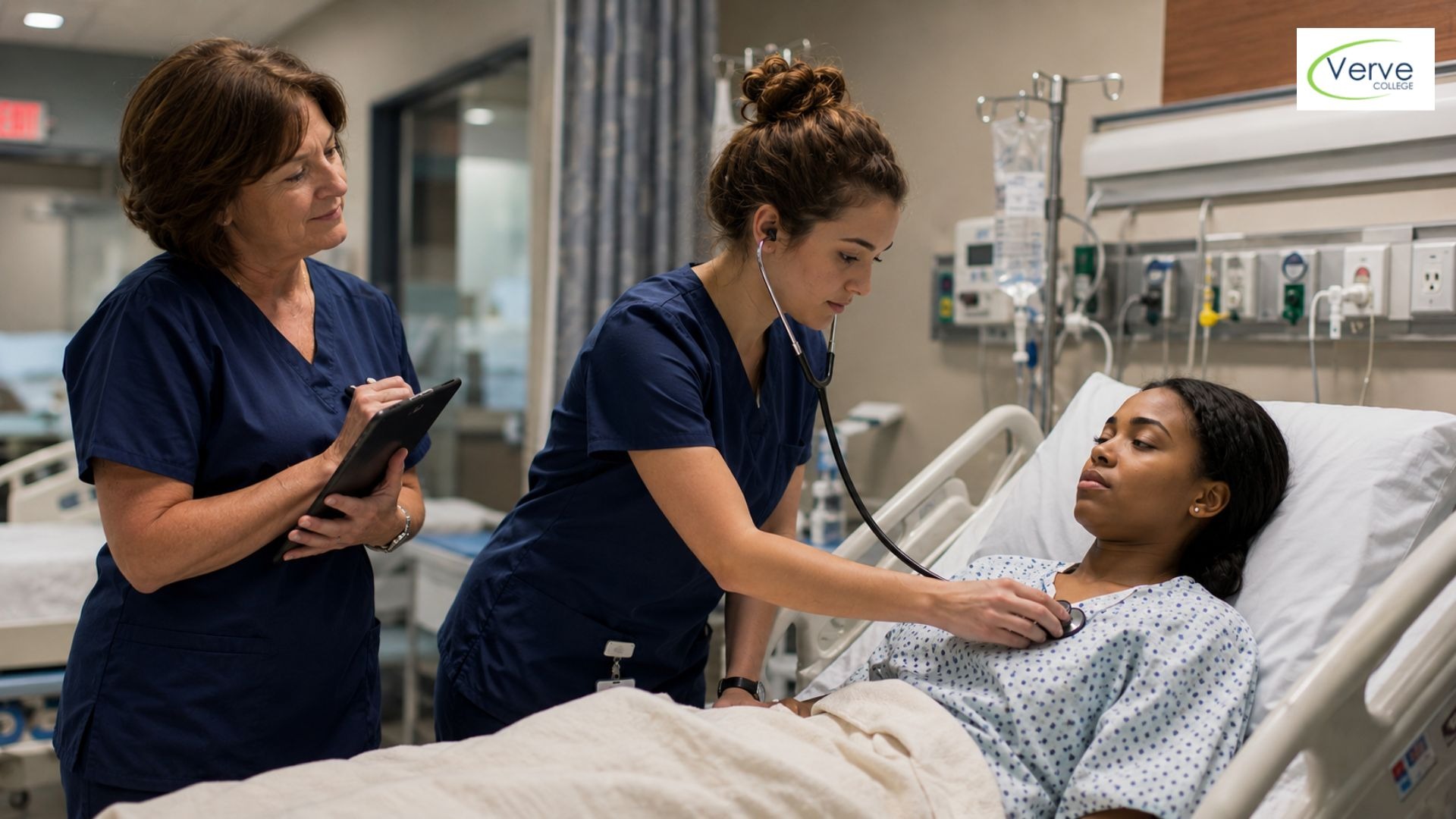
Understanding Nursing Competencies Before Graduation
Understanding Nursing Competencies Before Graduation
You can read textbooks and attend lectures, but can you actually perform patient care safely and confidently? That’s what nursing competencies measure. Nursing competencies are the combination of knowledge, technical skills, clinical judgment, communication skills, and professional behaviors that enable nurses to provide safe, effective, patient-centered care. Before you graduate from a nursing program, you’ll need to demonstrate competency in dozens of areas, from taking vital signs to communicating with patients to understanding when to ask for help. Understanding what nursing competencies are, how they’re developed, and why they matter helps you prepare for your career and know what to expect during your education.
Key Takeaways
- Nursing competencies are more than just knowing how to perform a task; they include the knowledge, clinical judgment, communication, and professionalism needed to care for patients safely.
- Students develop nursing competencies through classroom instruction, skills laboratory practice, simulation activities, and supervised clinical experience with real patients.
- Major competency areas include patient assessment, vital signs, medication administration, infection prevention, communication, documentation, safety, clinical decision-making, and teamwork.
- Demonstrating competency means performing a skill correctly, consistently, and independently in a variety of situations while maintaining patient safety and professional standards.
- If you’re researching best nursing schools in Illinois, ask how programs assess nursing competencies and what support they provide for competency development.
- Competency assessment typically happens through demonstrations, return demonstrations, simulations, clinical observation, and written or practical exams.
What Are Nursing Competencies?
Nursing competencies are the abilities you need to practice nursing safely and effectively. The term “competency” might sound abstract, but it’s really quite practical. It means you can do your job at a level that keeps patients safe and promotes their health.
A nursing competency includes several layers. First, there’s knowledge: understanding anatomy, physiology, pharmacology, disease processes, and nursing principles. Second, there’s technical skill: the ability to actually perform procedures like inserting a catheter or administering an injection. Third, there’s clinical judgment: knowing when something is wrong and what to do about it. Fourth, there’s communication: being able to talk with patients, families, and healthcare team members clearly and compassionately. Fifth, there’s professionalism: showing up on time, following protocols, respecting patient privacy, and maintaining ethical standards.
A single nursing competency pulls all these pieces together. Consider the competency “administers medications safely.” This requires knowledge of pharmacology, the ability to calculate doses and handle equipment, judgment about whether it’s safe to give the medication, communication skills to inform the patient, and professional responsibility to verify orders and document accurately.
Major Nursing Competency Areas Students Develop
Practical nursing programs teach and assess many different competencies. Here’s an overview of the major areas.
Patient Assessment and Vital Signs
Patient assessment is foundational. You’ll learn to gather patient information through interviews, observation, and physical examination. You’ll measure vital signs (temperature, pulse, respiration, blood pressure), recognize abnormal findings, and communicate what you observe.
Infection Prevention and Control
Infection prevention competencies include understanding how infections spread and using techniques like handwashing, personal protective equipment, and aseptic technique to prevent transmission of pathogens. These competencies are critical because improper technique puts patients and yourself at risk.
Medication Safety and Administration
This competency area includes calculating doses accurately, understanding medication interactions and side effects, administering medications through various routes (oral, intramuscular, intravenous), and recognizing adverse reactions. Medication errors can be serious, so medication competencies are thoroughly assessed.
Patient Communication
Clear communication is essential. This includes explaining procedures in ways patients understand, listening actively to patient concerns, adapting communication for patients with hearing loss or cognitive changes, and involving families appropriately in care discussions.
Documentation and Charting
Nursing documentation creates the medical record. You’ll learn to document accurately and completely what you observe, what you do, and how patients respond. Proper documentation supports patient care continuity and provides legal protection.
Basic Nursing Procedures
This includes procedures like moving and positioning patients, providing hygiene care, inserting urinary catheters, performing wound care, providing toileting assistance, and measuring intake and output. Proper technique ensures patient comfort and safety.
Patient Mobility and Positioning
You’ll learn to help patients move safely, transfer from bed to chair, use walkers or canes, and reposition patients in bed. These competencies prevent patient falls and protect your own back from injury.
Wound and Skin Care
You’ll learn to assess skin condition, prevent pressure injuries, perform basic wound care, apply bandages and dressings, and recognize signs of infection. Skin and wound competencies support patient healing and comfort.
Nutrition and Hydration Support
This includes understanding patient dietary needs, assisting with eating and drinking, managing feeding tubes, and monitoring for dehydration or malnutrition. Proper nutrition supports patient healing and overall health.
Safety and Fall Prevention
These competencies include recognizing hazards, preventing falls, responding to emergencies, and following safety protocols. Patient safety is the foundation of all nursing care.
Therapeutic Communication and Emotional Support
Beyond basic communication, therapeutic communication competencies include supporting patients emotionally, responding to patient anxiety or anger, and providing presence during difficult situations. These competencies address the human side of nursing care.
Team Collaboration and Reporting
Nursing doesn’t happen in isolation. You’ll develop competencies in working with physicians, respiratory therapists, physical therapists, and other team members. You’ll learn to report findings clearly and escalate concerns appropriately.
Patient Education
Teaching patients about their conditions, medications, and self-care is a nursing responsibility. Patient education competencies help you explain health information in understandable terms.
Clinical Observation and Critical Thinking
You’ll learn to observe patients carefully, recognize changes in their condition, think critically about what findings mean, and connect what you observe to what you know about disease processes. This is how you catch problems early.
Documentation Accuracy and Legal Compliance
Beyond basic charting, you’ll understand legal and ethical documentation requirements, patient privacy (HIPAA), and how documentation affects legal liability. This competency protects patients and yourself.
Ethical and Professional Conduct
You’ll develop competencies in maintaining patient confidentiality, avoiding conflicts of interest, respecting patient autonomy, and upholding nursing’s ethical principles. Professional conduct builds patient trust.
Clinical Decision-Making
You’ll learn to gather information, consider options, make care decisions, and evaluate outcomes. This higher-level competency develops throughout your career but begins during nursing education.
Learning a Skill vs Demonstrating Competency
Here’s an important distinction: learning how to do something is different from demonstrating that you can do it competently. You might learn in skills lab how to take a blood pressure. But demonstrating competency means you can take a patient’s blood pressure accurately, using correct technique, recognizing what the reading means, and communicating results to the patient.
Many students confuse exposure with competency. “I watched my instructor do that” doesn’t equal competency. “I practiced that in skills lab” is important but doesn’t guarantee competency. Demonstrating competency means you can perform the skill correctly under varying conditions, in real clinical situations, with minimal supervision, and while maintaining patient safety.
Competency development typically progresses through stages. First, you learn the theory and see a demonstration. Second, you practice with a model or mannequin in a controlled environment. Third, you perform the skill with direct supervision in a clinical setting. Fourth, you perform the skill with indirect supervision (instructor nearby but not watching every movement). Fifth, you perform the skill independently once your competency has been verified.
This progression exists because patient safety depends on competency. Nursing programs can’t let students practice independently until they’ve demonstrated they can do it safely.
How Nursing Instructors Assess Competencies
Different programs use different assessment methods, but most include several approaches. Understanding what to expect helps you prepare appropriately.
Skills Laboratory Demonstrations
In the skills lab, instructors watch you perform procedures on models or mannequins. They look for correct technique, safety practices, and proper handling of equipment. You typically demonstrate a skill multiple times before it’s considered competent.
Return Demonstrations
A return demonstration means the instructor shows you a procedure, then you perform it while they observe. This is a common assessment method for practical nursing skills. The instructor provides feedback, and you may need to demonstrate again if the first attempt isn’t competent.
Simulation Activities
Many programs use high-fidelity manikins (realistic patient simulators) that can respond to your actions. You might practice a scenario where a patient’s condition changes, requiring you to assess, communicate, and make clinical decisions. Simulations assess competencies in realistic situations without risking real patients.
Clinical Observation
During clinical rotations, instructors observe you working with actual patients. They watch your patient interactions, how you perform procedures, whether you follow protocols, how you handle unexpected situations, and how you respond to feedback. This is the truest test of competency because it happens in the real world.
Written or Practical Exams
Some nursing competencies are assessed through exams. You might answer questions about medication safety, write care plans, or complete written scenarios. These assess knowledge underlying competencies.
Documentation Review
Instructors review your charting to assess documentation competencies. They look for accuracy, completeness, proper format, and whether you documented appropriately and legally.
Competency Checklists and Rubrics
Many programs use detailed checklists or rubrics that specify exactly what demonstrates competency. These tools help standardize assessment and make expectations clear to students.
Why Nursing Competencies Matter Before Graduation
Competency assessment isn’t busywork or hoops to jump through. It exists for one critical reason: patient safety. A nurse who hasn’t demonstrated competency in medication administration might give the wrong dose. A nurse who hasn’t demonstrated competency in communication might miss important patient information. Competency requirements protect patients.
Competency assessment also protects you. When you graduate knowing that you can perform skills competently and independently, you start your career with confidence. You’re not guessing whether you know how to do your job. You know you do. That confidence translates to better patient care and less anxiety.
Additionally, competency assessment helps programs maintain standards. When licensed practical nurse programs require competency demonstration, they’re ensuring that all graduates meet the same high standards. This protects the public and maintains the profession’s credibility.
Employers also rely on nursing competencies. When you apply for a job, employers trust that you have demonstrated competency in the skills needed for the position. They don’t need to teach you basic procedures because you’ve already proven you can do them safely.
How to Strengthen Your Nursing Competencies During School
Competency development is partly about instruction, but it’s also about your effort and engagement. Here are practical strategies for developing strong competencies.
Practice Consistently
Don’t wait until competency assessment to practice. Use open skills lab time to practice procedures repeatedly. Repetition builds muscle memory and confidence. The more you practice, the more automatic proper technique becomes.
Review Procedures Before Practice
Before you practice, read the procedure step-by-step. Know what you’re trying to accomplish and how proper technique looks. This preparation makes practice time more effective.
Ask Your Instructors for Feedback
After practicing or performing a skill, ask your instructor for specific feedback. What did you do well? What needs improvement? This targeted feedback accelerates learning. Don’t assume silence means competency; ask directly whether you’re demonstrating competency.
Connect Theory with Practice
Understanding why you do something makes you better at doing it. When you know that handwashing reduces infection risk, you’re more likely to practice it consistently. Connect your classroom learning to your clinical practice.
Reflect on Your Performance
After clinical experiences, take time to think about what went well and what you’d do differently. Reflection helps you learn from experience and identify areas for improvement.
Become Familiar with Clinical Protocols
Every facility has specific protocols. Learn your clinical facility’s policies on documentation, medication administration, reporting procedures, and other important processes. Clinical competencies include understanding how things work at your specific facility.
Seek Diverse Experiences
Different patients present different challenges. Try to care for patients with different conditions, ages, and needs. Diverse experience helps you adapt your skills to various situations and develop deeper competencies.
Evaluating Programs Based on Competency Standards
When you’re choosing among practical nursing programs in Illinois, understanding how programs approach competency assessment helps you make an informed decision. Ask programs these questions.
What competencies do graduates need to demonstrate? Request a detailed list. Are these competencies aligned with licensing exam content? Do they reflect skills you’ll need on the job?
How do you assess competencies? Do programs use demonstrations, simulations, clinical observation, and written exams? Multiple assessment methods provide a more complete picture of competency than a single test.
What support do you provide for students struggling with competencies? Programs should offer additional practice time, tutoring, or additional instruction if students aren’t demonstrating competency. Support systems matter because not everyone learns at the same pace.
What is your competency pass rate? Programs should be able to report what percentage of students demonstrate competency in all required areas before graduation. High pass rates indicate that the program is preparing students well.
If you want to understand how competencies connect to your first clinical experiences, learning about practical nursing skills during your first clinical rotation can help you see the direct connection between classroom competencies and patient care.
Conclusion
Nursing competencies are the skills, knowledge, judgment, communication, and professionalism that allow you to practice safely and effectively. Before graduation, you’ll need to demonstrate competency in dozens of areas. This might feel daunting, but competency assessment exists to protect patients and set you up for success. When you graduate having demonstrated competency, you start your career knowing you can do your job safely. That confidence matters. That competency matters. And that preparation matters for your patients’ safety and your professional success.
Get Your Nursing Career Training Readiness Score Now!
Frequently Asked Questions (FAQs)
What if I don’t demonstrate competency on my first try?
Most nursing programs allow multiple attempts at competency assessment. You’ll typically receive feedback on what needs improvement, get additional instruction or practice time, and then demonstrate competency again. Not passing on the first try is common and doesn’t mean you can’t develop competency. Many successful nurses needed multiple attempts to demonstrate certain skills.
Do all nursing programs assess the same competencies?
Nursing competencies are fairly consistent across programs because all nurses must meet the same licensing requirements. However, the specific competencies, assessment methods, and number of competency checkoffs vary by program. This is why asking about competency standards when choosing a program is important.
How do I know if I’m truly competent or just following procedures I memorized?
True competency means you understand why you’re doing something and can adapt if situations change. If you can explain your actions, make decisions based on patient responses, and handle unexpected situations, you’re demonstrating competency. If you’re just following steps without understanding, ask your instructor to help you develop a deeper understanding.
Most Popular Blogs Posts

What Is Capillary Refill? A Guide…
October 13, 2026 Read More
How to Evaluate an LPN Program’s…
October 13, 2026 Read More
7 Benefits of Hands-On Nursing Education…
October 12, 2026 Read More
What Is Tissue Perfusion? A Simple…
October 12, 2026 Read More