-
Oak Brook
📍📞 630-705-99992625 Butterfield Rd. Suite 102E
Oak Brook, IL 60523📠 Fax: 630-705-1422✉️ inquiry@vervecollege.edu 🗺️ Open in Google Maps 🍎 Open in Apple Maps🕒Office HoursMon–Fri: 9:30 AM – 6:00 PM
Sat: 8:00 AM – 12:00 PM
Sun: Closed -
Chicago
📍📞 312-920-8822216 W. Jackson Blvd. Suite 900
Chicago, IL 60606📠 Fax: 630-705-1422✉️ inquiry@vervecollege.edu 🗺️ Open in Google Maps 🍎 Open in Apple Maps🕒Office HoursMon–Fri: 9:30 AM – 6:00 PM
Sat: 8:00 AM – 12:00 PM
Sun: Closed - Email:inquiry@vervecollege.edu
- Make a Payment
 Sign up
 Login
Login
- Home
- Programs
- Admission
- Resources
- ATI Entrance Exam Resources
- New E-Digital Library
- Refer a Friend
- School Newsletter
- Events
- Employers
- Job-Network
- Alpha Beta Kappa Candidates
- Verve College Library
- Graduation and Pinning Ceremony Photo Galleries
- Textbook Information
- Career Services
- Tutoring
- School Catalog
- FAQ
- Constitution Day Program
- Alumni
- Verve College Plans
- Financial Aid
- HEERF Reporting
- Satisfactory Academic Progress
- Apply For Financial Aid
- Net Price Calculator
- Return of Title IV Funds (R2T4)
- Financial Aid Office Code of Conduct
- Contact
- FAQs
- Verification Policy
- Vaccination Policy
- Student Right-to-Know Act
- Misrepresentation
- Information Security Program
- Academic Award Year
- Availability of Employee
- Cost of Attendance
- Health & Safety Exemption Requirement
- Students Rights and Responsibilities
- Leave of Absence
- Pell Formula
- Military Students
- Grants/ Scholarship Policy
- Contact Us
- Testimonials
- Blog
Is a Nursing Career Right For You?
Take The Free QuizHow LPN Training Prepares Students for Real-World Patient Care
How LPN Training Prepares Students for Real-World Patient Care
Starting a nursing career can feel overwhelming when you are unsure what happens between the classroom and your first patient. LPN patient care training helps bridge that gap by turning nursing knowledge into practical skills you can use with real patients.
Students learn how to assess patients, provide basic care, follow safety procedures, communicate clearly, document care, and respond to changes in a patient’s condition. The goal is not simply to pass exams. It is to build habits that support safe and confident patient care.
Key Takeaways
- LPN patient care training combines classroom learning, skills practice, simulation, and supervised clinical experience.
- Students practice essential skills such as vital signs, hygiene, mobility assistance, infection control, and documentation.
- Anatomy and physiology help students understand why different patient-care procedures are performed.
- Skills labs provide a controlled place to practice before working with real patients.
- Clinical experience helps students apply nursing skills while communicating with patients and healthcare teams.
- Verve College’s LPN patient care training focuses on building practical skills that students can carry into clinical settings.
What Is LPN Patient Care Training?
LPN patient care training is the hands-on part of practical nursing education that prepares students to provide direct care under the appropriate level of supervision and within their scope of practice.
Students do not begin by being expected to know everything. Training usually progresses from basic concepts to hands-on practice and then to supervised clinical experiences.
This progression matters because nursing requires more than memorizing information. A student may know the normal range for a patient’s blood pressure but still need practice using a blood pressure cuff correctly, communicating with the patient, recording the result, and recognizing when a finding may require attention.
At Verve College, the Practical Nursing Program includes subjects such as physical assessment, vital signs, infection control, hygiene, documentation, nursing processes, and medical calculations. The program also includes practical learning experiences that help connect classroom knowledge with patient care.
How LPN Patient Care Training Builds Clinical Skills
Good LPN patient care training gives students opportunities to practice before they are responsible for real patients. This typically starts with demonstrations and skills practice.
A student may first watch an instructor demonstrate a procedure. Next, the student performs the procedure using a mannequin, training equipment, or a simulated patient. The instructor can then provide feedback and identify areas that need improvement.
This repetition is important. A student who practices taking vital signs several times can become more comfortable with the equipment and the steps involved.
The same approach applies to other practical nursing skills. Students may practice:
- Taking temperature, pulse, respiration, and blood pressure
- Measuring oxygen saturation
- Performing basic patient assessments
- Providing hygiene and comfort care
- Positioning and transferring patients
- Applying infection-control procedures
- Using personal protective equipment
- Performing medication-related procedures within their training
- Communicating with patients
- Documenting patient information
- Responding to changes in patient condition
The specific procedures and scope of practice depend on the nursing program, clinical setting, state requirements, and the student’s level of education.
Why LPN Patient Care Training Includes Anatomy and Physiology
LPN patient care training becomes much easier to understand when students have a strong foundation in anatomy and physiology.
Anatomy focuses on the structure of the body. Physiology explains how those structures function. Together, they help students understand what they are seeing when they assess a patient.
For example, knowing where the heart and lungs are located helps a student understand where to listen during an assessment. Understanding how the respiratory system works also helps the student recognize why changes in breathing may be important.
Students who need additional preparation can explore Verve College’s Anatomy and Physiology Prep Program, which introduces body systems and their functions in a nursing-focused learning environment.
This foundation can make later clinical lessons easier to connect. Instead of memorizing isolated steps, students can understand why those steps matter.
How LPN Patient Care Training Teaches Patient Safety
Patient safety is one of the most important parts of LPN patient care training. Small actions can have a significant effect on patient outcomes.
Infection prevention is a good example. The CDC recommends hand hygiene before and after appropriate patient-care activities and identifies hand hygiene as an important part of infection prevention. Students therefore need to develop hand hygiene as a routine habit rather than treating it as an occasional task.
The CDC’s core infection prevention practices explain how healthcare workers use standard precautions, including hand hygiene and appropriate personal protective equipment, during patient care.
Students also learn that safety includes more than infection control. They must pay attention to patient identification, correct procedures, safe movement, medication checks, equipment use, communication, and accurate documentation.
A useful way to think about nursing safety is this: every step should have a reason. Students learn to slow down, check information, communicate clearly, and follow established procedures.
What Students Practice in LPN Patient Care Training
The practical side of LPN patient care training covers many of the everyday responsibilities students may encounter during clinical education.
Patient Assessment
Assessment means collecting information about a patient’s condition. Students learn to measure vital signs, observe physical changes, ask appropriate questions, and report important findings.
A patient’s temperature, pulse, breathing rate, blood pressure, and oxygen saturation can provide useful information about their condition. Students learn how to obtain these measurements accurately and document them appropriately.
Personal Care and Comfort
Patient care is not limited to complex medical procedures. Helping a patient with hygiene, positioning, mobility, nutrition, elimination, or comfort can be an important part of nursing care.
Students learn how to provide this assistance while respecting privacy, dignity, and individual needs.
Infection Control
Students practice hand hygiene, use of protective equipment, and other infection-control procedures. The CDC explains that standard precautions are used for all patient care and are designed to help prevent the spread of infection.
The CDC hand hygiene guidance also emphasizes cleaning hands before and after patient contact and after removing gloves.
These practices become part of a student’s routine through repetition.
Communication
A technically correct procedure can still create problems if the patient does not understand what is happening.
Students practice explaining procedures in simple language, listening to concerns, maintaining professional communication, and showing respect. They also learn that communication with other members of the healthcare team is important for continuity of care.
Documentation
Nurses need to record relevant patient information accurately and on time. Students learn how documentation supports communication between members of the healthcare team.
Verve College’s guide to nursing care documentation explains why accurate records are an important part of patient care and professional nursing practice.
How LPN Patient Care Training Uses Skills Labs
A nursing skills lab gives students a controlled environment where they can practice procedures before working with real patients.
This is where LPN patient care training becomes very hands-on. Students may work with simulation mannequins, hospital beds, vital-sign equipment, injection training equipment, wound-care supplies, and other clinical tools.
A typical practice session may follow several steps:
- The instructor explains the procedure and its purpose.
- The instructor demonstrates the correct technique.
- Students prepare the equipment.
- Students perform the procedure.
- The instructor observes and provides feedback.
- Students repeat the procedure and correct mistakes.
- The student continues practicing until the skill becomes more consistent.
This process helps reduce the gap between knowing what to do and actually doing it.
Students can also review what happens during a nursing skills lab to understand why skills labs are an important part of nursing education.
How LPN Patient Care Training Connects Classroom Learning to Clinical Practice
Classroom lessons provide the foundation. Skills labs provide controlled practice. Clinical experiences then allow students to apply those skills in real healthcare environments under appropriate supervision.
This progression is important because real patients are different from mannequins or practice scenarios. A patient may be anxious, uncomfortable, confused, tired, or unable to communicate clearly.
Students therefore need to combine several skills at the same time. They may need to assess a patient, communicate with them, perform a procedure safely, document the result, and report an important change.
That is why LPN patient care training should not be viewed as one class or one activity. It is a gradual process that brings different parts of nursing education together.
What Students Should Look for in LPN Patient Care Training
If you are comparing practical nursing programs, look beyond the program name or advertised schedule. Ask practical questions about how students learn.
Ask About Skills Practice
Find out how often students use the skills lab and what equipment is available. Ask whether students receive individual feedback and whether additional practice time is available.
Ask About Clinical Experience
Understand when clinical experiences begin, what types of settings students may experience, and how clinical learning is supervised.
Ask About Student Support
Nursing education can move quickly. Tutoring, faculty support, academic resources, and career guidance can make it easier to stay on track when a topic becomes difficult.
Consider Your Schedule
If you are a working adult or career changer, consider whether the program structure fits your responsibilities. A program that works with your schedule can make it easier to remain consistent with your studies.
Understand Admission Requirements
Admission requirements vary by school. For example, students interested in Verve College should review the PN program admission requirements before planning their next steps.
Understanding requirements early can help you avoid surprises later.
How to Prepare for LPN Patient Care Training
You do not need to know every nursing procedure before starting. However, a few habits can make your education easier.
Review before class. Read assigned material before skills practice so the procedure is not completely new.
Ask questions. If you do not understand why a step matters, ask your instructor. Understanding the reason behind a procedure often makes it easier to remember.
Practice consistently. Skills improve through repetition. Use available practice time rather than waiting until an evaluation is approaching.
Take feedback seriously. Corrections are part of the learning process. Use instructor feedback to improve your technique.
Build communication skills. Practice speaking clearly and respectfully with simulated patients. Good communication is part of safe care.
Learn from mistakes. A skills lab gives you a safer place to identify and correct mistakes before applying those skills in clinical practice.
Why LPN Patient Care Training Matters for Your Career
Strong LPN patient care training helps students move from theory toward practical nursing practice.
You learn how to perform essential procedures, communicate with patients, recognize important information, maintain safety, and work as part of a healthcare team.
Just as importantly, you learn how to think about the patient as a person rather than a checklist of tasks. Patient care involves comfort, communication, dignity, observation, and attention to individual needs.
The skills you build during nursing education can become the foundation for your clinical experience and future work as a practical nurse.
Conclusion
LPN patient care training prepares students for the practical side of nursing by combining knowledge, hands-on practice, simulation, and supervised clinical learning. Students develop skills in assessment, patient safety, infection control, communication, documentation, and daily patient care. Anatomy and physiology provide the scientific foundation behind these skills, while skills labs give students a place to practice before working with real patients. Clinical experiences then help students apply what they have learned in real healthcare settings. If you are considering practical nursing in Illinois, focus on programs that provide clear training, meaningful practice opportunities, and support throughout your education. The right preparation can help you enter clinical learning with stronger skills and greater confidence.
Get Your Nursing Career Training Readiness Score Now!
Frequently Asked Questions
What skills are taught in LPN patient care training?
Students commonly learn vital signs, patient assessment, hygiene and comfort care, mobility assistance, infection control, communication, documentation, and medication-related procedures appropriate to their level and scope of practice. The exact curriculum varies by program.
Is hands-on practice important for LPN students?
Yes. Nursing involves practical skills that cannot be learned effectively through reading alone. Skills labs and supervised clinical experiences give students opportunities to practice procedures, receive feedback, and apply classroom knowledge.
How can I get started with LPN patient care training?
Start by reviewing practical nursing program requirements, schedule options, curriculum, clinical experiences, student support, and total program costs. If you are considering Verve College, review the program requirements and determine whether the program structure fits your educational and career goals.
Most Popular Blogs Posts
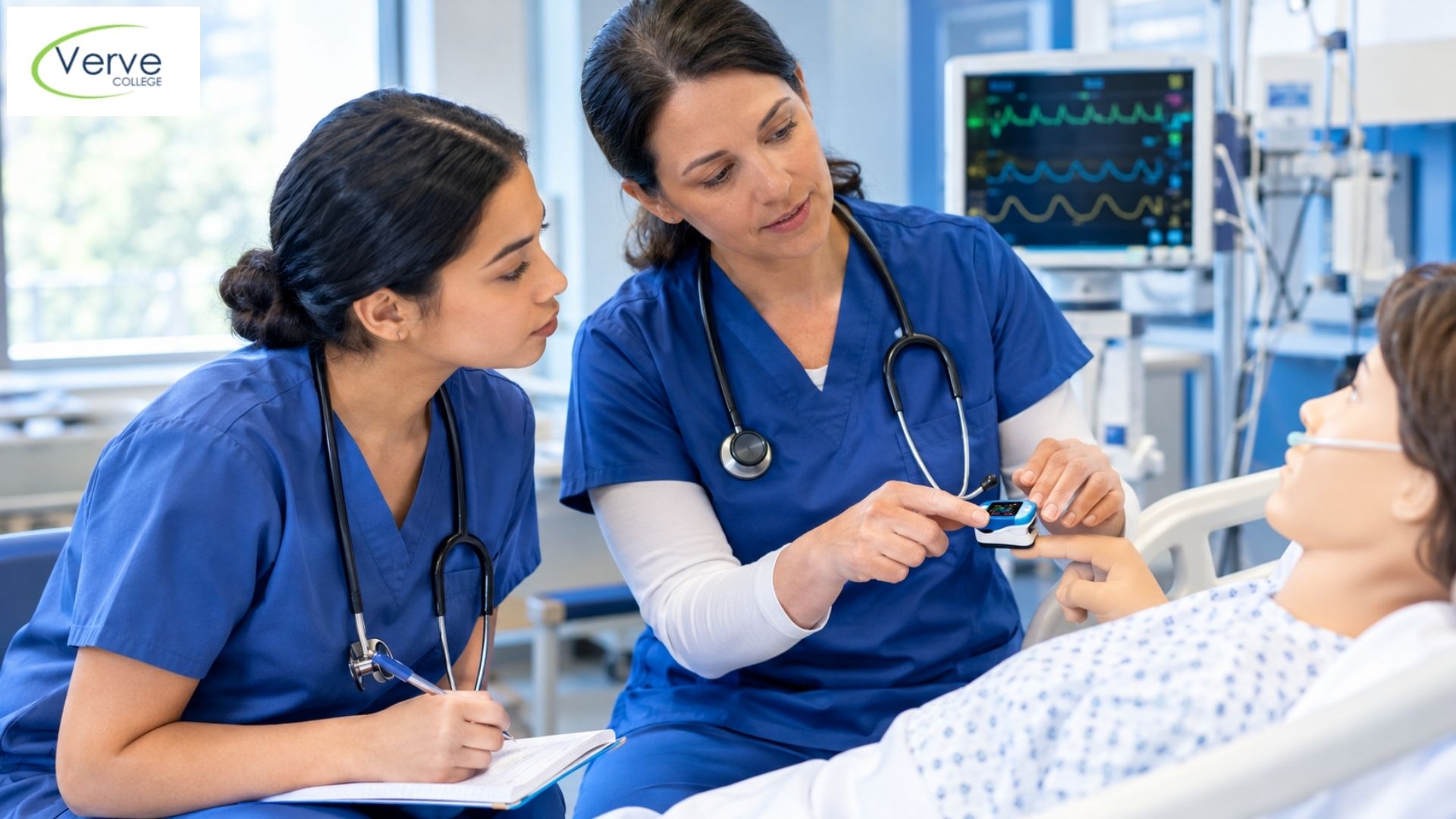
Hypoxia in Nursing Guide: Causes, Signs,…
October 22, 2026 Read More
Kidney Fluid Balance Nursing Guide: How…
October 21, 2026 Read More
What Is Stroke Volume? Understanding How…
October 20, 2026 Read More
5 Signs an LPN Program Provides…
October 19, 2026 Read More