- Oak Brook:(630) 705-9999
- Chicago:(312) 920-8822
- Email:inquiry@vervecollege.edu
- Make a Payment
 Sign up
 Login
Login
- Home
- Programs
- Admission
- Resources
- ATI Entrance Exam Resources
- New E-Digital Library
- Refer a Friend
- School Newsletter
- Events
- Employers
- Job-Network
- Alpha Beta Kappa Candidates
- Verve College Library
- Graduation and Pinning Ceremony Photo Galleries
- Textbook Information
- Career Services
- Tutoring
- School Catalog
- FAQ
- Constitution Day Program
- Alumni
- Verve College Plans
- Financial Aid
- HEERF Reporting
- Satisfactory Academic Progress
- Apply For Financial Aid
- Net Price Calculator
- Return of Title IV Funds (R2T4)
- Financial Aid Office Code of Conduct
- Contact
- FAQs
- Verification Policy
- Vaccination Policy
- Student Right-to-Know Act
- Misrepresentation
- Information Security Program
- Academic Award Year
- Availability of Employee
- Cost of Attendance
- Health & Safety Exemption Requirement
- Students Rights and Responsibilities
- Leave of Absence
- Pell Formula
- Military Students
- Grants/ Scholarship Policy
- Contact Us
- Testimonials
- Blog
Is a Nursing Career Right For You?
Take The Free Quiz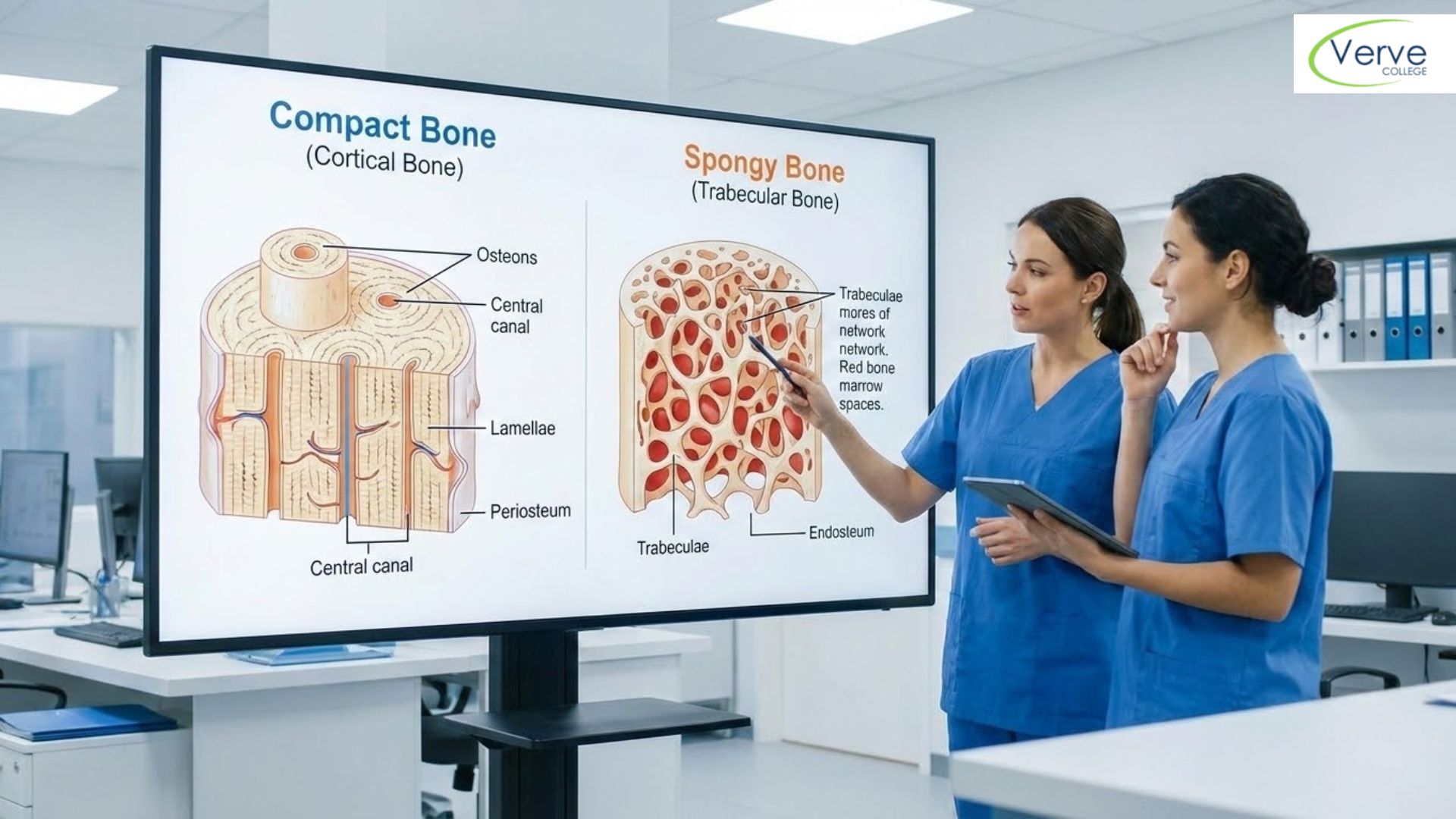
Compact Bone vs Spongy Bone: Key Differences Nursing Students Should Know
Compact Bone vs Spongy Bone: Key Differences Nursing Students Should Know
Healthcare data shows that musculoskeletal conditions affect millions of patients worldwide, making a strong understanding of bone structure essential for nursing practice. Studies in anatomy education highlight that students who clearly understand bone composition perform better in clinical assessments, especially when dealing with fractures, osteoporosis, and mobility-related conditions. Many students begin exploring these topics while searching for resources like anatomy and physiology course near me, where foundational knowledge of the skeletal system is introduced.
Understanding the difference between compact bone and spongy bone is not just theoretical. It directly supports patient care decisions, helps nurses interpret diagnostic results, and improves communication with healthcare teams.
Key Takeaways
- Compact bone provides strength and protection as the dense outer layer of bones.
- Spongy bone supports flexibility and blood cell production with its porous structure.
- Both bone types work together to balance strength and lightweight movement.
- Spongy bone contains bone marrow, making it essential for blood cell formation and immune function.
- Compact bone is crucial for weight-bearing and protecting internal organs from physical damage.
Understanding Compact Bone
Compact bone, also known as cortical bone, forms the hard outer layer of all bones. It is made up of tightly packed units called osteons, which give it strength and durability. This structure allows bones to support body weight and protect vital organs.
In nursing practice, compact bone plays a key role in understanding fractures. When a patient experiences a break in a long bone, it is often the compact bone that is affected. Healing in this area requires proper alignment and sometimes surgical intervention.
Compact bone also helps maintain posture and movement. Without it, the body would not have the support needed for daily activities such as walking, lifting, or standing.
Understanding Spongy Bone
Spongy bone, also called cancellous bone, is found inside bones, especially in areas like the ends of long bones and within the spine. It has a honeycomb-like structure made of trabeculae, which are small, supportive beams.
This structure allows spongy bone to absorb impact and reduce stress on the skeletal system. It also contains bone marrow, where red and white blood cells are produced. This makes it essential for both structural support and physiological functions.
For a deeper understanding of how bone tissues function together, students can explore topics covered in the “Complete Guide to Skeletal Tissues, Bone Structure, and Their Functions,” which explains how different bone types support the body.
In many lpn courses, students learn how spongy bone contributes to overall health, especially in conditions involving blood cell production and immune response.
Key Differences Between Compact and Spongy Bone
Compact bone is dense, solid, and forms the outer layer of bones, while spongy bone is porous and found inside. Compact bone provides strength and protection, whereas spongy bone focuses on flexibility and shock absorption.
Another major difference is weight. Compact bone is heavier, while spongy bone reduces the overall weight of the skeleton. This balance allows the body to remain strong without becoming too heavy.
From a clinical perspective, compact bone injuries are often more visible in imaging, while spongy bone issues may relate to internal conditions such as bone marrow disorders.
Clinical Importance for Nursing Students
Understanding the difference between these two types of bone helps nurses provide better care. For example, patients with osteoporosis often experience weakening in spongy bone, making them more prone to fractures.
Nurses must also understand how bones heal. Compact bone healing may take longer due to its density, while spongy bone, with its rich blood supply, can heal faster in some cases.
Students balancing education and responsibilities, such as those enrolled in night and weekend nursing programs, often benefit from clear, simplified explanations of these concepts to support both academic and clinical success.
Conclusion
Compact bone and spongy bone each play essential roles in maintaining the strength, flexibility, and function of the skeletal system. While compact bone provides structure and protection, spongy bone supports shock absorption and blood cell production.
For nursing students, understanding these differences is important for patient assessment, diagnosis, and care planning. Whether working in hospitals, rehabilitation centers, or community settings, this knowledge supports better clinical decision-making.
Students continuing their education through pathways such as hybrid lpn programs illinois can strengthen their understanding of these concepts, helping them apply anatomical knowledge effectively in real-world healthcare environments.
Get Your Nursing Career Training Readiness Score Now!
FAQs
1. Why is spongy bone more prone to certain diseases?
Spongy bone contains bone marrow and has a higher metabolic activity, which makes it more vulnerable to conditions like osteoporosis and infections that affect blood cell production.
2. How do nurses use knowledge of bone types in daily practice?
Nurses use this knowledge to assess injuries, understand diagnostic reports, and provide proper care for patients with fractures or bone-related conditions.
3. Can bone structure affect recovery time after injury?
Yes, bone structure plays a role in healing. Spongy bone may heal faster due to better blood supply, while compact bone may require more time and support for recovery.
Most Popular Blogs Posts
Compact Bone vs Spongy Bone: Key…
March 24, 2026 Read More
Can You Work While Studying LPN?…
March 24, 2026 Read More
Skeletal System: Everything Nursing Students Should…
March 23, 2026 Read More
Complete Guide to Skeletal Tissues, Bone…
March 19, 2026 Read More