- Oak Brook:(630) 705-9999
- Chicago:(312) 920-8822
- Email:inquiry@vervecollege.edu
- Make a Payment
 Sign up
 Login
Login
- Home
- Programs
- Admission
- Resources
- ATI Entrance Exam Resources
- New E-Digital Library
- Refer a Friend
- School Newsletter
- Events
- Employers
- Job-Network
- Alpha Beta Kappa Candidates
- Verve College Library
- Graduation and Pinning Ceremony Photo Galleries
- Textbook Information
- Career Services
- Tutoring
- School Catalog
- FAQ
- Constitution Day Program
- Alumni
- Verve College Plans
- Financial Aid
- HEERF Reporting
- Satisfactory Academic Progress
- Apply For Financial Aid
- Net Price Calculator
- Return of Title IV Funds (R2T4)
- Financial Aid Office Code of Conduct
- Contact
- FAQs
- Verification Policy
- Vaccination Policy
- Student Right-to-Know Act
- Misrepresentation
- Information Security Program
- Academic Award Year
- Availability of Employee
- Cost of Attendance
- Health & Safety Exemption Requirement
- Students Rights and Responsibilities
- Leave of Absence
- Pell Formula
- Military Students
- Grants/ Scholarship Policy
- Contact Us
- Testimonials
- Blog
Is a Nursing Career Right For You?
Take The Free Quiz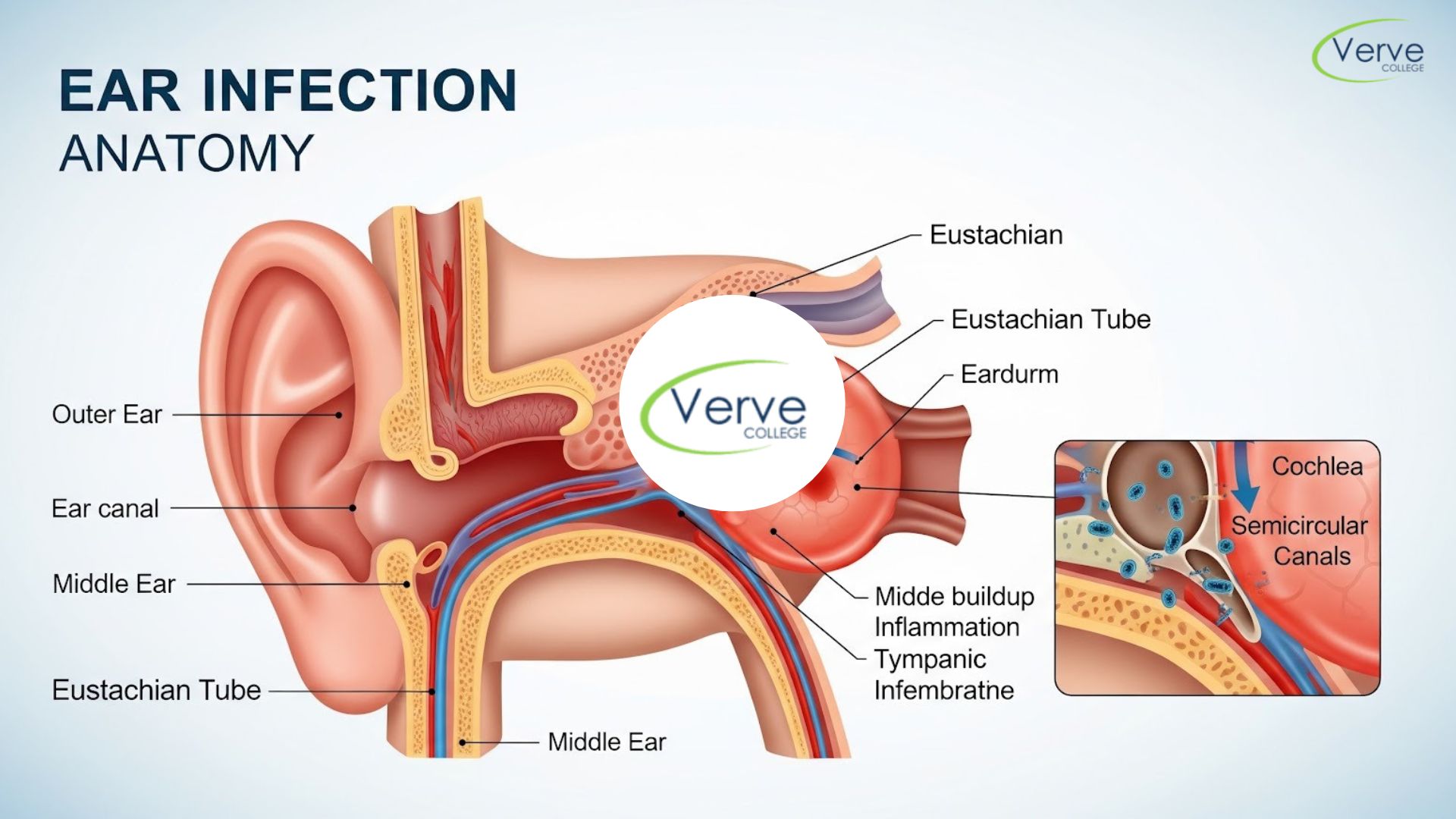
Ear Infection Anatomy: How Infections Affect the Ear
Ear Infection Anatomy: How Infections Affect the Ear
Recent clinical data show that ear infections are among the top reasons for doctor visits, especially in children, but adults are also commonly affected. According to healthcare reports, nearly 80% of children experience at least one ear infection before age three, while adults often develop infections due to sinus issues, allergies, or weakened immunity. To clearly understand why ear infections cause pain, hearing problems, and pressure, it is essential to learn the anatomy of ear infection and how different ear structures respond to infection. For students enrolled in an A&P Class, this topic builds a strong foundation for understanding head and neck disorders.
Key Takeaways
- The ear has three main sections, and infections can affect each differently
- Middle ear infections are the most common and cause pressure and pain
- Swelling and fluid buildup disrupt normal sound transmission
- Understanding anatomy helps identify symptoms and complications early
Anatomy of Ear Infection
The ear is divided into three main parts: the outer ear, middle ear, and inner ear. Each section has a unique structure and role, and infections behave differently depending on where they occur.
The outer ear includes the ear canal and leads sound inward. Infections here usually happen due to trapped moisture or bacteria.
The middle ear contains the eardrum and tiny bones that help transmit sound. This area is especially vulnerable to infection when fluid builds up behind the eardrum.
The inner ear controls balance and hearing signals. Infections here are less common but more serious because they can affect coordination and nerve function.
Understanding the anatomy of ear infection explains why symptoms like pain, muffled hearing, dizziness, and pressure occur.
How Outer Ear Infections Affect Anatomy?
Outer ear infections, also known as swimmer’s ear, mainly affect the ear canal lining. This canal is protected by earwax, which prevents bacteria from growing. When moisture remains in the canal, this protective barrier breaks down.
As bacteria multiply, the skin inside the ear canal becomes red, swollen, and tender. The swelling narrows the canal, making sound travel less efficiently. Patients often feel itching, pain when touching the ear, and sometimes fluid discharge.
From an anatomical perspective, inflammation reduces airflow and alters sound conduction. This is why mild hearing loss is common during infection but usually improves once swelling reduces.
Middle Ear Infections and Structural Changes
Middle ear infections are the most frequently diagnosed ear infections, especially in children. The middle ear is an air-filled space that relies on the Eustachian tube to balance pressure. When this tube becomes blocked due to colds or allergies, fluid gets trapped.
This fluid creates pressure against the eardrum, causing pain and fullness. Over time, bacteria grow in the trapped fluid, leading to infection. The tiny hearing bones may not vibrate properly, resulting in temporary hearing loss.
Students studying in anatomy and physiology classes near me often learn that repeated middle ear infections can thicken the eardrum or weaken nearby structures if left untreated.
Inner Ear Infections and Balance Disruption
Inner ear infections are less common but can be more severe. The inner ear contains the cochlea (hearing) and the vestibular system (balance). When infection or inflammation reaches this area, it interferes with nerve signals sent to the brain.
Patients may experience dizziness, nausea, spinning sensations, or difficulty walking. Hearing changes may also occur due to nerve irritation rather than fluid buildup.
Anatomically, inflammation in this area affects delicate sensory cells. This explains why symptoms feel more neurological than painful and why recovery may take longer compared to outer or middle ear infections.
Why Anatomy Knowledge Matters in Ear Infection Care?
Knowing the anatomy of ear infection helps healthcare providers determine the type, severity, and treatment approach. For example, outer ear infections often need topical care, while middle ear infections may require medication or monitoring fluid buildup.
Anatomy knowledge also helps prevent complications like hearing damage or balance disorders. Early recognition of which ear structure is involved leads to better outcomes and safer care planning.
Anatomy of Ear Infection: Final Thoughts
A clear understanding of the anatomy of ear infection explains why symptoms vary and why treatment differs based on the infected ear section. From fluid pressure in the middle ear to nerve involvement in the inner ear, anatomy shapes every stage of infection. For learners planning an anatomy and physiology course near me, mastering ear anatomy strengthens clinical understanding and patient care skills.
Frequently Asked Questions (FAQs)
- Can ear infections cause permanent hearing loss?
Most ear infections cause temporary hearing issues, but repeated or untreated infections may increase long-term risk. - Why are children more prone to ear infections?
Children have shorter and narrower Eustachian tubes, making fluid drainage less effective. - Do all ear infections require antibiotics?
No, some mild infections resolve on their own depending on the type and cause.
Most Popular Blogs Posts

Vital Signs Monitoring: A Complete Student…
March 26, 2026 Read More
Soft Skills That Make You a…
March 25, 2026 Read More
Compact Bone vs Spongy Bone: Key…
March 24, 2026 Read More
Can You Work While Studying LPN?…
March 24, 2026 Read More