- Oak Brook:(630) 705-9999
- Chicago:(312) 920-8822
- Email:inquiry@vervecollege.edu
- Make a Payment
 Sign up
 Login
Login
- Home
- Programs
- Admission
- Resources
- ATI Entrance Exam Resources
- New E-Digital Library
- Refer a Friend
- School Newsletter
- Events
- Employers
- Job-Network
- Alpha Beta Kappa Candidates
- Verve College Library
- Graduation and Pinning Ceremony Photo Galleries
- Textbook Information
- Career Services
- Tutoring
- School Catalog
- FAQ
- Constitution Day Program
- Alumni
- Verve College Plans
- Financial Aid
- HEERF Reporting
- Satisfactory Academic Progress
- Apply For Financial Aid
- Net Price Calculator
- Return of Title IV Funds (R2T4)
- Financial Aid Office Code of Conduct
- Contact
- FAQs
- Verification Policy
- Vaccination Policy
- Student Right-to-Know Act
- Misrepresentation
- Information Security Program
- Academic Award Year
- Availability of Employee
- Cost of Attendance
- Health & Safety Exemption Requirement
- Students Rights and Responsibilities
- Leave of Absence
- Pell Formula
- Military Students
- Grants/ Scholarship Policy
- Contact Us
- Testimonials
- Blog
Is a Nursing Career Right For You?
Take The Free Quiz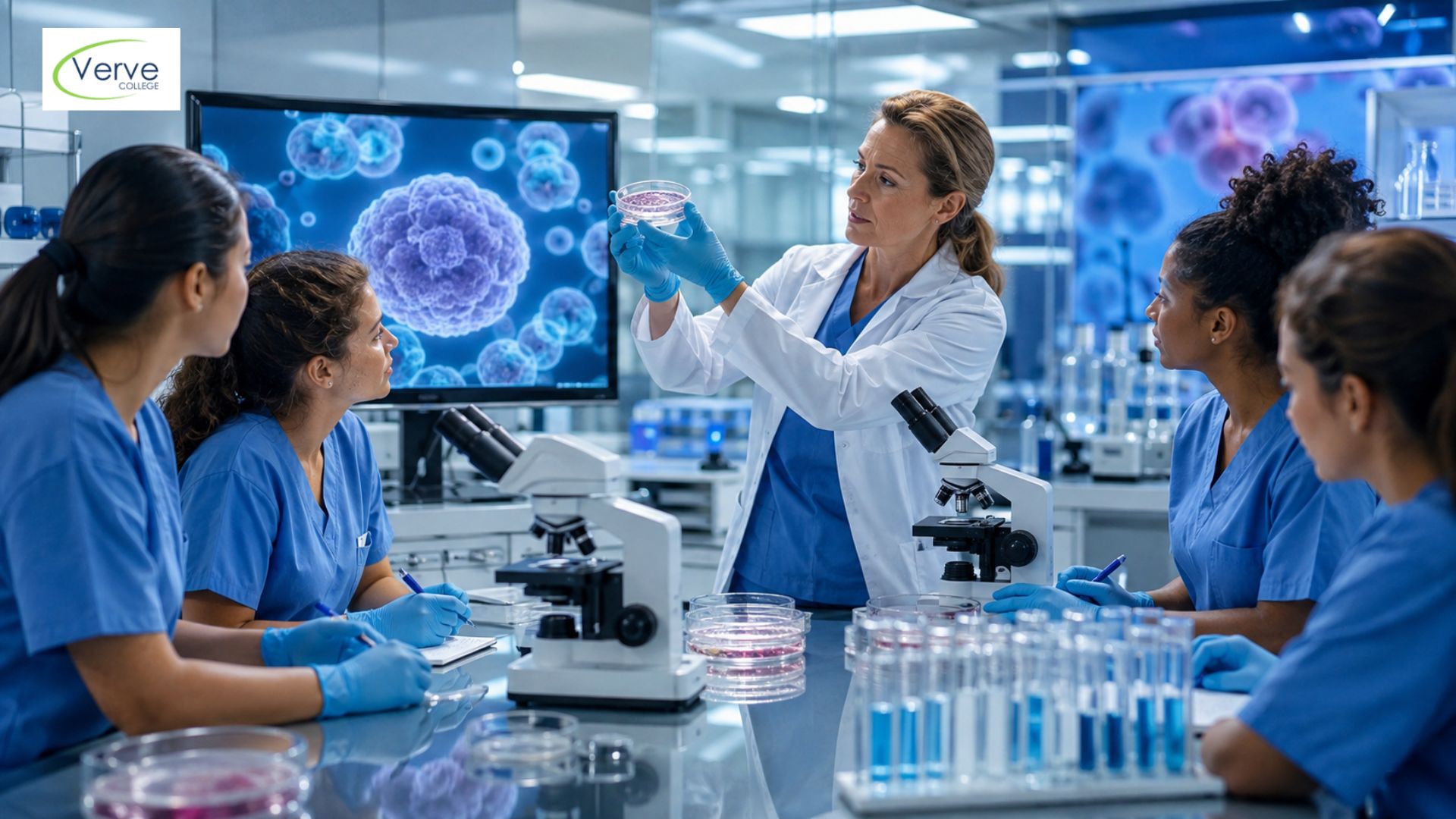
Stem Cells Explained for Nursing Students
Stem Cells Explained for Nursing Students
If you’re preparing for healthcare education or studying anatomy and physiology, you’ve probably heard the term “stem cells” thrown around in science classes and medical news. But what exactly are they? Why do they matter for nursing? And how will understanding stem cells strengthen your foundation in biology and patient care?
Stem cells are living cells with remarkable abilities: they can multiply indefinitely and transform into specialized cell types. For nursing students, understanding stem cells connects cellular biology to real clinical applications, from cancer treatment to tissue repair. This article breaks down stem cells into simple, practical language so you can grasp their importance before you step into an anatomy and physiology class near me environment.
Key Takeaways
- Stem cells are undifferentiated cells that can self-renew and transform into specialized cell types through a process called differentiation.
- The major types include embryonic stem cells, adult (somatic) stem cells, and induced pluripotent stem cells (iPSCs), each with different sources and clinical potential.
- Stem cells play crucial roles in growth, tissue repair, and regenerative medicine applications like bone marrow transplants and cartilage regeneration.
- Understanding stem cells deepens your knowledge of human biology and prepares you for clinical decision-making in healthcare careers.
- Enrolling in anatomy and physiology course near me programs ensures you learn these foundational concepts with expert guidance.
What Are Stem Cells? The Basics
A stem cell is a type of cell that hasn’t yet specialized into a specific function. Think of it as a blank slate. Most cells in your body are specialized: a heart cell beats, a neuron fires electrical signals, a skin cell provides a protective barrier. But stem cells haven’t committed to any single job yet. Stem cells have two defining characteristics. First, they can divide and copy themselves through self-renewal. A single stem cell can produce many identical copies. Second, they can differentiate, which means they can transform into specialized cells with specific functions. A stem cell might become a muscle cell, a nerve cell, or a blood cell depending on signals from surrounding tissue. This combination of self-renewal and specialization is why stem cells fascinate researchers and clinicians. They offer potential solutions to problems that specialized cells cannot solve on their own.
Why Understanding Stem Cells Matters for Nursing
You might wonder why a nursing student needs to understand cellular biology at this level. The answer is practical. Nurses work with patients who are undergoing regenerative treatments. Nurses administer medications developed through stem cell research. Nurses educate patients about emerging therapies and their realistic expectations. When a patient asks you about stem cell therapy for their arthritis, you need to understand what’s being proposed, what the evidence shows, and what the risks and benefits are. That knowledge builds trust and helps you provide informed care. It also deepens your understanding of how the body repairs and regenerates tissue, a concept central to nursing practice.
Types of Stem Cells and Their Characteristics
Stem cells fall into broad categories based on their source and developmental stage. Understanding these distinctions is essential for grasping how researchers use different stem cell types for different purposes.
Embryonic Stem Cells
Embryonic stem cells come from early-stage embryos (typically 3-5 days old). These cells are pluripotent, meaning they can differentiate into almost any cell type in the human body. They’re powerful research tools because of this versatility. However, embryonic stem cell research raises ethical questions. The extraction process destroys the embryo, which creates moral concerns for many people. Because of these ethical considerations, research involving embryonic stem cells is heavily regulated in most countries, including the United States.
Adult (Somatic) Stem Cells
Adult stem cells exist in various tissues throughout your body after birth. Bone marrow, fat tissue, skin, and blood all contain adult stem cells. These cells are multipotent, meaning they can differentiate into a limited range of cell types related to their tissue of origin. Adult stem cells are less versatile than embryonic stem cells, but they offer practical advantages. They can be harvested from a patient’s own body, reducing immune rejection. They raise fewer ethical concerns. And they’re already being used in established medical treatments, like bone marrow transplants for blood cancers.
Induced Pluripotent Stem Cells (iPSCs)
iPSCs are adult cells that have been reprogrammed back to a pluripotent state through laboratory techniques. Scientists introduce specific genes that “reset” the cell to an embryonic-like condition. This breakthrough allows researchers to create pluripotent stem cells without using embryos. iPSCs are revolutionary because they combine the versatility of embryonic stem cells with the ethical and practical advantages of adult stem cells. They can be created from a patient’s own cells, reducing immune rejection. And they sidestep many ethical concerns. Research into iPSCs is expanding rapidly.
Comparison Table: Major Stem Cell Types
| Stem Cell Type | Source | Potency | Ethical Issues | Current Clinical Use | Research Promise |
|---|---|---|---|---|---|
| Embryonic | Early-stage embryo | Pluripotent | High | Limited | High |
| Adult/Somatic | Bone marrow, fat, blood, skin | Multipotent | Minimal | Established | Moderate |
| iPSCs | Adult cells (reprogrammed) | Pluripotent | Minimal | Emerging | Very High |
How Stem Cells Work: Differentiation and Self-Renewal
To understand stem cell potential, you need to grasp two processes: differentiation and self-renewal. These mechanisms are how stem cells transform and maintain themselves. Differentiation happens when a stem cell receives signals from surrounding cells and the environment. These signals activate specific genes that push the cell toward specialization. A stem cell in bone marrow might receive signals that tell it to become an osteoblast (bone-forming cell). A stem cell near nerve tissue might differentiate into a neuron. Once differentiation occurs, the cell typically loses its ability to self-renew and commits to its specialized role. Self-renewal is the opposite process. When a stem cell divides, it can produce one specialized cell and one copy of itself. This allows stem cell populations to persist throughout life. In bone marrow, stem cells continuously self-renew to replace blood cells, which have a limited lifespan. Without self-renewal, you’d run out of red blood cells within weeks.
Stem Cell Therapy: Clinical Applications and Current Research
Stem cell therapy refers to treatments that use stem cells to repair or replace damaged tissue. Some applications are already standard medical practice. Others remain experimental.
Bone Marrow Transplantation
Bone marrow contains hematopoietic stem cells, which produce blood cells. Patients with blood cancers like leukemia undergo bone marrow transplants where healthy stem cells from a donor replace cancerous blood-producing tissue. This is an established, proven therapy. Nurses working in oncology units regularly care for patients before, during, and after bone marrow transplants.
Regenerative Medicine for Cartilage and Bone
Researchers are exploring how adult stem cells and iPSCs can regenerate damaged cartilage and bone. Patients with severe arthritis or bone fractures might benefit from therapies that use stem cells to rebuild tissue. Some treatments are in clinical trials. Others are still in the research phase. As a nurse, you’ll encounter patients interested in or undergoing these emerging treatments.
Neurological Conditions
Stem cell research holds promise for conditions like Parkinson’s disease and spinal cord injury. The theory is that stem cells could replace damaged neurons or produce chemicals that support nerve function. However, these therapies are not yet standard care. Clinical trials are ongoing. When patients ask about stem cell treatments for neurological conditions, it’s important to communicate that these are experimental, and results are not yet guaranteed.
Cardiovascular Applications
Some research suggests stem cells might help repair heart damage after a heart attack. Early clinical trials are showing modest benefits, but this application is still emerging. No definitive stem cell therapies for heart disease are standard practice yet.
Important: Most Stem Cell Therapies Are Still Under Investigation
A critical point for nursing students and future healthcare providers: many stem cell therapies you hear about in the news are still experimental. They’re not yet approved as standard medical treatments. Some are in clinical trials. Some are years away from approval. And some may never reach clinical use if research doesn’t support their safety or effectiveness. When patients ask about stem cell treatments, your role is to provide honest, evidence-based information. Explain what’s established versus experimental. Encourage discussion with their physician. Be aware that unproven stem cell therapies sold outside of clinical research can be expensive, ineffective, and potentially harmful.
Connecting Cellular Biology to Nursing Practice
Understanding how cells work, how tissues repair themselves, and how stem cells fit into this picture strengthens your foundation in human physiology. When you learn about wound healing in your anatomy and physiology courses, stem cells are part of the story. When you study immune response and inflammation, you’re seeing how the body recruits stem cells to repair damage. If you want a deeper understanding of how cells and tissues work together in disease and health, studying Introduction to Microbiology for Nursing Students can expand your perspective. Microbiology focuses on pathogens, but the same principles of cellular function apply.
Ethical Considerations in Stem Cell Research
Stem cell research raises legitimate ethical questions that affect healthcare providers. The use of embryonic stem cells involves concerns about when life begins and whether it’s ethical to destroy embryos for research. Different religions, cultures, and individuals hold different views. As a healthcare provider, you won’t be asked to perform stem cell research. But you may care for patients undergoing stem cell therapies. You’ll need to understand the ethical landscape so you can respect patients’ values and provide informed education. Understanding why certain stem cell research is regulated and why others proceed more freely helps you communicate respectfully with diverse patients.
Conclusion
Stem cells are far more than abstract scientific concepts. They’re central to how your body grows, repairs damage, and maintains health. Understanding stem cells gives you insight into cutting-edge medical treatments and prepares you to communicate thoughtfully with patients about emerging therapies. For nursing students, this knowledge is foundational. It bridges cellular biology to clinical practice. It helps you understand both the promise and the limitations of regenerative medicine. And it positions you as a knowledgeable healthcare provider capable of educating patients about realistic treatment options. As you continue your healthcare education and explore practical nursing programs, you’ll encounter stem cells again in different contexts. This foundational understanding makes those connections stronger and more meaningful.
Get Your Nursing Career Training Readiness Score Now!
Frequently Asked Questions
Can stem cell therapy cure all diseases?
No. While stem cells show promise for certain conditions, they’re not a universal cure. Some diseases have complex causes that stem cells alone cannot address. Research is ongoing for many conditions, and approval takes time. It’s important to be skeptical of clinics claiming stem cells can treat everything.
Are stem cell treatments covered by insurance?
Established treatments like bone marrow transplants for blood cancers are typically covered. Experimental stem cell therapies are usually not covered by insurance unless they’re part of an approved clinical trial. Patients should verify coverage with their insurance and discuss realistic costs with their healthcare provider.
Will I learn about stem cells in practical nursing programs?
Yes. Physiology and pathology courses in nursing programs cover how the body repairs tissue and maintains function. Stem cells are part of that story. You’ll study them more deeply in anatomy and physiology prerequisites, but understanding stem cells is woven throughout healthcare education.
Most Popular Blogs Posts

What Is Case Management Nursing? A…
September 17, 2026 Read More
What Is the Blood-Brain Barrier? A…
September 16, 2026 Read More
Neonatal Nursing: What Does a NICU…
September 16, 2026 Read More
Oncology Nursing: What Nurses Do in…
September 15, 2026 Read More