- Oak Brook:(630) 705-9999
- Chicago:(312) 920-8822
- Email:inquiry@vervecollege.edu
- Make a Payment
 Sign up
 Login
Login
- Home
- Programs
- Admission
- Resources
- ATI Entrance Exam Resources
- New E-Digital Library
- Refer a Friend
- School Newsletter
- Events
- Employers
- Job-Network
- Alpha Beta Kappa Candidates
- Verve College Library
- Graduation and Pinning Ceremony Photo Galleries
- Textbook Information
- Career Services
- Tutoring
- School Catalog
- FAQ
- Constitution Day Program
- Alumni
- Verve College Plans
- Financial Aid
- HEERF Reporting
- Satisfactory Academic Progress
- Apply For Financial Aid
- Net Price Calculator
- Return of Title IV Funds (R2T4)
- Financial Aid Office Code of Conduct
- Contact
- FAQs
- Verification Policy
- Vaccination Policy
- Student Right-to-Know Act
- Misrepresentation
- Information Security Program
- Academic Award Year
- Availability of Employee
- Cost of Attendance
- Health & Safety Exemption Requirement
- Students Rights and Responsibilities
- Leave of Absence
- Pell Formula
- Military Students
- Grants/ Scholarship Policy
- Contact Us
- Testimonials
- Blog
Is a Nursing Career Right For You?
Take The Free Quiz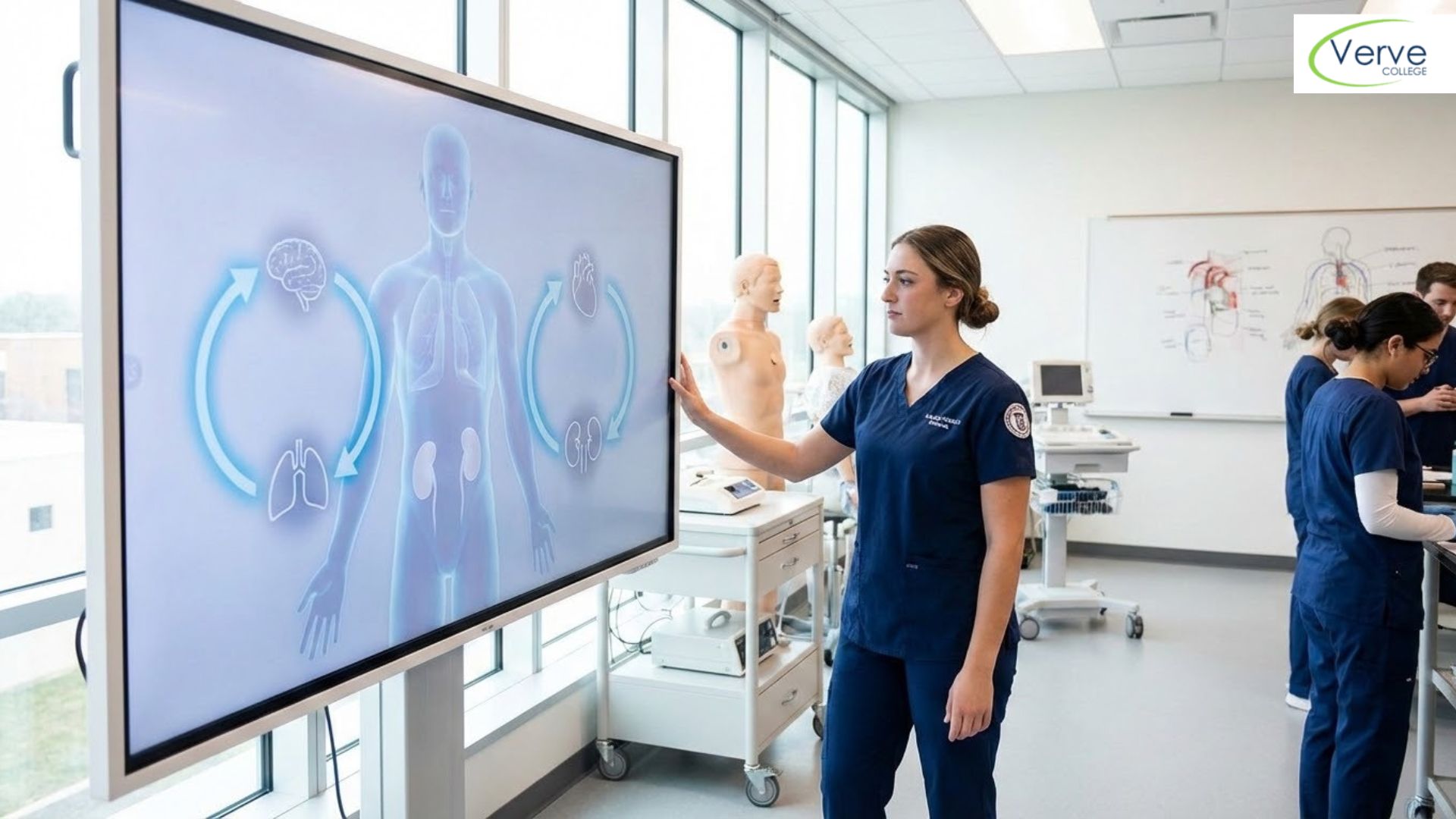
Homeostasis in Human Biology: Why Every Nursing Student Needs to Understand It
Homeostasis in Human Biology: Why Every Nursing Student Needs to Understand It
If you’ve ever wondered why the human body is so good at keeping itself alive, the answer comes down to one concept: homeostasis. It’s one of the most important ideas in biology, and it shows up constantly in nursing practice.
Whether you’re just starting to explore healthcare or you’re already enrolled in a program, understanding homeostasis in human biology will help you make sense of nearly everything you’ll learn about the body. This guide breaks it down in plain language so it actually sticks.
Key Takeaways
- Homeostasis is the body’s way of keeping its internal environment stable, even when outside conditions change
- Nurses rely on this concept every time they check vital signs or monitor a patient’s condition
- Common examples include temperature regulation, blood sugar control, and blood pressure balance
- When homeostasis breaks down, it often signals the beginning of illness or a medical emergency
- If you want to build a strong foundation before clinical training, exploring programs at some of the best nursing schools in Illinois can help you get started the right way
What Is Homeostasis in Human Biology?
Homeostasis is the process the body uses to maintain a stable internal environment. Think of it like a thermostat in your home. When it gets too cold, the heat turns on. When it’s warm enough, the heat shuts off. Your body does something similar, but with dozens of systems working at once.
The term comes from Greek words meaning “same” and “steady.” Your body constantly monitors things like temperature, fluid levels, blood sugar, and oxygen. When something drifts too far from normal, the body responds to bring it back.
This isn’t passive. It’s an active, ongoing process that never stops as long as you’re alive.
Why It Matters for Nursing Students
Nursing is built on observation. You watch patients, track changes, and respond when something is off. That’s exactly what homeostasis is about.
When a patient’s temperature spikes, their blood pressure drops, or their blood sugar swings out of range, something is interfering with the body’s ability to self-regulate. As a nurse, your job is to recognize those signs quickly and understand what they mean.
You won’t be able to do that well if you don’t understand what “normal” looks like at a biological level. That’s why this concept is introduced early in most nursing and anatomy courses.
How the Body Maintains Balance
Feedback Loops
The main tool the body uses is called a feedback loop. There are two types.
Negative feedback is the most common. It works by reversing a change. For example, when your body temperature rises too high, you start to sweat. Sweating cools you down, which brings the temperature back to normal.
Positive feedback is less common and amplifies a process instead of reversing it. Childbirth is a good example. Contractions trigger more contractions until the baby is born and the cycle ends naturally.
Understanding these two mechanisms helps nurses anticipate what the body is trying to do during illness or treatment.
Key Systems Involved
Homeostasis doesn’t belong to just one organ or system. It’s a team effort.
The nervous system acts fast, sending signals to adjust things in real time. The endocrine system uses hormones to manage slower, longer-term responses. The kidneys filter blood and regulate fluid and electrolyte balance. The respiratory system controls carbon dioxide and oxygen levels.
When multiple systems are struggling at once, it’s often a sign of serious illness. That’s why nurses are trained to think in systems, not just symptoms.
Real Examples You’ll See in Clinical Settings
Homeostasis becomes very real once you step into a clinical environment. Here are a few examples you’ll likely encounter:
Fever — A fever is actually the body raising its temperature set point to fight infection. It’s homeostasis in action, but it can become dangerous if the temperature climbs too high.
Hypoglycemia — When blood sugar drops too low, the body signals hunger and releases hormones to raise it back up. In patients with diabetes, this process can malfunction.
Dehydration — When the body loses too much fluid, the kidneys reduce urine output to conserve water. Nurses monitor fluid intake and output closely for this reason.
Shock — In cases of severe blood loss or infection, the body’s compensatory mechanisms can fail. Blood pressure drops, organs don’t get enough oxygen, and the consequences can be life-threatening.
Each of these situations connects back to the same core idea: the body is trying to stay balanced, and nursing care supports that effort.
Building the Foundation Before You Enter a Program
A lot of students feel behind when they start their nursing education because they haven’t been exposed to basic biology concepts yet. That’s completely normal, and it’s fixable.
Programs like Anatomy and Physiology Prep can help you build confidence before you ever step into a clinical setting. If you’re looking at accredited LPN programs in Chicago, Verve College offers foundational prep courses alongside its practical nursing program so students can start strong.
Understanding homeostasis before your first semester means you’re not learning the concept from scratch when your coursework gets intense. You’re building on something you already know.
A Common Misconception Worth Clearing Up
Many students assume homeostasis only applies to healthy bodies. In reality, understanding how it breaks down is just as important as knowing how it works.
Disease is often a story of homeostasis failing. Chronic conditions like hypertension, diabetes, and kidney disease are all related to the body’s inability to regulate certain variables over time. Treatment, in many cases, is about supporting or replacing what the body can no longer do on its own.
This is also why nursing school emphasizes both biology and clinical judgment. You need to understand the “why” behind what you’re seeing, not just follow a checklist.
Conclusion
Homeostasis in human biology is not just a textbook term. It’s the reason patients crash, recover, and everything in between. Nurses who understand it are better at spotting problems early and making sense of what they’re seeing at the bedside.
If you’re serious about a career in nursing, start building this foundation now. Explore the licensed practical nursing schools at Verve College, where programs are designed to give you both the knowledge and the hands-on skills you’ll need to care for real patients with confidence.
Get Your Nursing Career Training Readiness Score Now!
Frequently Asked Questions
What is homeostasis in human biology in simple terms?
Homeostasis is the body’s ability to keep its internal conditions stable even when the outside environment changes. Think of it as the body’s built-in balancing system. It controls things like temperature, blood sugar, and fluid levels continuously throughout your life.
What happens when homeostasis fails?
When the body can no longer maintain balance, illness or injury often follows. Conditions like fever, low blood sugar, dehydration, and shock are all related to disruptions in homeostasis. That’s why nurses are trained to monitor vital signs and lab values so closely.
Do I need to understand biology before starting an LPN program?
Having a basic understanding of biology, especially concepts like homeostasis, makes nursing school significantly easier. Some programs, including those at Verve College, offer prep courses to help students build that foundation before clinical training begins. Starting with a strong base can make a real difference in how well you absorb everything else.
Most Popular Blogs Posts
High-Fidelity Simulation in Nursing: How Realistic…
September 24, 2026 Read More
How to Compare Nursing Programs Before…
September 23, 2026 Read More
Thermoregulation: How the Body Regulates Temperature
September 23, 2026 Read More
Nursing Grants vs Scholarships: What’s the…
September 22, 2026 Read More