-
Oak Brook
📍📞 630-705-99992625 Butterfield Rd. Suite 102E
Oak Brook, IL 60523📠 Fax: 630-705-1422✉️ inquiry@vervecollege.edu 🗺️ Open in Google Maps 🍎 Open in Apple Maps🕒Office HoursMon–Fri: 9:30 AM – 6:00 PM
Sat: 8:00 AM – 12:00 PM
Sun: Closed -
Chicago
📍📞 312-920-8822216 W. Jackson Blvd. Suite 900
Chicago, IL 60606📠 Fax: 630-705-1422✉️ inquiry@vervecollege.edu 🗺️ Open in Google Maps 🍎 Open in Apple Maps🕒Office HoursMon–Fri: 9:30 AM – 6:00 PM
Sat: 8:00 AM – 12:00 PM
Sun: Closed - Email:inquiry@vervecollege.edu
- Make a Payment
 Sign up
 Login

- Home
- Programs
- Admission
- Resources
- ATI Entrance Exam Resources
- New E-Digital Library
- Refer a Friend
- School Newsletter
- Events
- Employers
- Job-Network
- Alpha Beta Kappa Candidates
- Verve College Library
- Graduation and Pinning Ceremony Photo Galleries
- Textbook Information
- Career Services
- Tutoring
- School Catalog
- FAQ
- Constitution Day Program
- Alumni
- Verve College Plans
- Financial Aid
- HEERF Reporting
- Satisfactory Academic Progress
- Apply For Financial Aid
- Net Price Calculator
- Return of Title IV Funds (R2T4)
- Financial Aid Office Code of Conduct
- Contact
- FAQs
- Verification Policy
- Vaccination Policy
- Student Right-to-Know Act
- Misrepresentation
- Information Security Program
- Academic Award Year
- Availability of Employee
- Cost of Attendance
- Health & Safety Exemption Requirement
- Students Rights and Responsibilities
- Leave of Absence
- Pell Formula
- Military Students
- Grants/ Scholarship Policy
- Contact Us
- Testimonials
- Blog
Is a Nursing Career Right For You?
Take The Free QuizWound Healing Stages in Nursing: The Four Phases Explained
Wound Healing Stages in Nursing: The Four Phases Explained
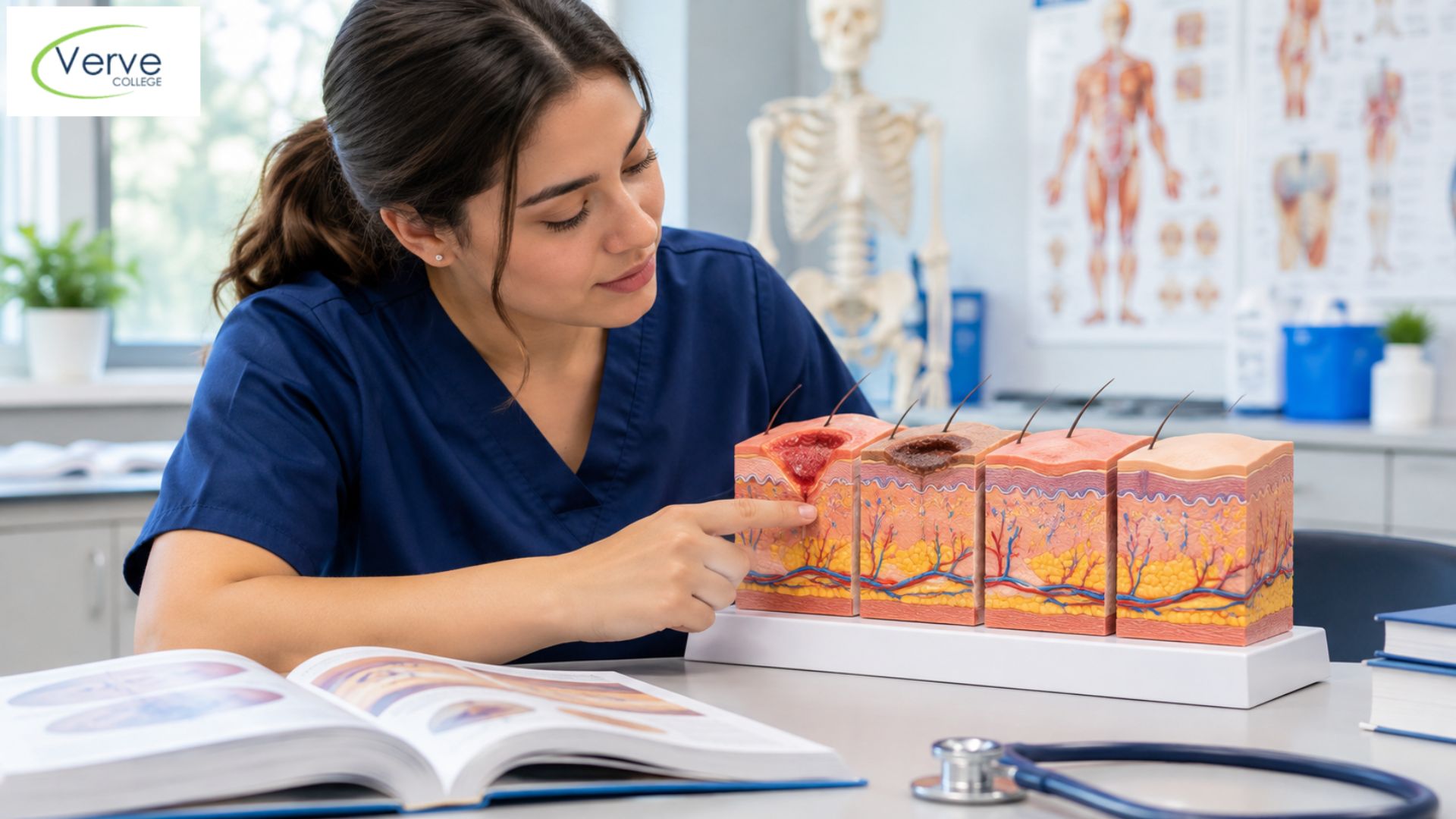
When skin or underlying tissue is damaged, the body begins repairing it almost immediately. Understanding the wound healing stages in nursing helps you recognize what normal repair looks like, notice when healing may be off track, and communicate clearly with the healthcare team. Wound healing unfolds in four overlapping phases: hemostasis, inflammation, proliferation, and remodeling. This article explains what happens in each phase, why the timing varies from person to person, and what nursing students should observe during wound assessment.
Key Takeaways
Here are the main points to remember:
Wound healing involves four overlapping phases rather than a strict, fixed sequence. Hemostasis stops bleeding and forms an initial clot. Inflammation helps clear bacteria and damaged tissue while preparing the wound for repair. Proliferation builds new tissue and works toward wound closure. Remodeling reorganizes collagen and strengthens the repaired area, though it rarely regains the full strength of uninjured skin. Nursing observation helps identify changes that may affect healing, and concerns should always be reported through appropriate clinical channels.
What Is Wound Healing?
Wound healing is the body’s natural process of repairing damaged skin and the tissue beneath it. When an injury breaks the skin barrier, the body responds with blood clotting, immune activity, new tissue formation, and gradual strengthening of the repaired area. Each step builds on the one before it.
Healing time varies. A small, clean cut on a healthy adult may close relatively quickly, while a deep wound in an older adult with poor circulation may take much longer. The wound itself and the person’s overall health both shape how the process unfolds.
What Are the Four Main Stages of Wound Healing?
1. Hemostasis: Stopping the Bleeding
Hemostasis begins immediately after tissue damage. Blood vessels constrict to reduce blood loss. Platelets gather at the injury site and stick together, forming a temporary plug. Clotting proteins then help build a mesh of fibrin that strengthens the clot. Together, these steps control bleeding and create an initial protective barrier over the wound.
2. Inflammation: Protecting the Wound
The inflammatory phase prepares the wound for repair. Blood vessels near the injury become more permeable, allowing white blood cells to move into the area. These immune cells help remove bacteria, damaged cells, and debris. Some redness, warmth, swelling, and tenderness are part of this normal response.
Inflammation is protective, but it must be monitored. Worsening pain, spreading redness, increasing warmth, or new drainage may signal a problem that requires clinical assessment. Those changes do not confirm a specific diagnosis on their own, but they should be reported.
3. Proliferation: Building New Tissue
During proliferation, the wound begins to fill in and close. Fibroblasts produce collagen, a protein that provides structural support. New blood vessels form through a process called angiogenesis, which supplies oxygen and nutrients to the healing tissue. This new tissue, called granulation tissue, fills the wound from the base upward. Epithelial cells then migrate across the surface to cover the wound, while the wound edges gradually contract and draw closer together.
A healthy blood supply and suitable wound conditions are essential in this phase. Without them, the body has fewer resources to build new tissue.
4. Remodeling: Strengthening the Repaired Tissue
Remodeling is the final and longest phase. Collagen fibers are reorganized and realigned along lines of stress, and the scar gradually changes in color, texture, and thickness. Tissue strength increases over time, but the repaired area usually remains weaker than the original uninjured skin.
Remodeling can continue for months or longer, depending on the injury. A scar that looks fully settled may still be strengthening beneath the surface.
How Long Does Each Stage of Wound Healing Take?
There are no exact timelines that apply to every wound. The phases overlap, and their duration depends on wound depth, location, blood supply, infection, nutrition, and the patient’s overall health. A deep wound may spend longer in inflammation and proliferation, while a superficial wound may move through them more quickly.
The table below summarizes the main activity of each stage:
| Healing stage | Main activity |
|---|---|
| Hemostasis | Controls bleeding and forms a clot |
| Inflammation | Removes debris and supports immune defense |
| Proliferation | Builds new tissue and closes the wound |
| Remodeling | Reorganizes collagen and strengthens tissue |
Because each patient heals differently, avoid treating any single timeline as a universal deadline. Compare a patient’s healing progress with their own baseline and with the expectations set by the care team.
What Factors Can Affect Wound Healing?
Several factors can slow or complicate healing:
- Poor blood circulation limits the oxygen and nutrients that repairing tissue needs.
- Infection increases inflammation and can disrupt normal repair.
- Inadequate nutrition and hydration reduce the raw materials the body uses to build tissue.
- Smoking and tobacco use narrow blood vessels and reduce oxygen delivery.
- Repeated pressure or friction can damage tissue that is trying to heal.
- Advanced age is associated with slower cell turnover and thinner skin.
- Certain chronic health conditions can affect circulation, immune response, or tissue repair.
- Wound size, depth, and location determine how much tissue must be rebuilt and how easily it can be protected.
Two patients with similar-looking wounds may heal at very different rates. That is why nurses consider the whole person, not only the appearance of the wound.
What Should Nursing Students Observe During Wound Assessment?
Careful observation helps you track how a wound is progressing. Note the wound’s location and approximate dimensions, and describe the wound bed, including its color and texture. Assess the condition of the surrounding skin. Record the amount, color, and consistency of any drainage, and note any odor when it is present. Ask about pain or tenderness, and observe changes in swelling, redness, or warmth.
Keep your observations objective. Write what you see and measure, such as “wound measures 2 cm by 1 cm with pink granulation tissue at the base,” rather than a general impression like “wound looks better.” Follow your facility’s documentation procedures, and report concerning changes through the appropriate clinical channels. Signs of delayed healing or possible infection should always be escalated, and no single finding confirms infection on its own.
Why Is Understanding Wound Healing Important in Nursing?
Knowing the four phases helps you connect what you see at the bedside with what is happening in the tissue. It helps you understand normal repair, recognize changes in wound condition, and explain findings clearly to the healthcare team. It also helps you monitor patient comfort, educate patients using approved care instructions, and keep accurate wound documentation.
Wound care is carried out under clinical direction and within your scope of practice. Your role is to observe carefully, report what matters, and support the plan of care. You can build these skills in the Verve College Practical Nursing Program, where wound observation and patient care are taught in a supervised setting.
How Can Nursing Students Remember the Four Stages?
A simple memory aid can help you keep the sequence and purpose of each phase in mind:
- Hemostasis: stop bleeding.
- Inflammation: protect and clean.
- Proliferation: build new tissue.
- Remodeling: strengthen and reorganize.
Reinforce this with labeled diagrams, flashcards, and short clinical examples. Ask yourself which phase a wound is in, what the body is doing at that stage, and what you would expect to observe.
Get Your Nursing Career Training Readiness Score Now!
Frequently Asked Questions
What are the four main stages of wound healing?
The four main stages are hemostasis, inflammation, proliferation, and remodeling. They overlap as the body stops bleeding, clears debris, builds new tissue, and strengthens the repaired area.
Which stage of wound healing involves the formation of new tissue?
The proliferation stage involves new tissue formation. Fibroblasts produce collagen, new blood vessels develop, granulation tissue fills the wound, epithelial cells cover the surface, and the wound edges contract.
What can slow down the wound healing process?
Factors such as poor circulation, infection, inadequate nutrition, smoking, repeated pressure, advanced age, and certain chronic health conditions can interfere with healing. Any concerns about a wound should be reported and assessed by the appropriate clinical professional.
Most Popular Blogs Posts
Wound Healing Stages in Nursing: The…
November 3, 2026 Read More
LPN School Financial Planning Guide: 7…
November 2, 2026 Read More
Nursing Clinical Documentation Guide for Safe…
October 29, 2026 Read More
Integumentary System Nursing Guide: Skin Anatomy…
October 28, 2026 Read More