- Oak Brook:(630) 705-9999
- Chicago:(312) 920-8822
- Email:inquiry@vervecollege.edu
- Make a Payment
 Sign up
 Login
Login
- Home
- Programs
- Admission
- Resources
- ATI Entrance Exam Resources
- New E-Digital Library
- Refer a Friend
- School Newsletter
- Events
- Employers
- Job-Network
- Alpha Beta Kappa Candidates
- Verve College Library
- Graduation and Pinning Ceremony Photo Galleries
- Textbook Information
- Career Services
- Tutoring
- School Catalog
- FAQ
- Constitution Day Program
- Alumni
- Verve College Plans
- Financial Aid
- HEERF Reporting
- Satisfactory Academic Progress
- Apply For Financial Aid
- Net Price Calculator
- Return of Title IV Funds (R2T4)
- Financial Aid Office Code of Conduct
- Contact
- FAQs
- Verification Policy
- Vaccination Policy
- Student Right-to-Know Act
- Misrepresentation
- Information Security Program
- Academic Award Year
- Availability of Employee
- Cost of Attendance
- Health & Safety Exemption Requirement
- Students Rights and Responsibilities
- Leave of Absence
- Pell Formula
- Military Students
- Grants/ Scholarship Policy
- Contact Us
- Testimonials
- Blog
Is a Nursing Career Right For You?
Take The Free Quiz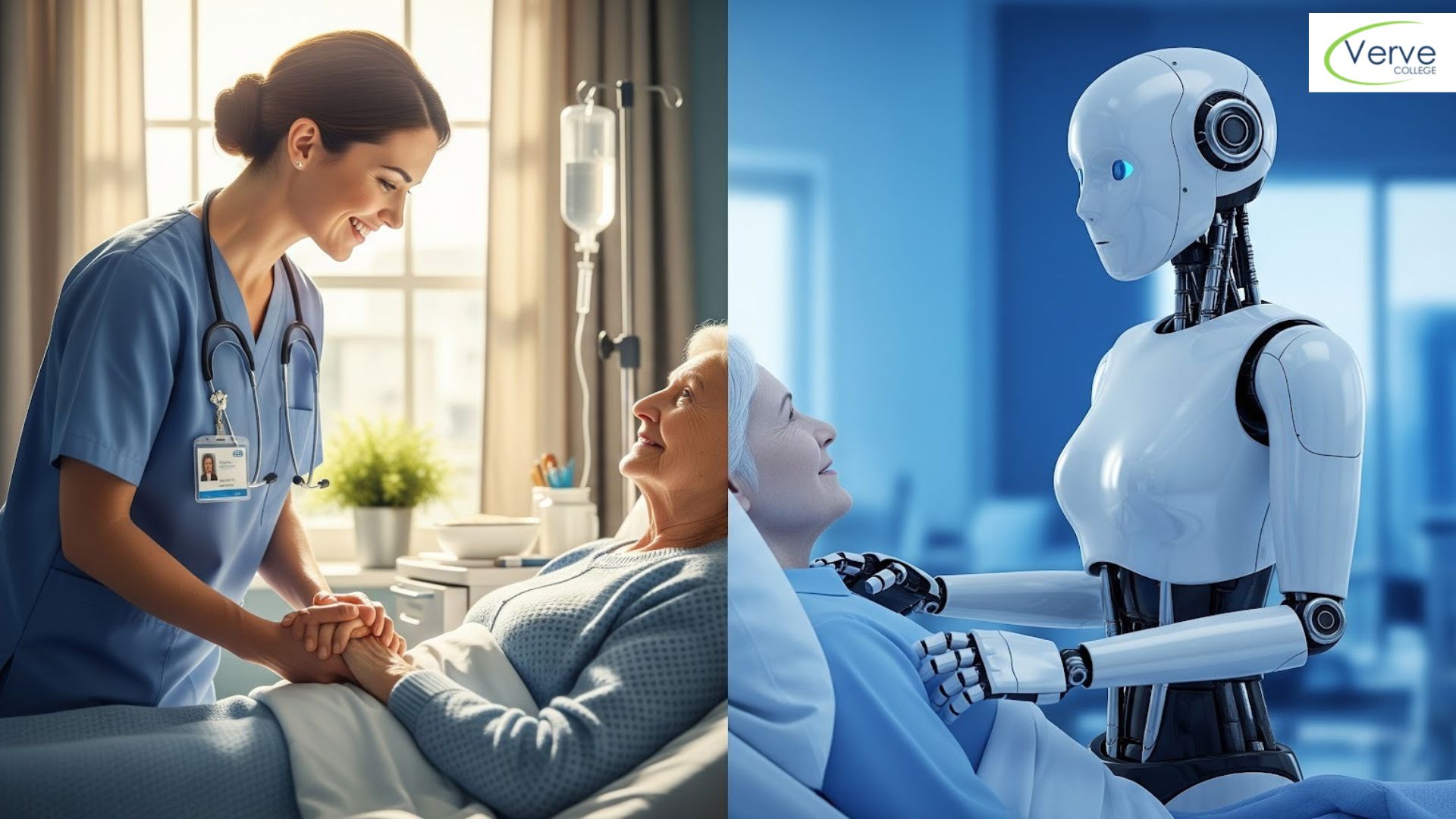
Will Robots Replace Nurses in the Future?
Will Robots Replace Nurses in the Future?
Healthcare automation is growing fast. According to global health technology reports, hospitals now use AI for patient monitoring, medical imaging, documentation, and even basic clinical decision support. By 2030, AI is expected to support over 30% of routine healthcare tasks. This has raised an important question for nursing students and professionals: will nursing be replaced by AI, and will robots replace nurses in the future?
While technology is changing how care is delivered, nursing remains a deeply human profession. Many students entering licensed practical nurse programs wonder how automation may shape their long-term careers. This article explains what AI can do, what it cannot replace, and how nurses can stay future-ready.
Key Takeaways
- AI will support nurses, not fully replace them
- Human judgment, empathy, and ethics remain irreplaceable
- Robots handle repetitive tasks, not complex patient care
- Nurses who adapt to technology will have stronger career security
What Roles Do Robots and AI Already Play in Nursing?
AI and robotics are already present in modern healthcare settings, but their role is supportive. Robots assist with medication delivery, inventory management, patient lifting, and room sanitation. AI systems help nurses track vital signs, predict patient deterioration, and reduce documentation workload.
These tools improve efficiency and patient safety, especially in high-pressure environments. However, they operate under strict programming and clinical protocols. They cannot think independently, assess emotional needs, or adjust care based on subtle patient behavior. Nurses remain responsible for interpreting data and making real-time clinical decisions.
Why Human Nurses Cannot Be Fully Replaced?
Nursing is not just about performing tasks—it is about human connection, trust, and critical thinking. Patients often experience fear, pain, and uncertainty. Nurses provide emotional reassurance, ethical judgment, cultural sensitivity, and advocacy—qualities machines do not possess.
In emergencies, nurses must prioritize care, communicate with families, and coordinate with healthcare teams instantly. These complex human interactions cannot be automated. Even advanced AI lacks moral reasoning and empathy, which are core to safe and compassionate nursing practice.
How AI Is Changing Nursing Workflows (Not Jobs)
AI is reshaping how nurses work, not eliminating their roles. Automation reduces paperwork, minimizes errors, and improves patient monitoring accuracy. As a result, nurses may spend more time to providing personal care for patients.
Flexible education formats such as LPN weekend classes are also adapting to include digital literacy and technology-assisted care training. Nurses who understand AI tools become more valuable, not less. Technology enhances productivity, but nurses remain the decision-makers and patient advocates.
Skills Nurses Need to Stay Future-Ready
To remain competitive, nurses must develop both technical and human skills. Understanding electronic health records, AI-assisted monitoring tools, and telehealth platforms is becoming essential. At the same time, communication, ethical judgment, leadership, and patient education skills are more important than ever.
Healthcare employers prefer nurses who can work alongside technology, not compete with it. Continuous learning, adaptability, and clinical experience will define successful nursing careers in the AI era.
At Result
The clear answer is no. Robots and AI will not replace nurses, but they will continue to reshape nursing roles. Technology will handle repetitive and data-driven tasks, while nurses focus on complex care, emotional support, and clinical judgment.
For students choosing reputable institutions such as the best nursing colleges in Illinois, this shift creates opportunity—not risk. Nurses who embrace technology will be more respected, more efficient, and more essential than ever.
Most Popular Blogs Posts

Vital Signs Monitoring: A Complete Student…
March 26, 2026 Read More
Soft Skills That Make You a…
March 25, 2026 Read More
Compact Bone vs Spongy Bone: Key…
March 24, 2026 Read More
Can You Work While Studying LPN?…
March 24, 2026 Read More