- Oak Brook:(630) 705-9999
- Chicago:(312) 920-8822
- Email:inquiry@vervecollege.edu
- Make a Payment
 Sign up
 Login
Login
- Home
- Programs
- Admission
- Resources
- ATI Entrance Exam Resources
- New E-Digital Library
- Refer a Friend
- School Newsletter
- Events
- Employers
- Job-Network
- Alpha Beta Kappa Candidates
- Verve College Library
- Graduation and Pinning Ceremony Photo Galleries
- Textbook Information
- Career Services
- Tutoring
- School Catalog
- FAQ
- Constitution Day Program
- Alumni
- Verve College Plans
- Financial Aid
- HEERF Reporting
- Satisfactory Academic Progress
- Apply For Financial Aid
- Net Price Calculator
- Return of Title IV Funds (R2T4)
- Financial Aid Office Code of Conduct
- Contact
- FAQs
- Verification Policy
- Vaccination Policy
- Student Right-to-Know Act
- Misrepresentation
- Information Security Program
- Academic Award Year
- Availability of Employee
- Cost of Attendance
- Health & Safety Exemption Requirement
- Students Rights and Responsibilities
- Leave of Absence
- Pell Formula
- Military Students
- Grants/ Scholarship Policy
- Contact Us
- Testimonials
- Blog
Is a Nursing Career Right For You?
Take The Free Quiz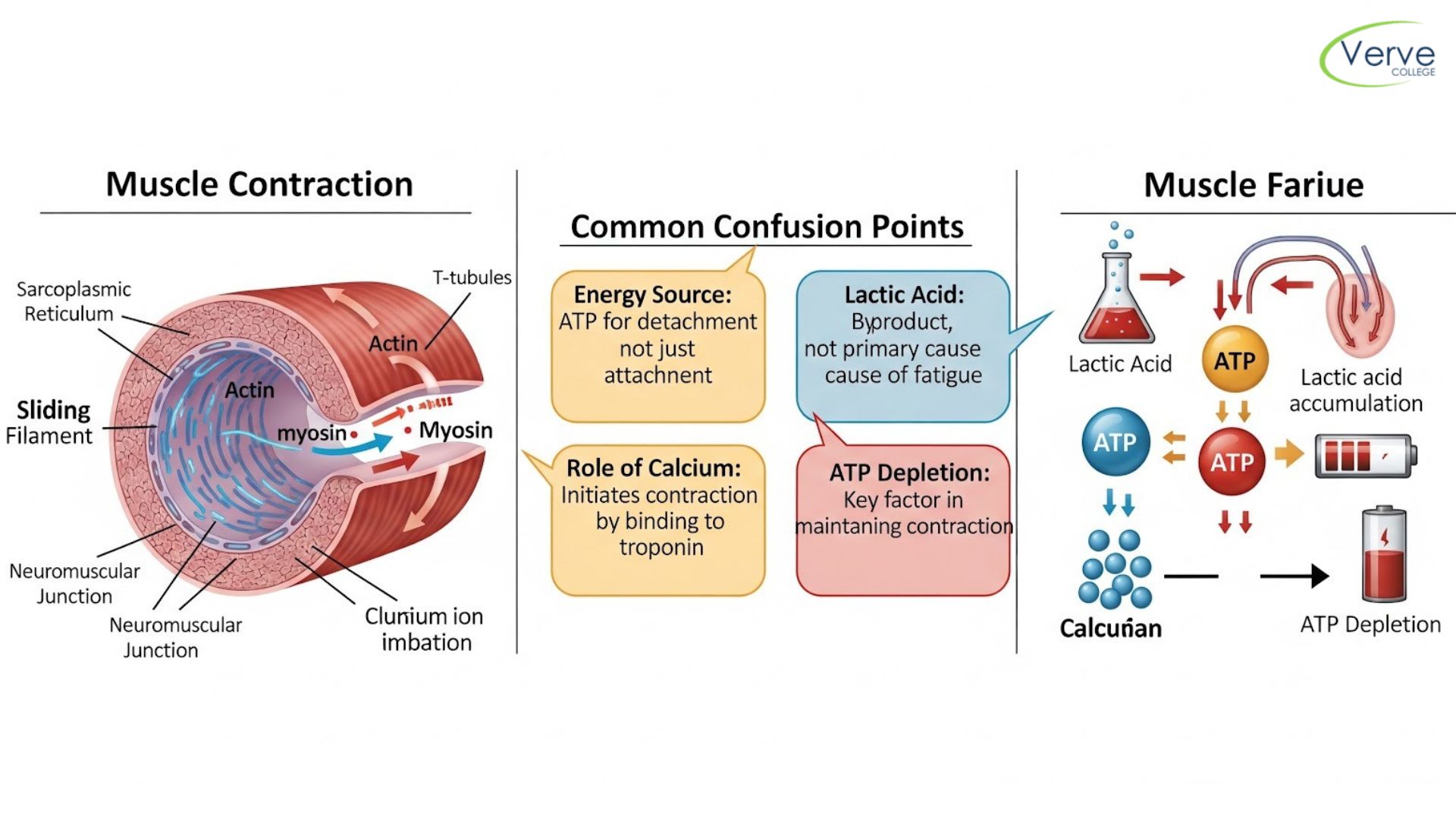
Muscle Fatigue & Contraction: Why It Confuses Students
Muscle Fatigue & Contraction: Why It Confuses Students
Let’s be honest: the first time you see a diagram of a sarcomere, you probably want to close the textbook and reconsider a career in accounting. Muscle contraction feels like it should be simple—you think “move,” and your arm moves. But underneath the skin, there is a chaotic, high-stakes molecular drama involving calcium ions, ATP, and protein filaments that act like tiny, caffeinated rowers.
The confusion usually stems from the “Sliding Filament Theory.” It’s a lot to process, and if you’re searching for the best nursing schools in Illinois, you already know that mastering this is the “make or break” moment of your early education. If you can’t grasp how a muscle fires, how are you going to understand cardiac arrest or respiratory failure? This isn’t just academic trivia; it’s the foundation of everything you’ll do on the med-surg floor.
Key Takeaways
- The “Click” Mechanism: Muscles don’t actually “shorten” by shrinking; they shorten because protein filaments slide past one another like interlocking fingers.
- Calcium is the Key: Without Calcium to move the “security guard” proteins (Troponin and Tropomyosin), your muscles stay in a permanent state of “off.”
- ATP is the Divorce Lawyer: Curiously, muscles need energy (ATP) to relax and release the bond between filaments, not just to pull them.
- Fatigue is a Shield: Muscle fatigue isn’t just “failure”; it’s your body’s way of preventing you from literally tearing your cells apart when energy runs low.
- Logical Prep Matters: Mastering A&P requires moving past rote memorization and into clinical visualization, which is why specialized prep is vital for nursing success.
The Sliding Filament Mystery: It’s Not Just a Pull
Key Takeaways
- Muscles require a constant “on” signal (Calcium) and “fuel” (ATP) to keep moving.
- Without ATP, the muscle doesn’t relax—it stays locked (the biological basis for rigor mortis).
Students often trip over the “Troponin-Tropomyosin” roadblock. Think of these as the “security guards” of the muscle. They prevent the contraction from happening until the “boss” (Calcium) shows up to distract them.
Once the security guards are out of the way, Myosin (the thick filament) grabs Actin (the thin filament) and pulls. This requires a massive amount of ATP. If you’re struggling with these concepts, an A&P prep course Illinois can help bridge the gap between “memorizing words” and “understanding the mechanism.”
The Chemistry of the “Burn”
Why do your muscles burn? Most students scream “Lactic Acid!” and while they aren’t entirely wrong, they are oversimplifying it. The burn is actually a result of pH changes and metabolic byproducts that interfere with how Calcium is released. If the Calcium can’t get out, the muscle can’t “turn on.”
Why “Fatigue” Isn’t Just Feeling Tired
Key Takeaways
- Fatigue is a protective mechanism to prevent permanent cellular energy depletion.
- Psychological fatigue usually hits long before your muscles actually reach physiological failure.
Muscle fatigue is essentially your body’s “low battery” mode. When the motor neurons can’t fire fast enough, or the internal environment of the muscle becomes too acidic, the contraction weakens.If you find yourself constantly searching for anatomy and physiology classes near me because your current curriculum feels like a foreign language, you aren’t alone. Muscle physiology is one of the top reasons students struggle in healthcare programs. It requires a specific type of “clinical logic” that many general biology courses simply don’t teach.
The “Wall” of Knowledge: Why Students Get Stuck
Students often fail because they try to memorize the steps rather than visualizing the process as a cycle. You have to think of the muscle as a biological engine. If the spark plug (neuron) doesn’t fire, the fuel (ATP) won’t ignite, and the pistons (filaments) won’t move.
At Verve College, we don’t just expect you to know the terms. We expect you to understand the why. Whether you are at our Chicago or Oak Brook campus, our focus is on making sure these complex systems become second nature. You can’t be a safe practitioner if you’re still guessing where the calcium goes during a contraction.
Conclusion
Muscle contraction and fatigue are the gatekeepers of nursing education. They represent the transition from being a student to becoming a clinician who understands the “why” behind patient symptoms. Once you grasp how the body moves at a molecular level, you stop seeing isolated issues and start seeing an interconnected system. This level of understanding is what separates a student who passes a test from a nurse who provides exceptional care.
Don’t let a few protein filaments and chemical gradients stand between you and your nursing license. At Verve College, we bridge that gap with hands-on learning and focused curriculum designed specifically for the nursing path. Mastering these foundational concepts now will ensure that when you finally step onto the clinical floor, you aren’t just reciting facts—you are applying life-saving knowledge.
FAQs
1. Why does a muscle need ATP to relax if it’s “resting”?
This is the most counterintuitive part of A&P. The myosin head is actually “cocked” and ready to pull; it requires the binding of a new ATP molecule to break the bond with the actin filament. This is why muscles become stiff (rigor mortis) after death: no ATP means the muscles stay locked in whatever position they were in.
2. What is the “All-or-None” Law in muscle contraction?
The “All-or-None” Law states that a single muscle fiber will either contract completely or not at all when stimulated. It doesn’t do a “half-contraction.” To get a stronger movement, your brain simply recruits more muscle fibers, rather than making one fiber pull harder.
3. Does lactic acid cause muscle soreness the next day?
Contrary to popular belief, no. Lactic acid is usually cleared from the system within an hour of exercise. That “Day 2” soreness (DOMS) is actually caused by microscopic tears in the muscle fibers and the subsequent inflammatory response required to repair and strengthen them.
4. How does hydration affect muscle fatigue?
Muscles rely on an electrical gradient maintained by electrolytes like Sodium, Potassium, and Magnesium. When you are dehydrated, these levels get out of whack, meaning the electrical signal from your brain can’t “jump” effectively to the muscle, leading to premature fatigue and cramping.
5. Why is the sarcomere called the “functional unit” of the muscle?
Because it is the smallest part of the muscle that can actually perform a contraction. Think of it like a single pixel on a TV screen—one pixel can’t show a movie, but thousands of them working together create the full picture. Similarly, millions of sarcomeres shortening at once create a visible movement.
Most Popular Blogs Posts

Vital Signs Monitoring: A Complete Student…
March 26, 2026 Read More
Soft Skills That Make You a…
March 25, 2026 Read More
Compact Bone vs Spongy Bone: Key…
March 24, 2026 Read More
Can You Work While Studying LPN?…
March 24, 2026 Read More