-
Oak Brook
📍📞 630-705-99992625 Butterfield Rd. Suite 102E
Oak Brook, IL 60523📠 Fax: 630-705-1422✉️ inquiry@vervecollege.edu 🗺️ Open in Google Maps 🍎 Open in Apple Maps🕒Office HoursMon–Fri: 9:00 AM – 6:00 PM
Sat: 10:00 AM – 4:00 PM
Sun: Closed -
Chicago
📍📞 312-920-8822216 W. Jackson Blvd. Suite 900
Chicago, IL 60606📠 Fax: 312-658-0775✉️ inquiry@vervecollege.edu 🗺️ Open in Google Maps 🍎 Open in Apple Maps🕒Office HoursMon–Fri: 9:00 AM – 6:00 PM
Sat: 10:00 AM – 4:00 PM
Sun: Closed - Email:inquiry@vervecollege.edu
- Make a Payment
 Sign up
 Login
Login
- Home
- Programs
- Admission
- Resources
- ATI Entrance Exam Resources
- New E-Digital Library
- Refer a Friend
- School Newsletter
- Events
- Employers
- Job-Network
- Alpha Beta Kappa Candidates
- Verve College Library
- Graduation and Pinning Ceremony Photo Galleries
- Textbook Information
- Career Services
- Tutoring
- School Catalog
- FAQ
- Constitution Day Program
- Alumni
- Verve College Plans
- Financial Aid
- HEERF Reporting
- Satisfactory Academic Progress
- Apply For Financial Aid
- Net Price Calculator
- Return of Title IV Funds (R2T4)
- Financial Aid Office Code of Conduct
- Contact
- FAQs
- Verification Policy
- Vaccination Policy
- Student Right-to-Know Act
- Misrepresentation
- Information Security Program
- Academic Award Year
- Availability of Employee
- Cost of Attendance
- Health & Safety Exemption Requirement
- Students Rights and Responsibilities
- Leave of Absence
- Pell Formula
- Military Students
- Grants/ Scholarship Policy
- Contact Us
- Testimonials
- Blog
Is a Nursing Career Right For You?
Take The Free Quiz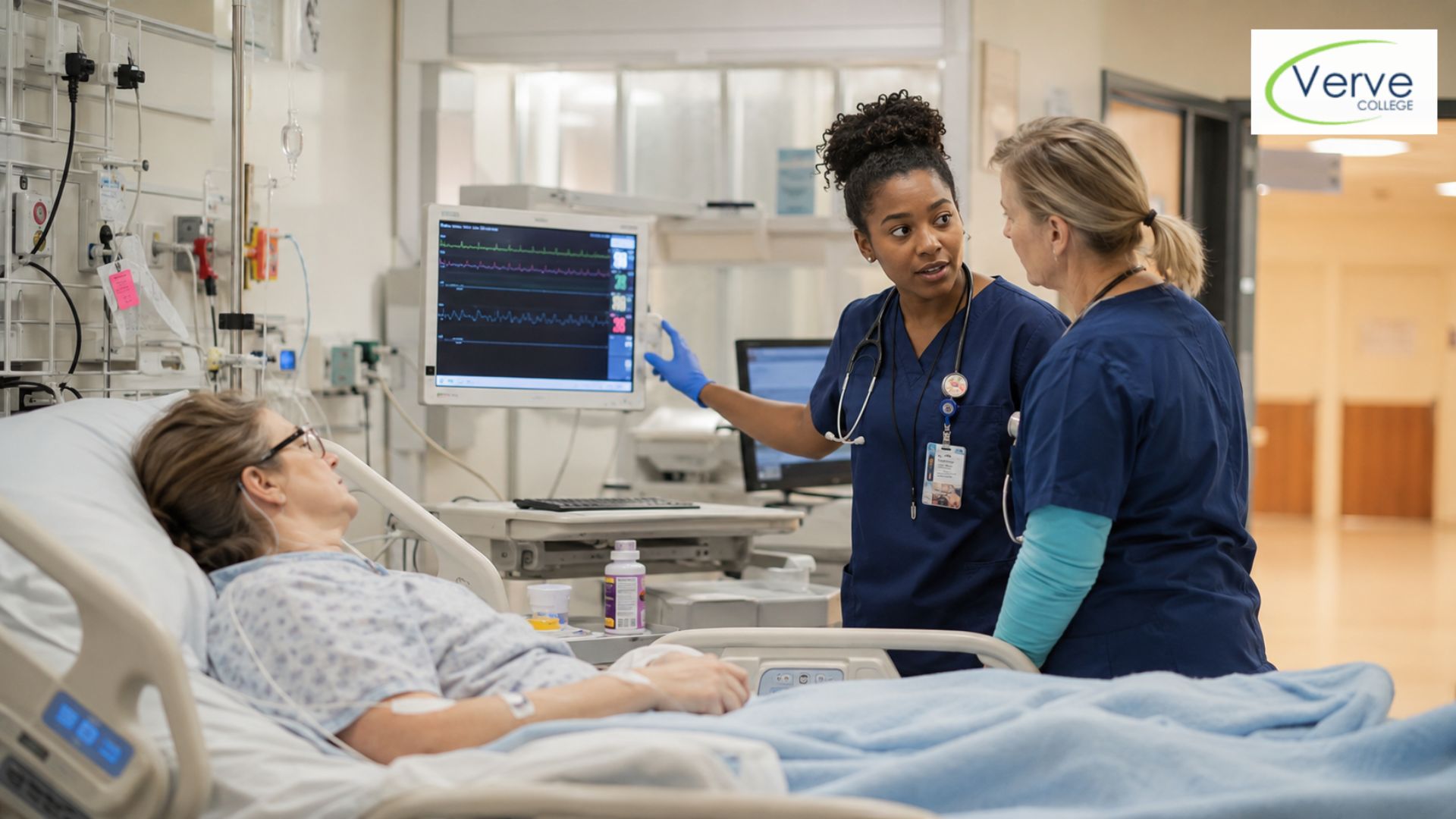
What Is Situational Awareness in Healthcare?
What Is Situational Awareness in Healthcare?
As a nursing student or aspiring healthcare professional, you’ve probably heard the term “situational awareness” thrown around in clinical settings or class discussions. But what does it actually mean, and why do instructors emphasize it so heavily? Situational awareness in healthcare is the ability to perceive, understand, and respond to what’s happening around you in a patient care environment at any given moment. It’s not just about noticing one thing; it’s about grasping the bigger picture: your patient’s condition, the equipment in the room, what your teammates are doing, and potential risks before they become emergencies. This skill can literally save lives, and it’s something every nurse needs to master.
Key Takeaways
- Situational awareness means understanding the full clinical picture, not just isolated details
- It involves continuous observation, communication, and critical thinking about patient safety
- Strong situational awareness helps nurses anticipate problems and respond faster to changes
- This skill is developed through classroom theory, simulation practice, and supervised clinical experience
- If you’re exploring nursing careers, enrolling in practical nursing programs teaches these competencies in real-world contexts
- Patient safety awareness and clinical decision-making are built on the foundation of solid situational awareness
What Is Situational Awareness in Healthcare?
Situational awareness in healthcare goes beyond simply watching a patient. It means staying mentally engaged with everything happening in your clinical environment. This includes knowing your patient’s vital signs, recent lab results, medication schedule, and any changes since your last assessment. It also means noticing if a call light is on, if equipment alarms are sounding, if a family member looks confused, or if another team member seems overwhelmed.
Think of it this way: a nurse with strong situational awareness doesn’t just react when something goes wrong. They predict, prevent, and adjust care before problems escalate. This is the difference between good nursing and safe nursing.
Why Situational Awareness Matters for Patient Safety
Patient safety awareness depends entirely on situational awareness. When nurses miss important details or fail to connect information, patient harm can follow. Medication errors, missed diagnoses, falls, infections, and communication breakdowns often trace back to a lapse in awareness about what’s actually happening in the clinical moment.
Research in healthcare shows that many adverse events involve breakdowns in communication or failure to recognize early warning signs. A nurse who actively practices situational awareness catches these warning signs before they become crises. For example, noticing that a patient’s breathing pattern has changed, their color looks different, or they’re suddenly more confused than before can be the difference between a stable patient and a code situation.
This is why every accredited nursing program emphasizes it from day one.
The Key Components of Situational Awareness in Nursing
Situational awareness breaks down into several interconnected skills. First is observation: actually looking, listening, and assessing what’s in front of you. Many student nurses learn this through hands-on experience in clinical settings and simulation labs.
Second is integration: connecting the dots between different pieces of information. A patient’s elevated heart rate might seem unrelated to their anxiety, but together they paint a clearer clinical picture.
Third is anticipation: using what you observe and integrate to predict what might happen next. Will this patient likely fall? Are they at risk for complications? Fourth is communication: sharing what you’ve noticed with your team in clear, timely ways.
Finally, there’s continuous reassessment: understanding that patient situations change constantly, so your awareness must stay dynamic and updated.
How Nurses Develop Situational Awareness
Situational awareness isn’t something you’re born with; it’s a learned skill that improves over time. It starts in the classroom with theory and foundational knowledge. You need to understand normal vital signs, disease processes, medications, and how the body works before you can recognize what’s abnormal.
That’s why foundational learning matters. When you pursue practical nursing programs, you’re not just memorizing facts. You’re building a mental framework that helps you interpret clinical situations faster and more accurately. Classroom instruction teaches the “why” behind patient responses.
But classroom learning is just the beginning. The real development happens in simulation labs and supervised clinical experiences. In these settings, you practice making quick assessments under pressure. You learn what normal feels like, so abnormal jumps out at you. You develop the habit of constant vigilance without becoming burnt out by it.
Situational Awareness in Real Clinical Settings
When you step into a hospital floor, an urgent care clinic, or any patient care environment, situational awareness becomes your safety net. A skilled nurse entering a patient’s room is mentally noting dozens of things: Is the patient alert? Are they pale or flushed? What’s the room temperature? Is the IV running smoothly? Are monitors beeping? Who’s in the room? What’s the mood?
This isn’t paranoia; it’s professionalism. Nurses who practice strong situational awareness develop what feels like a sixth sense about their patients. They notice subtle changes that other people miss. They catch near-miss events before they become incidents. Over time, this awareness becomes almost automatic, freeing up mental energy for complex clinical decisions.
In team-based settings like operating rooms or critical care units, situational awareness extends to your entire team. You’re aware of what surgeons are doing, what anesthesia is managing, what other nurses are handling, and how all these moving pieces affect your patient’s safety.
The Connection to Anatomy and Physiology
To develop strong situational awareness, you need a solid foundation in how the human body works. Understanding anatomy and physiology classes gives you the knowledge base to recognize what’s normal and what signals a problem.
For example, if you understand the cardiovascular system deeply, you’ll recognize the significance of subtle changes in a patient’s pulse, blood pressure, or skin temperature. Without this foundation, you might observe these changes without truly understanding their clinical meaning. Many nursing students find that deepening their anatomy and physiology knowledge transforms their ability to practice situational awareness on the clinical floor.
Developing This Skill for Your Nursing Career
If you’re preparing for a nursing career, you can start building situational awareness habits now. Practice in your daily life: observe your surroundings, notice details others miss, think about connections between different pieces of information. In clinical settings, always ask yourself: What do I notice? What does it mean? What might happen next?
When you enroll in a structured program like our licensed practical nurse programs, instructors guide this development intentionally. They create scenarios that teach you to think critically under realistic pressure. They provide feedback on your decision-making. They help you practice until situational awareness becomes part of how you think about patient care.
Get Your Nursing Career Training Readiness Score Now!
Frequently Asked Questions (FAQs)
Q1: Is situational awareness something you either have or don’t have, or can it be learned?
Situational awareness is absolutely a learned skill. Some people may naturally be more observant, but every nurse can develop and strengthen it through intentional practice, education, and clinical experience. It improves significantly once you understand what to look for and why it matters.
Q2: What happens if a nurse misses important details or lacks situational awareness?
Missed details can lead to delayed diagnosis, medication errors, preventable complications, or patient harm. This is why healthcare organizations emphasize situational awareness training and why it’s a core competency in every nursing program. It’s not about blame; it’s about prevention.
Q3: How long does it take to develop good situational awareness as a new nurse?
Most nursing students begin developing this skill during their education and continue refining it throughout their careers. Early clinical rotations and supervised experiences accelerate learning. New graduate nurses usually show significant improvement in their first year of independent practice as they gain real-world experience.
Most Popular Blogs Posts

What Is Cardiac Output? A Simple…
October 6, 2026 Read More
What Should You Look for in…
October 6, 2026 Read More
How LPN Training Prepares Students for…
October 5, 2026 Read More
What Is Inflammation? A Simple Guide…
October 1, 2026 Read More