Sign up
 Login
Login
Is a Nursing Career Right For You?
Take The Free Quiz
What Capillaries Do in Your Heart & Blood System?
What Capillaries Do in Your Heart & Blood System?
Ever wonder how the vital stuff, like oxygen and nutrients, actually gets from your blood into your body’s tissues? It’s not magic, it’s a microscopic marvel of engineering happening trillions of times a day. We often hear about the heart, arteries, and veins as the superstars of the circulatory system, but the real unsung heroes are the capillaries. These tiny, web-like vessels are where the action truly happens. Understanding what function do capillaries serve in the cardiovascular system is like discovering the secret delivery routes that keep your entire body running. They are the final frontier of your bloodstream, the critical link between your major blood vessels and every single cell you’re made of.
Key Takeaways
- The Exchange Hub: Capillaries are the primary sites for the exchange of oxygen, nutrients, waste products, and carbon dioxide between the blood and the body’s tissues.
- Microscopic Connectors: They are the smallest blood vessels, forming vast networks that connect the smallest arteries (arterioles) to the smallest veins (venules).
- Gatekeepers of Health: The health and function of your capillary network are crucial for everything from regulating blood pressure to enabling a proper immune response.
- Foundation of Physiology: A solid grasp of capillary function is a non-negotiable cornerstone for anyone studying nursing or human biology.
Tiny Tunnels, Mighty Mission: Unpacking the Role of Capillaries
What Exactly Are Capillaries? The Microscopic Middlemen
Key Takeaway: Capillaries are incredibly thin blood vessels, often only one cell thick, that form a bridge between arteries and veins, allowing for the easy passage of substances.
Think of your cardiovascular system as a massive highway network. Arteries are the major highways carrying oxygen-rich blood away from the heart. Veins are the return routes, bringing deoxygenated blood back. But how does the cargo get to the individual houses and businesses (your cells)? That’s where the capillaries come in. They are the intricate network of tiny side streets and residential roads.
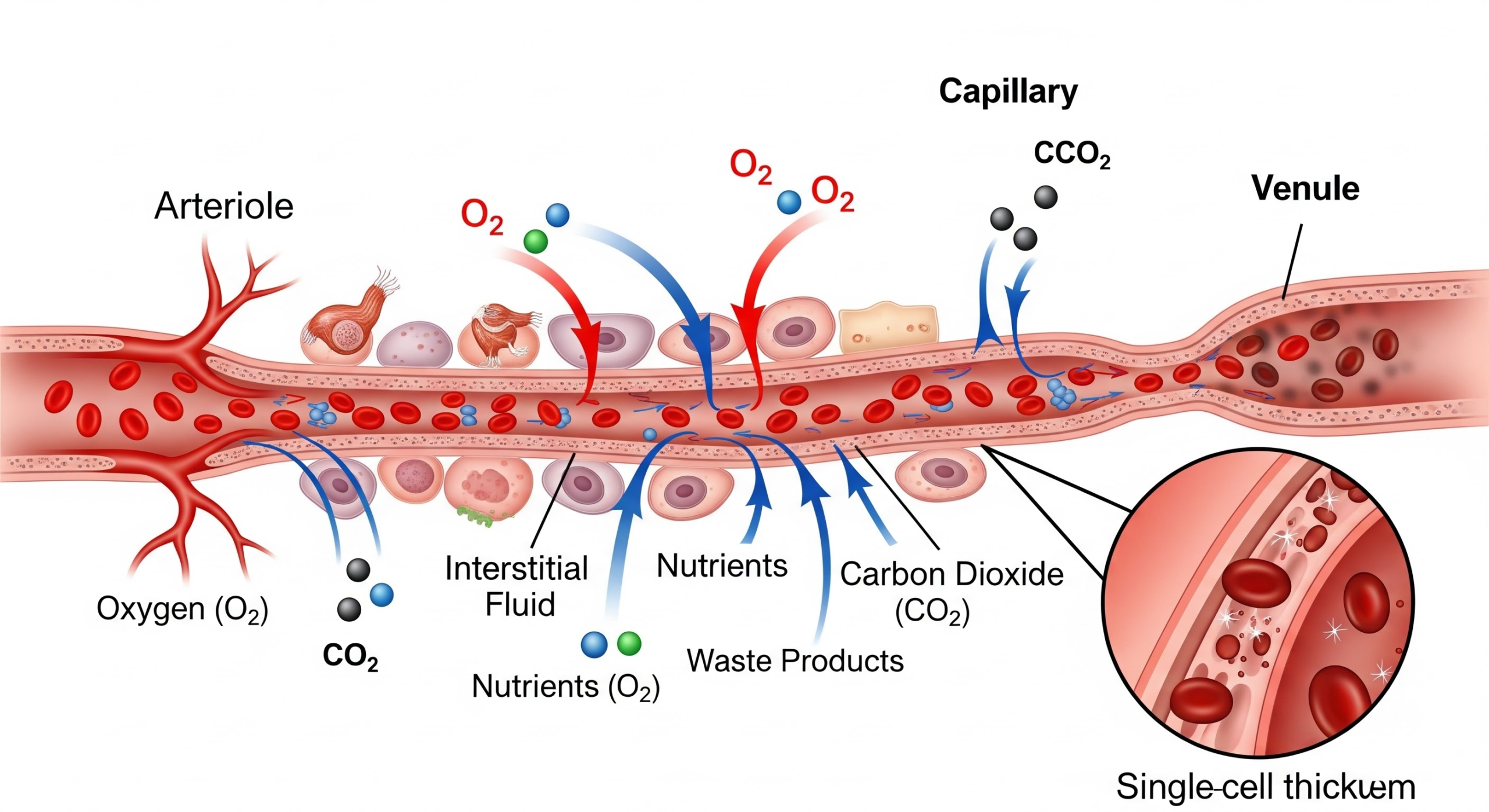
Their walls are so astonishingly thin, often just a single layer of cells, that molecules like oxygen, water, and nutrients can easily slip through to nourish the surrounding tissues. At the same time, waste products like carbon dioxide from the cells can just as easily pass back into the capillaries to be hauled away. This exchange is the fundamental role of the cardiovascular system. Without this microscopic hand-off, our cells would starve and drown in their own waste.
The Great Exchange: What Function Do Capillaries Serve in the Cardiovascular System?
Key Takeaway: The primary function of capillaries is to facilitate the efficient exchange of gases, nutrients, and waste products between the blood and the body’s cells.
Let’s get straight to the point. The main job of capillaries is exchange. It’s that simple and that profound. This process occurs in a few critical ways:
- Oxygen Delivery: Red blood cells, traveling single file through these narrow passages, release oxygen which diffuses across the capillary wall into the tissues.
- Nutrient Drop-off: Vital nutrients absorbed from your food and transported in the blood, like glucose and vitamins, are delivered to your cells for energy and maintenance.
- Waste Removal: On the flip side, metabolic byproducts like carbon dioxide and urea are picked up from the tissues and carried away for disposal by the lungs and kidneys.
- Fluid Balance: Capillaries also play a key role in regulating the fluid balance between your blood and tissues, a concept known as Starling’s forces, which is a fascinating topic you’ll dive deep into during anatomy and physiology classes.
Essentially, if you want to know what function do capillaries serve in the cardiovascular system, the answer is that they are the critical sites of transaction that keep you alive, moment by moment.
Why Their Structure is Their Superpower?
Key Takeaway: The structure of capillaries, specifically their thin walls and vast numbers, is perfectly designed for their function of exchange.
Why are capillaries so good at their job? It boils down to two key design features:
- They are incredibly thin: This minimal barrier makes for a short travel distance for molecules, ensuring a rapid and efficient exchange process.
- They are incredibly numerous: Your body contains an estimated 10 billion capillaries. If you laid them all end-to-end, they would circle the globe more than twice! This massive surface area ensures that no cell is ever too far from its supply line.
This elegant design is a perfect example of how structure dictates function, a core concept that is foundational for anyone entering healthcare and a central theme in every A&P class.
Ready to turn your fascination with the human body into a career? Verve College provides the hands-on training you need to become a confident and competent nurse.
Capillaries in Action: From Blushing to Fighting Infection
You see capillary function in your daily life more than you realize. A blush on your cheeks? That’s blood rushing into the capillary beds just under your skin. A bruise? That’s the result of damaged capillaries leaking blood into the surrounding tissue.
They are also vital for your immune system. When you have an infection or injury, capillaries in the area can become more permeable, allowing white blood cells to squeeze through the walls and get to the site of the problem to fight off invaders. This highlights just how dynamic and essential these tiny vessels are. For aspiring nurses, understanding these processes is crucial for patient care, and it’s a topic covered extensively in quality practical nursing programs in Chicago.
Conclusion
So, let’s circle back to the core question: what function do capillaries serve in the cardiovascular system? They are not just passive pipes; they are the active, bustling marketplaces of your body. They are the precise locations where life-sustaining trades of oxygen, nutrients, and waste occur. Without the silent, tireless work of these billions of microscopic vessels, the heart’s powerful pump would be for nothing. They are the true connection between the grand scale of the circulatory system and the microscopic needs of every single cell, proving that in human biology, the smallest components often have the most significant impact.
Frequently Asked Questions (FAQs)
Q: What is the difference between an artery, a vein, and a capillary? A: Arteries carry oxygenated blood away from the heart, veins carry deoxygenated blood toward the heart, and capillaries are the tiny vessels that connect them, where the exchange of gases and nutrients happens with the tissues.
Q: Can new capillaries be formed? A: Yes, the body can create new capillaries through a process called angiogenesis. This happens normally during exercise (to increase blood supply to muscles), growth, and wound healing.
Q: What happens if capillaries are damaged? A: Damage to capillaries can lead to bruising, swelling (edema), and tiny red dots on the skin called petechiae. Conditions like high blood pressure and diabetes can damage capillaries over time, leading to more serious health complications.
Q: How does blood flow get regulated in the capillaries? A: Blood flow into capillary beds is controlled by tiny muscular rings called precapillary sphincters, located where arterioles meet the capillaries. They can contract or relax to direct blood where it’s needed most.
Take the Next Step with Verve College
Understanding the intricate workings of the human body, from the mighty heart to the microscopic capillary, is the first step toward a rewarding career in healthcare. If this glimpse into the cardiovascular system has sparked your curiosity, imagine what you could learn in a structured, supportive environment. At Verve College Chicago, we specialize in transforming that curiosity into competence.
Our nursing programs are designed to give you the knowledge and skills needed to excel. Don’t just wonder about the human body, make it your profession. c
Most Popular Blogs Posts

Soft Skills That Make You a…
March 25, 2026 Read More
Compact Bone vs Spongy Bone: Key…
March 24, 2026 Read More
Can You Work While Studying LPN?…
March 24, 2026 Read More
Skeletal System: Everything Nursing Students Should…
March 23, 2026 Read More