- Oak Brook:(630) 705-9999
- Chicago:(312) 920-8822
- Email:inquiry@vervecollege.edu
- Make a Payment
 Sign up
 Login
Login
- Home
- Programs
- Admission
- Resources
- ATI Entrance Exam Resources
- New E-Digital Library
- Refer a Friend
- School Newsletter
- Events
- Employers
- Job-Network
- Alpha Beta Kappa Candidates
- Verve College Library
- Graduation and Pinning Ceremony Photo Galleries
- Textbook Information
- Career Services
- Tutoring
- School Catalog
- FAQ
- Constitution Day Program
- Alumni
- Verve College Plans
- Financial Aid
- HEERF Reporting
- Satisfactory Academic Progress
- Apply For Financial Aid
- Net Price Calculator
- Return of Title IV Funds (R2T4)
- Financial Aid Office Code of Conduct
- Contact
- FAQs
- Verification Policy
- Vaccination Policy
- Student Right-to-Know Act
- Misrepresentation
- Information Security Program
- Academic Award Year
- Availability of Employee
- Cost of Attendance
- Health & Safety Exemption Requirement
- Students Rights and Responsibilities
- Leave of Absence
- Pell Formula
- Military Students
- Grants/ Scholarship Policy
- Contact Us
- Testimonials
- Blog
Is a Nursing Career Right For You?
Take The Free Quiz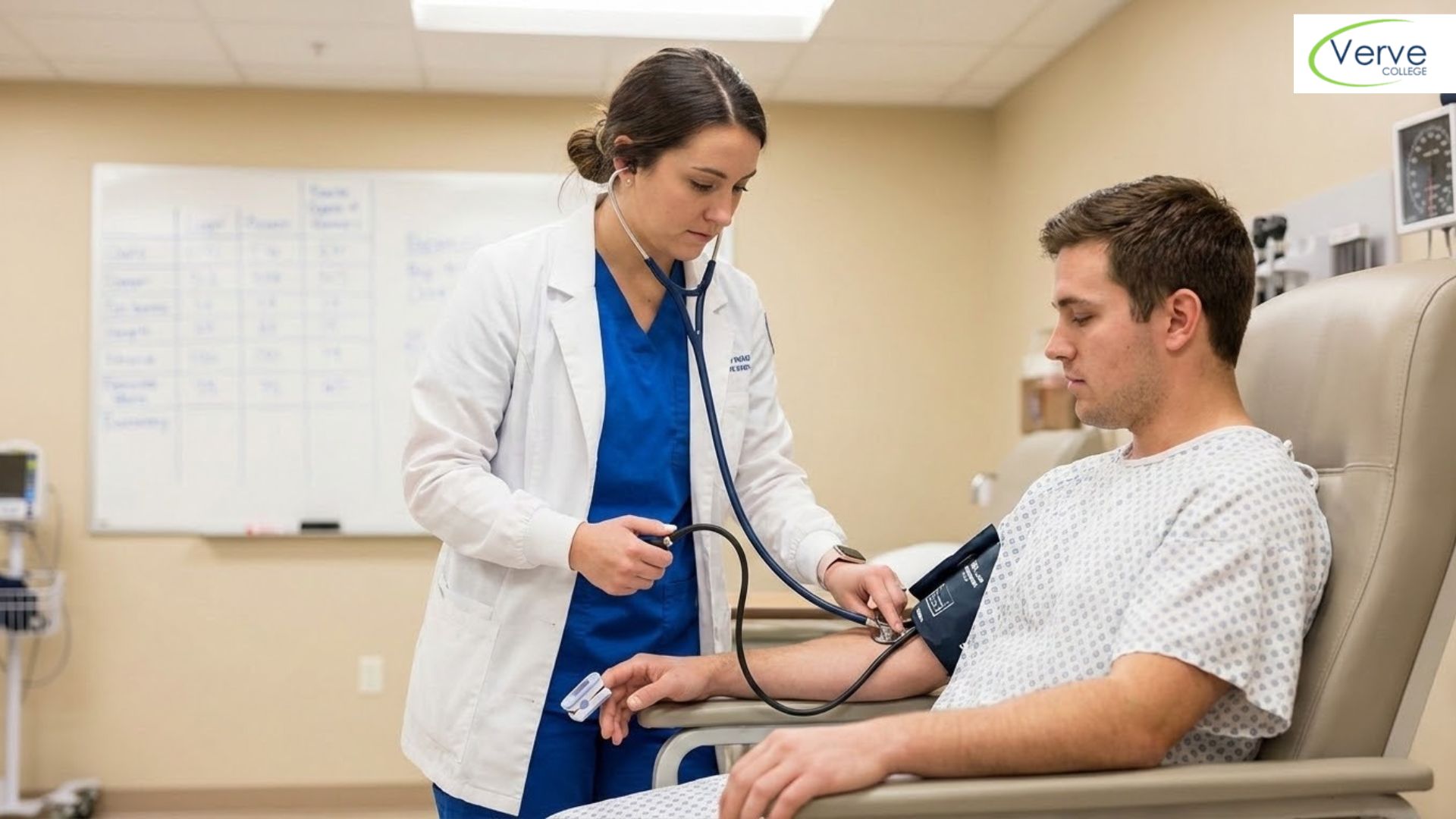
Vital Signs Monitoring: A Complete Student Guide
Vital Signs Monitoring: A Complete Student Guide
Imagine walking into your first clinical shift. The supervising nurse looks at you and says, “Go check vitals on the patient in room 3.” Your heart races. You know what vital signs are — but do you know exactly what to check, how to measure each one correctly, and what to do if something looks off?
This guide is written for nursing students who want a clear, practical understanding of vital signs monitoring — what it is, how to do it right, and what the numbers actually mean in real patient care.
Key Takeaways
- Vital signs include temperature, pulse, respiration rate, blood pressure, and oxygen saturation
- Each vital sign has a normal range — knowing these ranges is what helps you spot a problem early
- Proper technique matters as much as the equipment you use
- Small errors in positioning or timing can lead to inaccurate readings and poor clinical decisions
- Students enrolled in licensed practical nurse programs learn vital signs monitoring as a hands on clinical skill, not just a classroom concept
- Vital signs monitoring requires judgment, not just mechanics — and that judgment is built through practice
What Are Vital Signs and Why Do They Matter
Vital signs are the body’s most basic measurements. They tell you whether a patient’s core systems are functioning the way they should. When something is wrong, vital signs are usually the first place it shows up.
The four traditional vital signs are temperature, pulse, respiration rate, and blood pressure. Oxygen saturation — measured using a small device clipped to the finger — is now considered a standard fifth measurement in most clinical settings.
Together, these five numbers give you a snapshot of how the body is doing right now. A change in even one of them can signal infection, dehydration, cardiac stress, respiratory problems, or something more serious. That is why nurses check them consistently and document them carefully.
How to Measure Each Vital Sign Correctly
Temperature
Body temperature is most commonly measured orally using a digital thermometer placed under the tongue. It can also be taken at the ear, forehead, armpit, or rectally depending on the patient’s condition and age. Normal oral temperature for an adult sits around 98.6°F (37°C). Make sure the patient has not eaten, drunk anything hot or cold, or smoked within 15 minutes before an oral reading — all of these can affect accuracy.
Pulse
Pulse is the number of times the heart beats per minute. The most common site is the radial pulse, found on the inside of the wrist just below the thumb. Place two fingers gently on the site, count the beats for 30 seconds, and multiply by two. If the rhythm feels irregular, count for a full 60 seconds. Normal resting pulse for an adult is 60 to 100 beats per minute.
Respiration Rate
Respiration rate is the number of breaths a patient takes per minute. Count chest rises for 30 seconds and multiply by two. The key here is not to tell the patient what you are doing — people unconsciously change their breathing when they know it is being observed. Normal respiration rate for an adult is 12 to 20 breaths per minute.
Blood Pressure
Blood pressure measures the force of blood pushing against artery walls. It is recorded as two numbers — systolic (the pressure when the heart beats) over diastolic (the pressure when the heart rests between beats). A reading of 120/80 mmHg is considered normal for most adults. Use a properly sized cuff, position the patient’s arm at heart level, and make sure they have been seated and calm for at least five minutes before measuring.
Oxygen Saturation
Oxygen saturation, often called SpO2, measures how much oxygen is in the blood. A pulse oximeter clipped to the fingertip gives you this reading in seconds. Normal SpO2 for a healthy adult is 95 to 100 percent. Readings below 90 percent are a clinical concern and typically require immediate attention.
Normal Ranges Every Nursing Student Should Know
Here is a quick reference for adult normal ranges:
Temperature: 97°F to 99°F (36.1°C to 37.2°C)
Pulse: 60 to 100 beats per minute
Respiration Rate: 12 to 20 breaths per minute
Blood Pressure: Less than 120/80 mmHg
Oxygen Saturation: 95 to 100 percent
These numbers are your baseline. The moment a reading falls outside the normal range, your job shifts from measuring to thinking. What changed? Has it changed gradually or suddenly? Does it match what you are seeing in the patient? Knowing the difference between a reading that needs to be rechecked and one that needs to be escalated is a skill you build over time — and learning about understanding normal vs abnormal vital signs will give you the clinical context to start making those calls with more confidence.
Common Mistakes Students Make When Monitoring Vital Signs
Every nursing student makes mistakes when starting out. The goal is to learn from them early so they do not follow you into clinical practice.
Wrong positioning is one of the most common errors. A patient lying down, having a conversation, or holding tension in their arm will produce a different blood pressure reading than a relaxed, properly seated patient. Position always matters.
Patient anxiety affects multiple readings at once. A nervous patient will have an elevated heart rate, higher blood pressure, and faster breathing. If you notice this, give the patient a moment to settle before rechecking. Note it in your documentation too.
Equipment errors happen when cuff sizes are wrong, thermometers are not properly calibrated, or pulse oximeters are placed on cold or poorly perfused fingers. Always check your equipment before you start.
Documentation mistakes are easy to overlook but clinically important. Recording the wrong number, the wrong time, or forgetting to note an abnormal reading can delay care. Build the habit of documenting immediately after measuring, not at the end of your shift.
When to Report Abnormal Vital Signs
Not every abnormal reading is an emergency — but all of them deserve attention.
Report immediately if a patient has a blood pressure above 180/120 mmHg or below 90/60 mmHg, a heart rate above 120 or below 50 beats per minute, an oxygen saturation below 90 percent, a temperature above 103°F or below 96°F, or a respiration rate above 24 or below 10 breaths per minute.
For borderline readings, recheck after five minutes with the patient at rest. If the reading stays abnormal on the second check, escalate. When in doubt, report. A good nurse never second guesses a concerning number — they communicate it.
How the Right Training Prepares You to Monitor Vital Signs with Confidence
Vital signs monitoring is a skill that lives at the intersection of science knowledge and hands on practice. You need both.
Starting with a strong science foundation through an a&p prep course illinois helps you understand why vital signs change in the first place. When you know how the cardiovascular and respiratory systems work, a dropping SpO2 or a racing pulse is not just a number — it tells a story. That deeper understanding is what separates students who can measure from students who can think clinically.
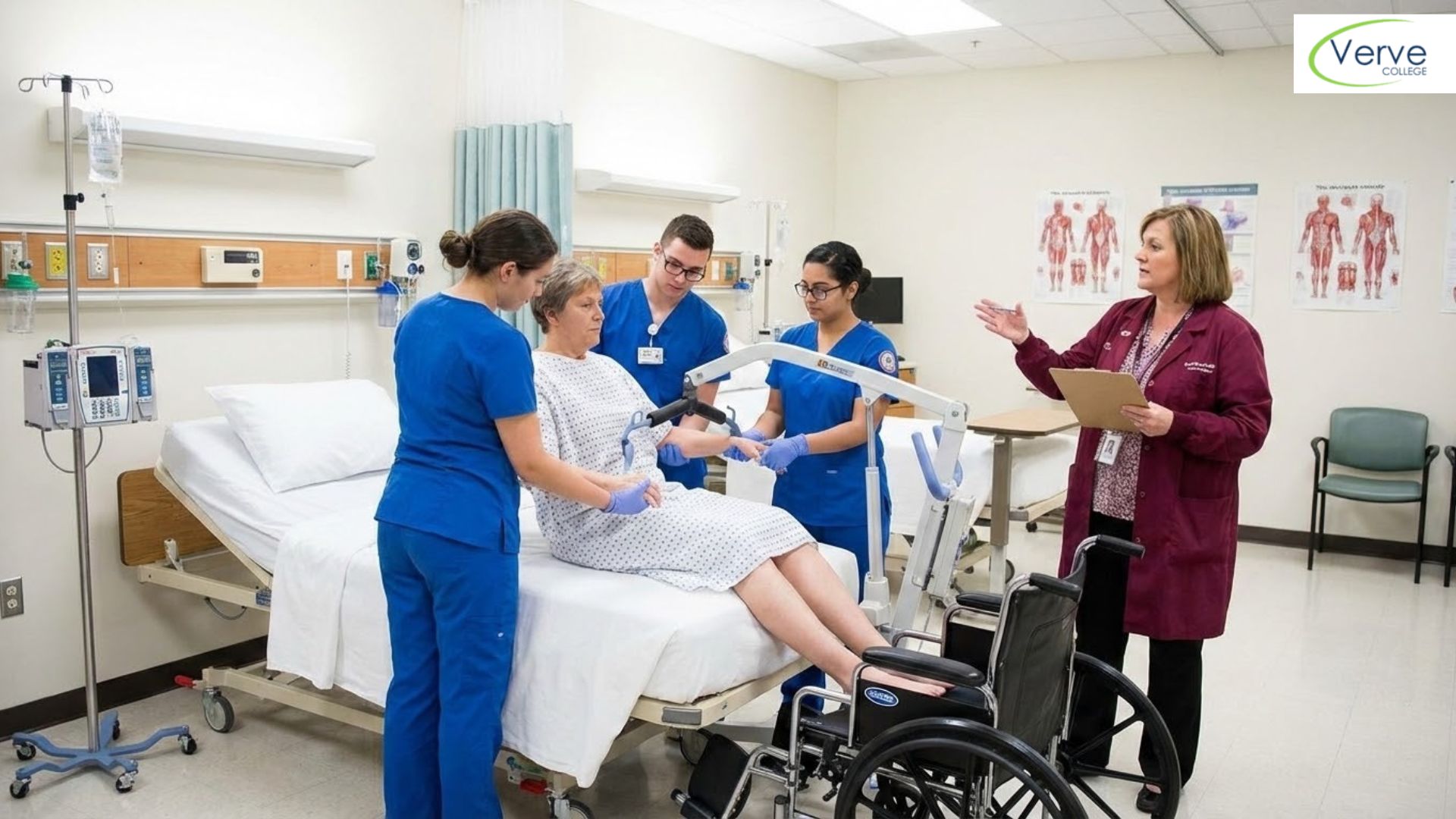
From there, licensed practical nurse programs put that knowledge into practice through clinical labs and real patient scenarios. At Verve College, vital signs monitoring is taught and repeated in hands on lab settings so students build both accuracy and confidence before their first real shift.
For students who need schedule flexibility, hybrid lpn programs illinois combine online coursework with in person clinical training — so you never miss the hands on practice that this skill actually requires.
Vital Signs Are More Than a Checklist
One thing many students get wrong early on: they treat vital signs monitoring as a routine task to get through. Check the numbers, write them down, move on.
But experienced nurses know it is much more than that. Vital signs are a conversation the body is having with you. A patient whose blood pressure has been creeping up over three shifts, or whose temperature is climbing slowly — that pattern means something. Noticing it, connecting it, and acting on it is clinical judgment. And that is exactly what great nursing training is designed to build.
Conclusion
Vital signs monitoring is one of the first clinical skills you will learn and one you will use every single shift for the rest of your nursing career. Getting it right matters — for your patients and for your confidence as a nurse. The technique is learnable. The judgment takes time and good training. If you are starting your journey toward a nursing career in Illinois, Verve College’s programs are built to give you both the science foundation and the hands on practice to walk into your first clinical shift ready.
Get Your Nursing Career Training Readiness Score Now!
Frequently Asked Questions
What are the 5 vital signs nurses monitor? The five vital signs are temperature, pulse, respiration rate, blood pressure, and oxygen saturation. These measurements give a quick overview of how the body’s core systems are functioning. Most clinical settings check all five together during routine patient assessments.
What should I do if a vital sign reading seems off? First, recheck it. Make sure the patient is positioned correctly, the equipment is working, and the patient is calm. If the reading stays abnormal after a second check, report it to your supervising nurse right away. Document both readings with the time and any relevant observations about the patient’s condition.
Do LPN students learn vital signs monitoring before clinical rotations? Yes. Most licensed practical nurse programs, including Verve College’s PN program, teach vital signs monitoring in the lab setting before students enter clinical rotations. This gives students time to practice technique, ask questions, and build confidence in a low pressure environment before working with real patients.
Most Popular Blogs Posts
Vital Signs Monitoring: A Complete Student…
March 26, 2026 Read More
Soft Skills That Make You a…
March 25, 2026 Read More
Compact Bone vs Spongy Bone: Key…
March 24, 2026 Read More
Can You Work While Studying LPN?…
March 24, 2026 Read More