-
Oak Brook
📍📞 630-705-99992625 Butterfield Rd. Suite 102E
Oak Brook, IL 60523📠 Fax: 630-705-1422✉️ inquiry@vervecollege.edu 🗺️ Open in Google Maps 🍎 Open in Apple Maps🕒Office HoursMon–Fri: 9:30 AM – 6:00 PM
Sat: 8:00 AM – 12:00 PM
Sun: Closed -
Chicago
📍📞 312-920-8822216 W. Jackson Blvd. Suite 900
Chicago, IL 60606📠 Fax: 630-705-1422✉️ inquiry@vervecollege.edu 🗺️ Open in Google Maps 🍎 Open in Apple Maps🕒Office HoursMon–Fri: 9:30 AM – 6:00 PM
Sat: 8:00 AM – 12:00 PM
Sun: Closed - Email:inquiry@vervecollege.edu
- Make a Payment
 Sign up
 Login
Login
- Home
- Programs
- Admission
- Resources
- ATI Entrance Exam Resources
- New E-Digital Library
- Refer a Friend
- School Newsletter
- Events
- Employers
- Job-Network
- Alpha Beta Kappa Candidates
- Verve College Library
- Graduation and Pinning Ceremony Photo Galleries
- Textbook Information
- Career Services
- Tutoring
- School Catalog
- FAQ
- Constitution Day Program
- Alumni
- Verve College Plans
- Financial Aid
- HEERF Reporting
- Satisfactory Academic Progress
- Apply For Financial Aid
- Net Price Calculator
- Return of Title IV Funds (R2T4)
- Financial Aid Office Code of Conduct
- Contact
- FAQs
- Verification Policy
- Vaccination Policy
- Student Right-to-Know Act
- Misrepresentation
- Information Security Program
- Academic Award Year
- Availability of Employee
- Cost of Attendance
- Health & Safety Exemption Requirement
- Students Rights and Responsibilities
- Leave of Absence
- Pell Formula
- Military Students
- Grants/ Scholarship Policy
- Contact Us
- Testimonials
- Blog
Is a Nursing Career Right For You?
Take The Free Quiz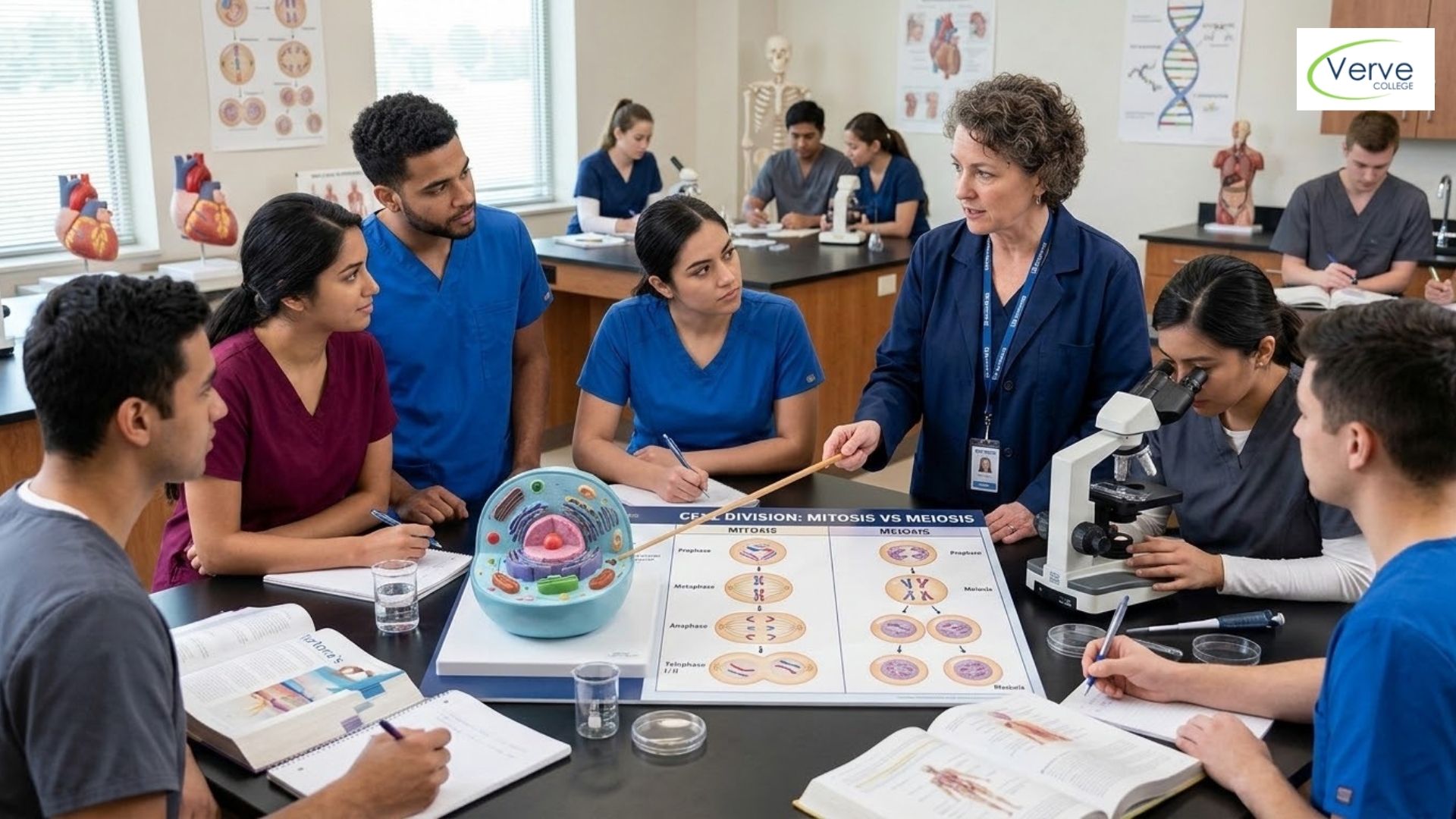
Mitosis vs Meiosis: Key Differences Nursing Students Should Know
Mitosis vs Meiosis: Key Differences Nursing Students Should Know
Your cells are constantly dividing. Your body grows, heals, and maintains itself through cell division. But did you know there are two fundamentally different types of cell division? Mitosis and meiosis are both processes that create new cells, but they work differently, produce different results, and serve different purposes. Understanding mitosis vs meiosis is essential for nursing students because these processes underlie growth, development, reproduction, genetics, and certain disease processes. When you understand the difference between mitosis and meiosis, you grasp foundational concepts that explain how bodies develop from single cells, how genetic information passes between generations, and how certain cancers develop. This article explains what mitosis and meiosis are, how they differ, what each produces, and why nursing students need to understand both processes.
Key Takeaways
- Mitosis is cell division that creates two identical daughter cells with the same genetic material, used for growth, repair, and asexual reproduction.
- Meiosis is cell division that creates four genetically unique cells with half the genetic material, used specifically for sexual reproduction (producing sperm and eggs).
- The difference between mitosis and meiosis includes the number of divisions, number of resulting cells, chromosome numbers, genetic variation, and purpose.
- If you’re taking anatomy and physiology classes, understanding mitosis vs meiosis is fundamental to comprehending human biology and reproduction.
- Mitosis vs meiosis differences matter clinically because understanding cell division helps you recognize how cancers develop, how genetic diseases pass through families, and how reproductive issues occur.
- Both mitosis and meiosis are carefully regulated processes that, when they malfunction, contribute to serious health problems.
What Is Mitosis?
Mitosis is a process of cell division that creates two identical daughter cells from one parent cell. The daughter cells have the same genetic material as the parent cell. The daughter cells are clones of the parent.
Mitosis occurs in body cells (somatic cells) throughout your life. Your skin cells divide by mitosis to replace damaged skin. Your bone cells divide by mitosis to repair fractures. Your blood cells divide by mitosis to replace old cells. Essentially, any cell in your body that isn’t a sex cell (sperm or egg) divides by mitosis.
The primary purpose of mitosis is growth, development, and tissue repair. When you were an embryo, mitosis allowed your body to develop from a single fertilized cell into trillions of cells. As you grow, mitosis continues adding cells. Throughout your life, mitosis replaces damaged or aging cells.
A key feature of mitosis is that the chromosome number stays the same. If a cell starts mitosis with 46 chromosomes (23 pairs), both daughter cells end with 46 chromosomes. This is why daughter cells are genetically identical to the parent cell.
What Is Meiosis?
Meiosis is a process of cell division that creates four genetically unique cells, each with half the genetic material of the parent cell. These special cells are sex cells (gametes): sperm in males and eggs in females.
Meiosis occurs only in reproductive tissues. In males, meiosis creates sperm cells. In females, meiosis creates egg cells. Meiosis doesn’t happen in your skin, bone, blood, or other body tissues. It only happens in specialized reproductive cells.
The purpose of meiosis is sexual reproduction. Sperm and eggs each carry half the genetic information. When sperm (23 chromosomes) fertilizes an egg (23 chromosomes), they combine to create a zygote with 46 chromosomes. This is how genetic information from two parents combines to create a new individual.
A key feature of meiosis is that daughter cells have half the genetic material of the parent cell. A cell starting meiosis with 46 chromosomes produces four cells with 23 chromosomes each. Additionally, meiosis creates genetic variation. Even though four cells result from one parent cell, they’re not identical to each other or to the parent. This genetic variation is why siblings aren’t identical even though they come from the same parents.
Mitosis vs Meiosis: Key Differences
Understanding the difference between mitosis and meiosis is easier when comparing them directly.
| Feature | Mitosis | Meiosis |
|---|---|---|
| Purpose | Growth, repair, asexual reproduction | Sexual reproduction (producing gametes) |
| Where it occurs | Body cells (somatic cells) | Reproductive cells (germ cells) |
| Number of divisions | One division | Two divisions |
| Daughter cells produced | Two cells | Four cells |
| Genetic content | Identical to parent cell | Half the genetic material of the parent cell |
| Chromosome number | Stays the same (diploid → diploid) | Halved (diploid → haploid) |
| Genetic variation | No variation (daughter cells are clones) | Significant variation (each cell unique) |
| Crossing over | Does not occur | Occurs (genetic exchange between chromosomes) |
| When it occurs | Throughout life in body cells | Only in reproductive tissue during puberty onward |
| Function in humans | Continuous tissue replacement and growth | Production of sperm and eggs only |
This table captures the essential differences between mitosis and meiosis. Study these differences because they form the basis of understanding mitosis vs meiosis on nursing exams.
Stages of Mitosis Explained
Understanding the stages of mitosis helps you see how a cell divides to create two identical daughters. Mitosis occurs in four main stages, often remembered by the acronym PMAT: Prophase, Metaphase, Anaphase, Telophase.
Prophase
The cell’s nuclear membrane dissolves. Chromosomes (which have replicated during the S phase of interphase) become visible as condensed structures. Spindle fibers form from the centrosomes and attach to the chromosomes.
Metaphase
Chromosomes line up at the cell’s equator (metaphase plate). Spindle fibers attach to the centromeres of chromosomes. The cell is ready to separate the replicated chromosomes.
Anaphase
Spindle fibers pull replicated chromosomes apart. Sister chromatids separate and move toward opposite poles of the cell. The cell begins to constrict at the equator.
Telophase
Nuclear membranes reform around the separated chromosomes. The cell membrane pinches inward, forming a cleavage furrow. Cytokinesis (actual separation of cytoplasm) completes, creating two distinct daughter cells.
The result is two daughter cells, each with identical genetic material to the parent cell.
Stages of Meiosis Explained
Meiosis is more complex because it involves two divisions: Meiosis I and Meiosis II. This creates four unique cells from one parent cell. Understanding this complexity is important for understanding mitosis vs meiosis for nursing students.
Meiosis I (First Division)
During prophase I, homologous chromosomes pair up and crossing over occurs (genetic exchange between paired chromosomes). This is where genetic variation begins.
During metaphase I, paired homologous chromosomes line up at the cell’s equator.
During anaphase I, paired chromosomes separate and move toward opposite poles. Importantly, whole chromosomes (consisting of two sister chromatids) move toward each pole, not individual chromatids.
During telophase I, two cells form, each with half the chromosomes of the parent cell (but each chromosome still consists of two sister chromatids).
Meiosis II (Second Division)
Meiosis II is similar to mitosis in each of the two cells. Sister chromatids separate during anaphase II, and the result is four cells, each with half the genetic material and a unique genetic composition.
The key difference between mitosis and meiosis becomes clear when you compare the stages. Mitosis has one division creating two identical cells. Meiosis has two divisions creating four unique cells.
Genetic Variation: A Key Difference Between Mitosis and Meiosis
One of the most important differences between mitosis and meiosis is genetic variation. Mitotic division produces genetically identical cells. Meiotic division produces genetically unique cells.
In meiosis, genetic variation occurs through two mechanisms: crossing over and independent assortment.
Crossing over happens during prophase I when homologous chromosomes pair up. These paired chromosomes exchange genetic material, creating new combinations of genes on each chromosome. This shuffling ensures that even though you inherited some chromosomes from your mother and some from your father, the genetic material is mixed, creating unique combinations.
Independent assortment happens because homologous chromosomes separate randomly during meiosis I. Which chromosome goes to which cell is random. This random separation creates additional variation.
These two mechanisms explain why siblings with the same parents aren’t genetically identical (unless they’re identical twins from the same fertilized egg that split, which is a different process entirely). Each sperm cell your father could produce is genetically unique. Each egg cell your mother could produce is genetically unique. When a unique sperm fertilizes a unique egg, the result is a unique individual.
This genetic variation is biologically important. It creates diversity within populations. It allows evolution. It explains why genetic diseases can appear unpredictably in families. Understanding genetic variation is essential for understanding mitosis vs meiosis for nursing students.
Why Nursing Students Need to Understand Mitosis vs Meiosis
Understanding cell division is foundational to nursing because it explains growth, development, genetics, reproduction, and disease.
Growth and Development
Your body develops from a single fertilized cell. Mitosis allows that cell to divide, creating two identical cells. Those two divide, creating four. Four become eight. By the time you’re born, you have trillions of cells, all created through mitosis from that original single cell. Understanding mitosis helps you grasp how bodies develop.
Genetics and Inheritance
If you’re taking an A&P class, you’ll learn how genetic traits pass through families. Meiosis explains this. Through meiosis, each parent contributes unique genetic material. The combination of these contributions creates the genetic makeup of offspring. Understanding meiosis helps you explain to patients why they inherited certain traits or why genetic diseases run in their families.
Reproduction
Infertility, pregnancy complications, and reproductive health all relate to meiosis. If meiosis doesn’t happen correctly, viable sperm and eggs aren’t produced. If meiosis produces chromosomal abnormalities (like trisomy 21, which causes Down syndrome), these affect reproduction and fetal development. Understanding meiosis helps you support patients with reproductive concerns.
Cancer Biology
Cancer is fundamentally a disease of uncontrolled cell division. Mitosis gone wrong. Cancer cells divide through mitosis but do so uncontrollably, without the normal limits on how many times cells can divide. Understanding normal mitosis helps you grasp how cancer develops when mitosis becomes dysregulated.
Genetic Variation in Disease
Some diseases show variable presentations among family members because genetic variation affects disease severity. Understanding how genetic variation occurs during meiosis helps you explain why identical twins might show different disease severity even though they carry the same mutations.
Mitosis vs Meiosis in Disease and Treatment
Clinical applications of understanding mitosis vs meiosis include:
Cancer
Cancer results from mitosis gone wrong. A mutation creates a cell that divides uncontrollably. Chemotherapy and targeted cancer treatments often work by stopping mitosis or inducing cell death. Understanding normal mitosis helps you understand cancer treatment mechanisms.
Genetic Diseases
Conditions caused by chromosomal abnormalities (like Down syndrome from trisomy 21) result from errors in meiosis. Understanding meiosis helps you counsel families about these conditions.
Infertility
Problems with meiosis reduce viable sperm and egg production, contributing to infertility. Understanding meiosis helps you support patients dealing with infertility.
Pharmacology
Some medications affect mitosis. Methotrexate, for example, interferes with DNA synthesis needed for mitosis. Understanding how mitosis works helps you understand why such medications have side effects related to rapidly dividing cells (like hair loss and GI upset).
Preparing for Nursing Education on Mitosis vs Meiosis
If you’re preparing for A&P nursing class or already enrolled, understanding mitosis vs meiosis thoroughly prepares you for exams and clinical applications.
Study the stages of both processes. Know what happens during each stage. Be able to identify cells at different stages under a microscope. Practice describing the difference between mitosis and meiosis in simple language because you’ll need to explain these concepts clearly on exams.
Understand the purposes of mitosis and meiosis. Why does your body use mitosis for growth but meiosis for reproduction? Understanding the purpose helps you remember which process does what.
Create comparison charts. Visual representations help you remember differences. The table in this article is a good starting point.
Connect mitosis and meiosis to clinical applications. How do these processes relate to pregnancy, cancer, genetic diseases? Making these connections helps you see why these processes matter beyond just passing an exam.
Common Misconceptions About Mitosis vs Meiosis
Many nursing students misunderstand key concepts about mitosis vs meiosis. Clarifying these prevents confusion.
Misconception: Meiosis Produces Identical Cells
Meiosis produces genetically unique cells, not identical ones. This is a critical difference from mitosis. If you forget this, you’ll misunderstand the purpose of meiosis.
Misconception: Meiosis Only Happens During Puberty
Meiosis begins during fetal development in future mothers (eggs stop in prophase I until ovulation). In future fathers, meiosis doesn’t begin until puberty. After that, sperm production continues throughout life. Meiosis timing differs between sexes.
Misconception: All Cell Division Is the Same
Mitosis and meiosis are fundamentally different processes with different purposes, different numbers of divisions, and different results. Understanding mitosis vs meiosis means recognizing these aren’t variations on the same process but distinct mechanisms.
Misconception: Mitosis Creates Variation
Mitosis creates identical cells. Variation occurs during meiosis. Don’t confuse these. This distinction is essential for understanding genetics.
Conclusion
Mitosis and meiosis are two fundamental cell division processes with different purposes, different structures, and different results. Mitosis creates two identical daughter cells for growth and repair. Meiosis creates four genetically unique cells specifically for sexual reproduction. Understanding mitosis vs meiosis is foundational to nursing because these processes underlie development, genetics, reproduction, and disease.
When you understand the difference between mitosis and meiosis, you grasp how bodies grow from single cells to trillions of cells. You understand how genetic information passes through families. You understand why certain diseases run in families. You understand how cancer develops when mitosis becomes uncontrolled. This knowledge supports your understanding of anatomy, physiology, genetics, reproduction, and pathology.
Study mitosis and meiosis thoroughly. Create visual representations. Practice describing the stages and differences. Connect these processes to clinical applications. Your effort in understanding these fundamental processes pays dividends throughout your nursing education and career.
Get Your Nursing Career Training Readiness Score Now!
Frequently Asked Questions (FAQs)
Why does meiosis have two divisions instead of one?
The two divisions of meiosis serve different purposes. Meiosis I separates homologous chromosomes, reducing the chromosome number by half. Meiosis II separates sister chromatids, similar to mitosis. The two divisions ensure that sex cells have half the genetic material of parent cells. When sperm (23 chromosomes) and egg (23 chromosomes) combine, the result is a complete set of 46 chromosomes.
Can mitosis create variation?
No. Mitosis creates genetically identical daughter cells. The daughter cells have the same DNA as the parent cell. Variation occurs during meiosis through crossing over and independent assortment. Understanding this distinction is crucial for understanding genetics.
What happens if mitosis or meiosis goes wrong?
If mitosis malfunctions, cells might not divide properly (leading to tissue that doesn’t repair or grow) or might divide uncontrollably (leading to cancer). If meiosis malfunctions, viable sperm and eggs might not be produced (leading to infertility) or might carry chromosomal abnormalities (leading to conditions like Down syndrome). Many health problems trace back to cell division errors.
Most Popular Blogs Posts
7 Benefits of Hands-On Nursing Education…
October 12, 2026 Read More
What Is Tissue Perfusion? A Simple…
October 12, 2026 Read More
Best Nursing Colleges Near Oak Brook:…
October 8, 2026 Read More
How to Compare LPN Program Schedules…
October 7, 2026 Read More