-
Oak Brook
📍📞 630-705-99992625 Butterfield Rd. Suite 102E
Oak Brook, IL 60523📠 Fax: 630-705-1422✉️ inquiry@vervecollege.edu 🗺️ Open in Google Maps 🍎 Open in Apple Maps🕒Office HoursMon–Fri: 9:30 AM – 6:00 PM
Sat: 8:00 AM – 12:00 PM
Sun: Closed -
Chicago
📍📞 312-920-8822216 W. Jackson Blvd. Suite 900
Chicago, IL 60606📠 Fax: 630-705-1422✉️ inquiry@vervecollege.edu 🗺️ Open in Google Maps 🍎 Open in Apple Maps🕒Office HoursMon–Fri: 9:30 AM – 6:00 PM
Sat: 8:00 AM – 12:00 PM
Sun: Closed - Email:inquiry@vervecollege.edu
- Make a Payment
 Sign up
 Login

- Home
- Programs
- Admission
- Resources
- ATI Entrance Exam Resources
- New E-Digital Library
- Refer a Friend
- School Newsletter
- Events
- Employers
- Job-Network
- Alpha Beta Kappa Candidates
- Verve College Library
- Graduation and Pinning Ceremony Photo Galleries
- Textbook Information
- Career Services
- Tutoring
- School Catalog
- FAQ
- Constitution Day Program
- Alumni
- Verve College Plans
- Financial Aid
- HEERF Reporting
- Satisfactory Academic Progress
- Apply For Financial Aid
- Net Price Calculator
- Return of Title IV Funds (R2T4)
- Financial Aid Office Code of Conduct
- Contact
- FAQs
- Verification Policy
- Vaccination Policy
- Student Right-to-Know Act
- Misrepresentation
- Information Security Program
- Academic Award Year
- Availability of Employee
- Cost of Attendance
- Health & Safety Exemption Requirement
- Students Rights and Responsibilities
- Leave of Absence
- Pell Formula
- Military Students
- Grants/ Scholarship Policy
- Contact Us
- Testimonials
- Blog
Is a Nursing Career Right For You?
Take The Free QuizIntegumentary System Nursing Guide: Skin Anatomy Explained
Integumentary System Nursing Guide: Skin Anatomy Explained
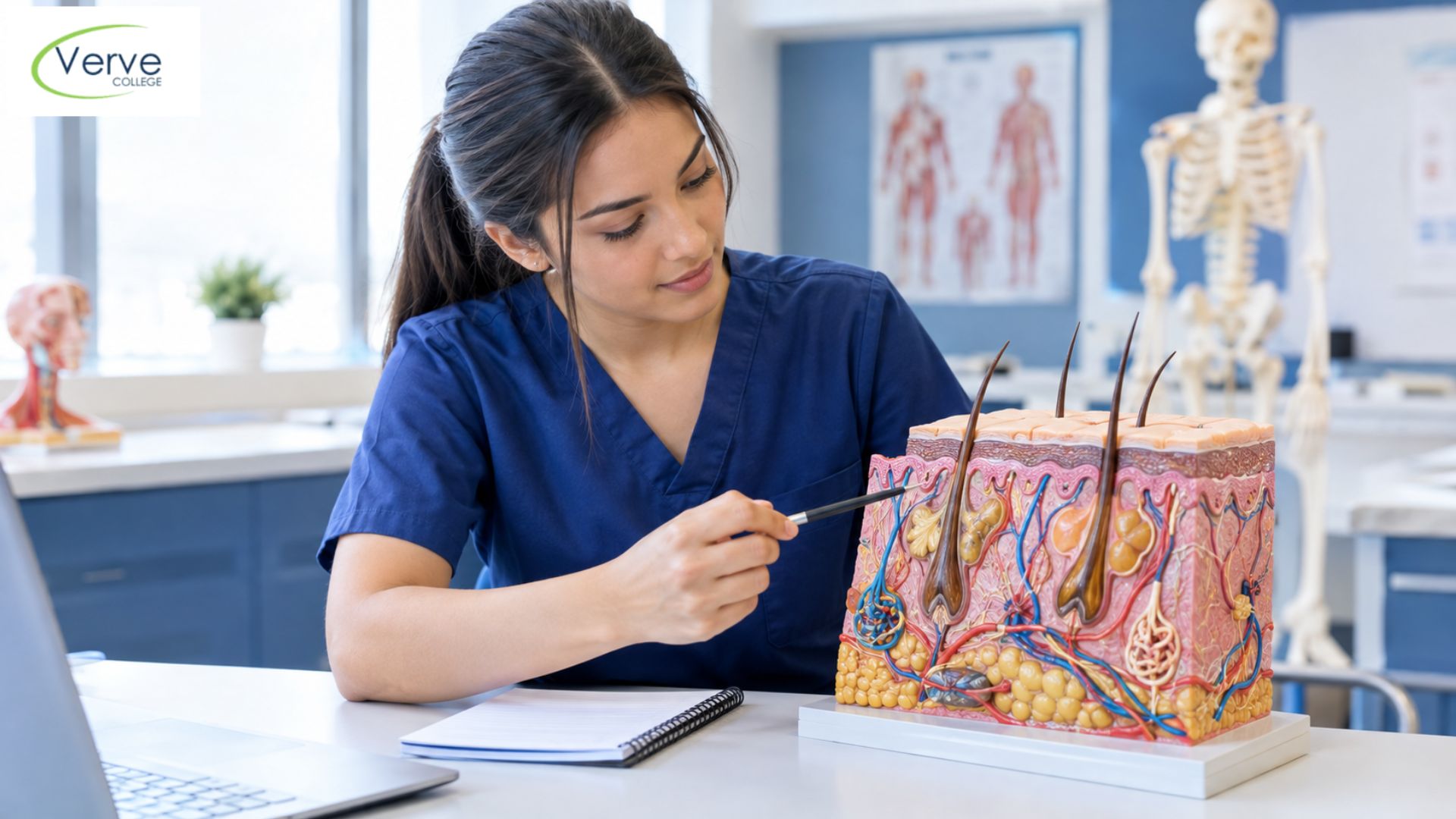
The integumentary system is the body’s outer covering, and it does far more than hold everything in place. A solid integumentary system nursing guide starts with the skin and its accessory structures, including hair, nails, sweat glands, and sebaceous glands. Together, these structures protect the body, help regulate temperature, provide sensory information, and support healing. For nursing students, understanding this system is the first step toward recognizing what healthy skin looks like and noticing when something has changed. This article explains the skin’s layers, its functions, and why skin observation matters in patient care.
Key Takeaways
Here are the main points to remember:
The integumentary system includes the skin and its accessory structures, such as hair, nails, and glands. The epidermis, dermis, and hypodermis have different structures and roles, and the hypodermis is technically beneath the skin rather than part of it. The system supports protection, temperature regulation, sensation, vitamin D production, and immune defense. Skin assessment is an important part of nursing observation, but findings must always be interpreted in context and reported according to facility protocol.
What Is the Integumentary System?
The integumentary system is the organ system made up of the skin and the structures attached to it. The skin is the largest organ of the body, forming a protective barrier between the internal environment and the outside world. Its accessory structures include hair, nails, sweat glands, and sebaceous glands. Each contributes to the skin’s protective and regulatory roles.
Hair helps protect certain areas of the body and contributes to sensation. Nails protect the tips of the fingers and toes and help with fine touch and grasping. Sweat glands release fluid onto the skin surface to help cool the body. Sebaceous glands release an oily substance called sebum that helps keep the skin and hair moist and flexible.
What Are the Main Layers of the Skin?
Anatomy courses commonly describe three layers: the epidermis, the dermis, and the hypodermis. Each has a distinct structure and purpose.
Epidermis
The epidermis is the outermost layer. It is made mostly of closely packed epithelial cells, many of which contain keratin, a tough protein that helps waterproof and protect the skin. The epidermis forms a barrier against microorganisms, chemicals, and physical damage. It also contains melanocytes, which produce melanin, the pigment that influences skin color and helps protect deeper tissues from ultraviolet light.
Dermis
The dermis lies beneath the epidermis and is much thicker. It contains connective tissue that gives the skin strength and elasticity, along with blood vessels, nerve endings, hair follicles, and many glands. Blood vessels in the dermis help supply nutrients to the skin and play a role in temperature regulation. Nerve endings detect touch, pressure, pain, and temperature.
Hypodermis
The hypodermis, also called the subcutaneous tissue, lies beneath the dermis. It is made largely of fat and connective tissue. Although it is often discussed alongside the skin, it is not technically part of the skin itself. The hypodermis cushions the body, insulates it from temperature changes, and anchors the skin to deeper structures such as muscles and bones.
What Are the Main Functions of the Integumentary System?
The integumentary system performs several important jobs at the same time.
Protection: The skin shields the body from physical injury, many microorganisms, and excessive water loss. Its layered structure makes it a strong first line of defense.
Temperature regulation: Sweat glands release moisture that cools the body as it evaporates. The skin’s blood vessels widen or narrow to release or retain heat, which helps keep the body’s core temperature stable.
Sensation: Receptors in the skin detect touch, pressure, vibration, pain, and temperature. This sensory input helps the body respond quickly to its environment.
Vitamin D production: When skin is exposed to appropriate ultraviolet light, it can produce vitamin D, which the body uses in calcium absorption and bone health.
Immune defense and repair: The skin contains immune cells that help identify and respond to threats. After an injury, the skin also takes part in wound repair, forming new tissue and closing breaks in the barrier.
What Are the Accessory Structures of the Integumentary System?
The accessory structures extend the skin’s functions and contribute to its daily maintenance.
Hair protects some areas of the body, such as the scalp, and helps detect light touch when it bends. Hair follicles also serve as a site for hair growth and are connected to nerve endings that sense movement.
Nails protect the ends of the fingers and toes, support fine movements, and help with grasping small objects. Healthy nails are an indicator observed during general assessment, though their appearance can be affected by many factors.
Sweat glands are found across most of the body and release sweat through ducts onto the skin surface. Sweat helps regulate temperature and is part of the body’s response to heat and exercise.
Sebaceous glands are usually connected to hair follicles and release sebum. Sebum helps lubricate the skin and hair and creates a slightly protective film on the skin surface.
Why Is the Integumentary System Important in Nursing?
Skin is one of the most visible parts of the body, and nurses observe it during nearly every patient encounter. Learning the integumentary system helps you understand what you are looking at. Nurses observe skin color, temperature, moisture, texture, integrity, swelling, and areas of pressure. Changes in these features can offer clues about circulation, hydration, wound healing, and the presence of possible infection.
Skin findings must always be interpreted in context. A patient’s baseline appearance, age, skin tone, medications, and overall condition all affect what is normal for that individual. For example, a bruise may be expected in one patient and concerning in another. Nurses use skin observations alongside vital signs, patient history, and other assessment findings, and they report significant changes according to facility protocols.
Skin observation also plays a role in preventing harm. Patients who cannot move easily are at risk of pressure injuries, and careful skin assessment helps identify early changes so the healthcare team can respond. Understanding the layers of the skin helps you appreciate why damage to deeper tissues can be serious even when the surface looks only mildly affected.
Common Skin Conditions Nursing Students Should Recognize
Nursing students encounter a range of skin conditions during training. Common examples include pressure injuries, which develop from sustained pressure on tissue; dermatitis, which is inflammation of the skin; burns; wounds; and skin infections. Each condition has different causes, presentations, and management approaches.
This article provides only an introduction to these conditions. Assessment and treatment depend on the patient’s circumstances, the healthcare provider’s orders, and facility protocols. Your instructors will guide you on how to recognize, document, and report these findings in your clinical setting.
How Can Nursing Students Study the Integumentary System Effectively?
Learning skin anatomy is easier when you use active study methods. Start with labeled diagrams that show the epidermis, dermis, and hypodermis, and practice drawing them from memory. Flashcards are useful for learning the names and functions of accessory structures such as sweat glands and sebaceous glands.
A simple comparison table can help you organize what you learn. Create columns for structure, location, and function, then fill in rows for the epidermis, dermis, hypodermis, hair, nails, sweat glands, and sebaceous glands. As you study, connect each concept to a patient scenario. Ask yourself what you would look for in a patient with dry skin, or what changes you might notice in someone who has been immobile for several days.
Finally, review the integumentary system alongside other body systems. The skin works closely with the circulatory, nervous, and immune systems, so understanding those connections deepens your learning. Building this foundation in the anatomy and physiology for nursing students program can make later clinical topics easier to understand. Once you have a solid grasp of the basics, you can apply them to practice in the practical nursing program, where skin assessment becomes a daily part of patient care. The skin also plays a role in homeostasis in human biology, since it helps keep the body’s internal conditions stable. Many students also find that understanding the function of the lymphatic system helps explain how the skin contributes to immune defense.
Get Your Nursing Career Training Readiness Score Now!
Frequently Asked Questions
What organs and structures make up the integumentary system?
The integumentary system includes the skin, hair, nails, sweat glands, and sebaceous glands. Together these structures protect the body, help regulate temperature, provide sensory information, and support wound repair.
What are the three main layers commonly discussed when studying the skin?
The epidermis, dermis, and hypodermis are commonly discussed. The epidermis is the outer protective layer, the dermis lies beneath it and contains blood vessels and nerves, and the hypodermis is the subcutaneous tissue beneath the skin. The hypodermis is often studied with the skin but is not technically part of it.
Why should nursing students study the integumentary system?
Understanding the integumentary system helps nursing students learn skin anatomy and recognize changes in skin condition during patient observation and assessment. Knowing how the skin protects and regulates the body also helps students understand why skin changes can signal broader concerns about circulation, hydration, wound healing, or infection, which should always be reported and evaluated in context.
Most Popular Blogs Posts
Integumentary System Nursing Guide: Skin Anatomy…
October 28, 2026 Read More
Practical Nursing Program Accreditation Guide: What…
October 27, 2026 Read More
Practical Nursing Class Schedule Guide: How…
October 26, 2026 Read More
Hypoxia in Nursing Guide: Causes, Signs,…
October 22, 2026 Read More