- Oak Brook:(630) 705-9999
- Chicago:(312) 920-8822
- Email:inquiry@vervecollege.edu
- Make a Payment
 Sign up
 Login
Login
- Home
- Programs
- Admission
- Resources
- ATI Entrance Exam Resources
- New E-Digital Library
- Refer a Friend
- School Newsletter
- Events
- Employers
- Job-Network
- Alpha Beta Kappa Candidates
- Verve College Library
- Graduation and Pinning Ceremony Photo Galleries
- Textbook Information
- Career Services
- Tutoring
- School Catalog
- FAQ
- Constitution Day Program
- Alumni
- Verve College Plans
- Financial Aid
- HEERF Reporting
- Satisfactory Academic Progress
- Apply For Financial Aid
- Net Price Calculator
- Return of Title IV Funds (R2T4)
- Financial Aid Office Code of Conduct
- Contact
- FAQs
- Verification Policy
- Vaccination Policy
- Student Right-to-Know Act
- Misrepresentation
- Information Security Program
- Academic Award Year
- Availability of Employee
- Cost of Attendance
- Health & Safety Exemption Requirement
- Students Rights and Responsibilities
- Leave of Absence
- Pell Formula
- Military Students
- Grants/ Scholarship Policy
- Contact Us
- Testimonials
- Blog
Is a Nursing Career Right For You?
Take The Free Quiz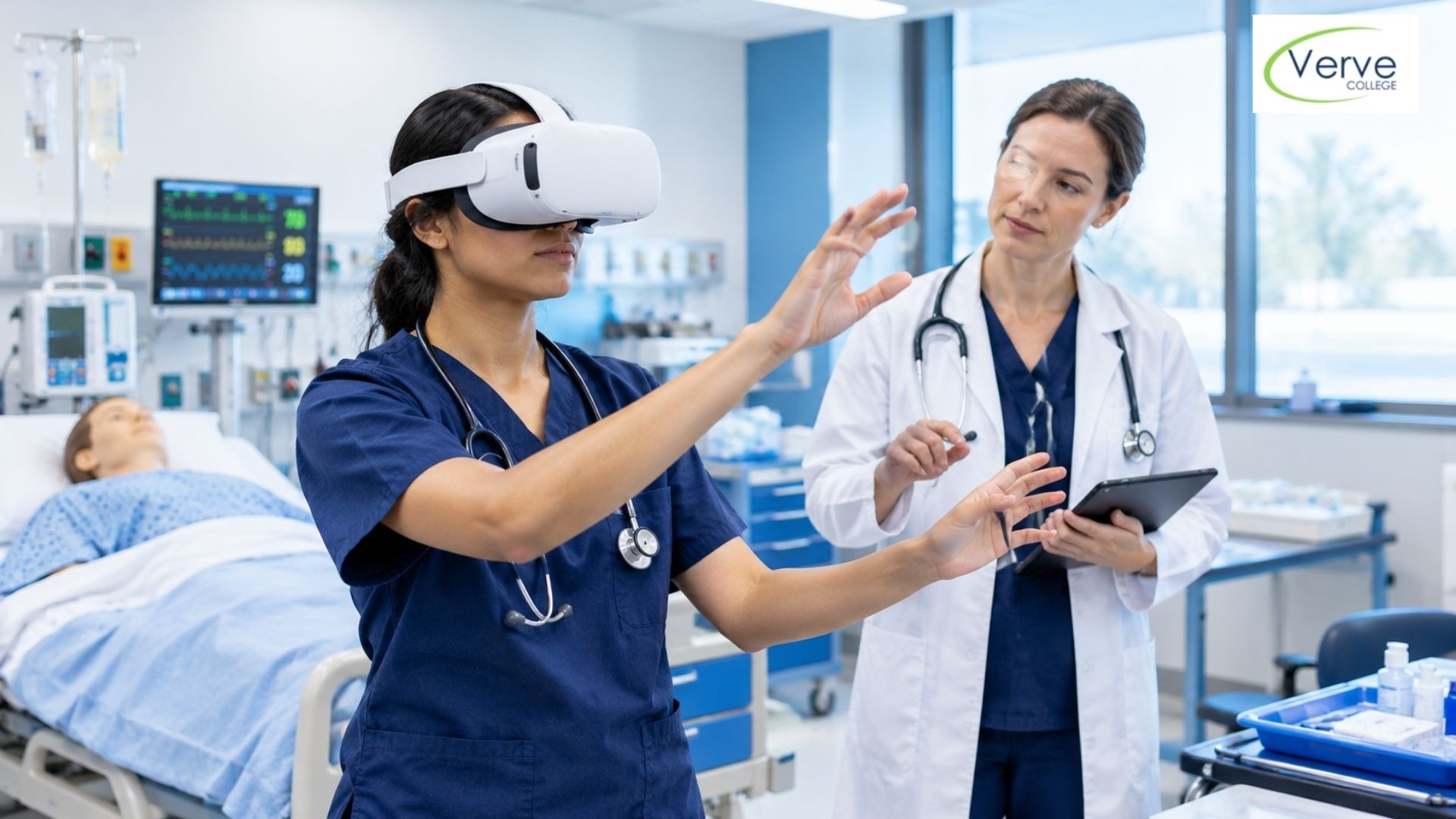
Virtual Reality in Nursing : How VR Can Support Student Learning
Virtual Reality in Nursing : How VR Can Support Student Learning
Technology is transforming nursing education. Beyond traditional classrooms and clinical settings, nursing programs are increasingly incorporating virtual reality to expand student learning opportunities. Virtual reality in nursing creates immersive environments where students practice clinical skills, make decisions, and experience realistic patient-care scenarios. VR offers unique advantages complementing classroom instruction, skills labs, simulations, and clinical practice. For prospective nursing students, understanding how virtual reality in nursing education works reveals how modern programs prepare students for real-world practice. As healthcare evolves, technology-enhanced learning becomes an increasingly important component of nursing education.
Key Takeaways
- Virtual reality in nursing creates immersive learning environments where students practice clinical situations from a first-person perspective.
- VR can support clinical reasoning, patient assessment, communication, prioritization, and decision-making skills.
- Virtual reality in nursing education allows repeated practice of scenarios and immediate feedback in controlled environments.
- VR complements but does not replace classroom instruction, skills labs, high-fidelity simulation, or real clinical experience.
- Different learning environments serve different educational purposes in comprehensive nursing programs.
- Challenges include equipment costs, technology access, motion discomfort for some users, and need for instructor integration.
- When evaluating nursing programs, ask about technology-supported learning options and how they integrate with hands-on practice.
- The most effective nursing education combines multiple learning methods to develop well-rounded clinical competency.
What Is Virtual Reality in Nursing?
Virtual reality in nursing refers to immersive, computer-generated simulations creating three-dimensional clinical environments. Using VR headsets, students enter realistic healthcare settings from a first-person perspective. Rather than observing a high-fidelity simulator externally, students in VR experience patient-care situations as if they were actually in the clinical environment.
Virtual reality in nursing education creates scenarios where students assess patients, make clinical decisions, and respond to changing conditions. The immersive nature of VR creates psychological presence and engagement different from watching scenarios unfold on screens or external observations.
VR scenarios are interactive. Students move through clinical environments, access patient information, perform assessments, and make decisions. The scenario responds to student choices, creating dynamic, personalized learning experiences.
How Is Virtual Reality Used in Nursing Education?
Virtual reality in nursing has multiple educational applications.
Patient Assessment: Students practice assessing patients in realistic environments. They observe patient appearance, movement, and behavior. They interact with vital-sign monitors, electronic health records, and medical equipment.
Clinical Decision-Making: VR scenarios present patient situations requiring clinical judgment. Students must recognize problems, prioritize concerns, and decide on appropriate nursing interventions.
Emergency Scenarios: Virtual reality in nursing allows practicing emergency situations that students might not encounter frequently. Students can rehearse responding to cardiac arrests, severe allergic reactions, respiratory distress, and other crises.
Patient Communication: Some VR scenarios include avatar patients with whom students practice communication. Students explain procedures, obtain consent, address concerns, and develop therapeutic communication skills.
Procedural Practice: VR can allow practicing certain procedures in simulated environments before performing on actual patients or high-fidelity simulators.
Environmental Familiarization: Students new to healthcare can explore simulated healthcare environments, reducing anxiety about unfamiliar settings. This is particularly valuable for career changers and adult learners.
Team-Based Scenarios: Some VR programs allow multiple students to work together in shared virtual environments, practicing teamwork and communication.
What Can Nursing Students Practice With VR?
Virtual reality in nursing education supports developing multiple competencies.
Clinical Reasoning: VR scenarios present complex patient situations requiring analysis, interpretation, and decision-making. Students develop the critical thinking essential for nursing practice.
Patient Assessment: Students practice gathering subjective and objective assessment data, recognizing normal versus abnormal findings, and prioritizing assessment information.
Communication Skills: Whether communicating with patients or healthcare team members, VR scenarios develop clear, effective communication essential in nursing.
Prioritization: VR scenarios can present multiple patient problems requiring students to decide which need immediate attention and which can wait.
Safety Awareness: Students recognize safety concerns in virtual environments and learn to prevent errors, infections, and injuries.
Decision-Making: Real-time scenario responses allow students to see consequences of their decisions, learning through experience rather than observation alone.
Repetition Without Risk: Students can repeat scenarios multiple times, learning from mistakes and practicing different approaches, all without patient risk.
Benefits of Virtual Reality Nursing Education
Virtual reality in nursing education offers distinct advantages.
Immersive Learning: First-person immersion creates engagement and psychological presence different from external observation. Students feel like they’re actually in clinical situations.
Repeated Practice: Students can access VR scenarios multiple times, practicing until they develop competency. This repetition builds confidence and automatic responses for emergencies.
Controlled Environments: VR provides safe spaces for error. Students learn from mistakes without consequences, building psychological safety essential for learning.
Engagement: The interactive nature of VR appeals to many learners, particularly younger students expecting technology-integrated education.
Exposure to Diverse Scenarios: VR programs can include scenarios representing patient populations and clinical situations students might not encounter frequently in clinical practice.
Consistent Scenario Delivery: Every student encounters standardized scenarios, ensuring consistent learning opportunities. Clinical experiences vary widely between students.
Immediate Feedback: VR programs can provide automatic feedback on student performance, supplementing instructor feedback.
Virtual Reality in Nursing vs. Traditional Simulation
Understanding how virtual reality in nursing differs from other learning methods clarifies its role in nursing education.
Traditional Classroom: Lectures and discussions provide foundational knowledge. VR cannot replace this knowledge foundation but allows applying knowledge in simulated contexts.
Skills Labs: Hands-on practice with models and equipment develops psychomotor skills and muscle memory. VR provides limited haptic (touch) feedback compared with hands-on practice, though some newer systems are improving tactile simulation.
High-Fidelity Simulation: Sophisticated patient mannequins respond realistically to interventions. Instructors can manually control scenario progression. Students see physical responses to their actions. VR provides similar scenario progression but from an immersive first-person perspective rather than external observation.
Clinical Experience: Real patients, real stakes, and real clinical complexity cannot be fully replicated in any simulation. Nothing replaces learning from experienced nurses while providing actual patient care.
Virtual reality in nursing is not superior to other methods. Rather, it’s complementary. Different learning environments serve different purposes in comprehensive nursing education.
How Virtual Reality Supports Clinical Decision-Making
Virtual reality in nursing education effectively develops clinical decision-making through branching scenarios. Decisions students make alter scenario progression.
A student might assess a patient presenting with chest pain and difficulty breathing. Based on assessment, the student recognizes possible myocardial infarction. The decision to call the physician quickly might result in faster intervention. A delayed decision might show patient deterioration. The scenario demonstrates consequences of clinical decisions in real time.
This cause-and-effect relationship helps students understand why clinical decisions matter and how assessment findings guide appropriate interventions. Students develop the clinical reasoning essential in real nursing practice.
Challenges and Limitations of Virtual Reality in Nursing Education
Virtual reality in nursing education has real limitations worth acknowledging.
Equipment Costs: VR headsets and software represent significant educational investments. Not all programs can afford robust VR capabilities.
Technology Access: Students need access to equipment for learning to occur. Limited availability reduces the benefit.
Technical Difficulties: Technology sometimes fails. Technical issues interrupt learning and frustrate students.
Learning Curve: Some students need time adjusting to VR interfaces. Motion sickness affects certain users, though this is decreasing with technology improvements.
Limited Haptic Feedback: Current VR systems provide limited tactile sensation compared with hands-on practice. Students practicing IV starts, wound care, or other hands-on skills benefit from actual physical practice.
Instructor Integration: VR is most effective when instructors thoughtfully integrate it into curricula and provide guidance on applying VR learning to clinical practice. Poorly integrated VR becomes disconnected from core nursing education.
Not a Complete Solution: VR cannot replace clinical experience with real patients and hands-on skill development with actual equipment and procedures.
How Classroom, Simulation, VR, and Clinical Learning Work Together
Comprehensive nursing education combines multiple learning approaches. Effective programs integrate classroom instruction, skills labs, simulation, virtual reality, and clinical experience into a coherent progression.
One possible progression: Students learn concepts in classroom. They practice basic skills in skills labs with equipment and models. They encounter complex scenarios in simulation or VR, applying knowledge and skills to realistic situations. They apply everything in clinical practice with real patients under experienced nurse supervision. Throughout, they reflect on experiences, solidifying learning.
Different learning environments develop different competencies. Classroom builds knowledge. Skills labs develop psychomotor skills. Simulation and VR develop decision-making and clinical reasoning. Clinical practice develops the full scope of nursing competency working with real patients.
Understanding classroom and clinical learning reveals how nursing education works best when coordinating multiple approaches rather than relying on single methods.
Integrating Virtual Reality Into Practical Nursing Programs
For practical nursing students, practical nursing education in Illinois increasingly includes technology-supported learning alongside traditional methods.
Virtual reality in nursing allows practicing scenarios LPNs encounter regularly: patient assessment, vital-sign monitoring, medication safety, infection prevention, and communication. LPNs work in fast-paced settings requiring quick assessment and decision-making. VR practice develops these skills efficiently.
Quality practical nursing programs integrate virtual reality in nursing education thoughtfully, recognizing it as one tool supporting comprehensive skill development, not as a replacement for hands-on nursing skills training.
Virtual Reality and Flexible Learning Programs
For working adults pursuing nursing through flexible nursing education options, virtual reality offers advantages.
VR can be accessed remotely, supporting hybrid learning models. Students with limited clinical placement access might use VR for scenario practice between in-person sessions. This flexibility helps working adults balance education with employment and family responsibilities.
However, hybrid programs must still include robust hands-on practice and real clinical experiences. VR should supplement, not replace, essential hands-on learning and clinical practice.
What Should Students Look for in a Technology-Enabled Nursing Program?
When evaluating nursing programs, ask about technology-supported learning.
Skills Lab Access: Does the program provide adequate skills lab access for hands-on practice? Are equipment and supplies sufficient?
Simulation Opportunities: What simulation equipment does the program use? How frequently do students participate in simulations?
Virtual Reality Integration: Does the program use VR? How is it integrated into the curriculum? How frequently do students access VR scenarios?
Technology Support: Are instructors trained in technology-supported learning? Do they help students apply VR learning to clinical practice?
Clinical Experiences: Most importantly, does the program provide adequate real clinical experiences? Technology should supplement, never replace, clinical practice.
Hands-On Practice: Are students provided time for developing psychomotor skills through hands-on practice?
Balanced Approach: Does the program thoughtfully integrate multiple learning methods or seem over-reliant on technology?
Key Takeaways
- Virtual reality in nursing creates immersive learning through first-person scenario experiences in realistic clinical environments.
- VR develops clinical reasoning, decision-making, patient assessment, and communication skills through interactive scenarios.
- Virtual reality in nursing education allows repeated practice and learning from mistakes without patient risk.
- Different learning environments serve different educational purposes in comprehensive nursing programs.
- VR complements but does not replace classroom instruction, skills labs, high-fidelity simulation, or clinical experience.
- Challenges include equipment costs, technology access, limited haptic feedback, and need for thoughtful curriculum integration.
- The most effective nursing education combines multiple learning methods rather than relying on single approaches.
- When choosing nursing programs, evaluate how technology-supported learning integrates with hands-on practice and real clinical experiences.
Conclusion
Virtual reality in nursing education represents an expanding opportunity for nursing students to practice clinical skills, develop decision-making abilities, and experience realistic patient-care situations in immersive, interactive environments. As technology advances, VR will likely play an increasingly important role in nursing education. However, virtual reality in nursing education works best as part of comprehensive approaches combining classroom instruction, skills labs, high-fidelity simulation, and real clinical practice. The most effective nursing programs use virtual reality thoughtfully, integrating it with other learning methods to develop well-prepared, competent nurses. As you explore nursing programs, look for schools balancing technology-supported learning with essential hands-on practice and robust clinical experiences.
Get Your Nursing Career Training Readiness Score Now!
Frequently Asked Questions
What is virtual reality in nursing education?
Virtual reality in nursing education uses VR headsets and immersive computer simulations to create three-dimensional clinical learning environments. Students experience patient-care situations from a first-person perspective, interact with virtual patients and equipment, and make clinical decisions. The scenarios respond to student choices, creating personalized, dynamic learning experiences different from observing simulations externally.
What can nursing students practice using virtual reality in nursing?
Nursing students can practice patient assessment, vital-sign monitoring, clinical decision-making, recognizing emergency situations, communicating with patients and healthcare teams, prioritizing multiple patient problems, recognizing safety concerns, and practicing complex clinical scenarios. Virtual reality in nursing allows repeated practice of situations students might encounter infrequently in clinical practice, developing confidence and competency.
How does virtual reality in nursing education compare with high-fidelity simulation and clinical practice?
Virtual reality in nursing offers immersive, first-person experiences and accessible scenario repetition. High-fidelity simulation provides realistic external observation with complex mannequins responding to interventions. Clinical practice provides real patients, real stakes, and comprehensive learning impossible to replicate. Each serves different educational purposes. Most effective nursing programs combine all three: VR and simulation for controlled practice, plus real clinical experience with actual patients.
Most Popular Blogs Posts

Cognitive Development: How Thinking Changes Across…
September 28, 2026 Read MoreVirtual Reality in Nursing : How…
September 28, 2026 Read More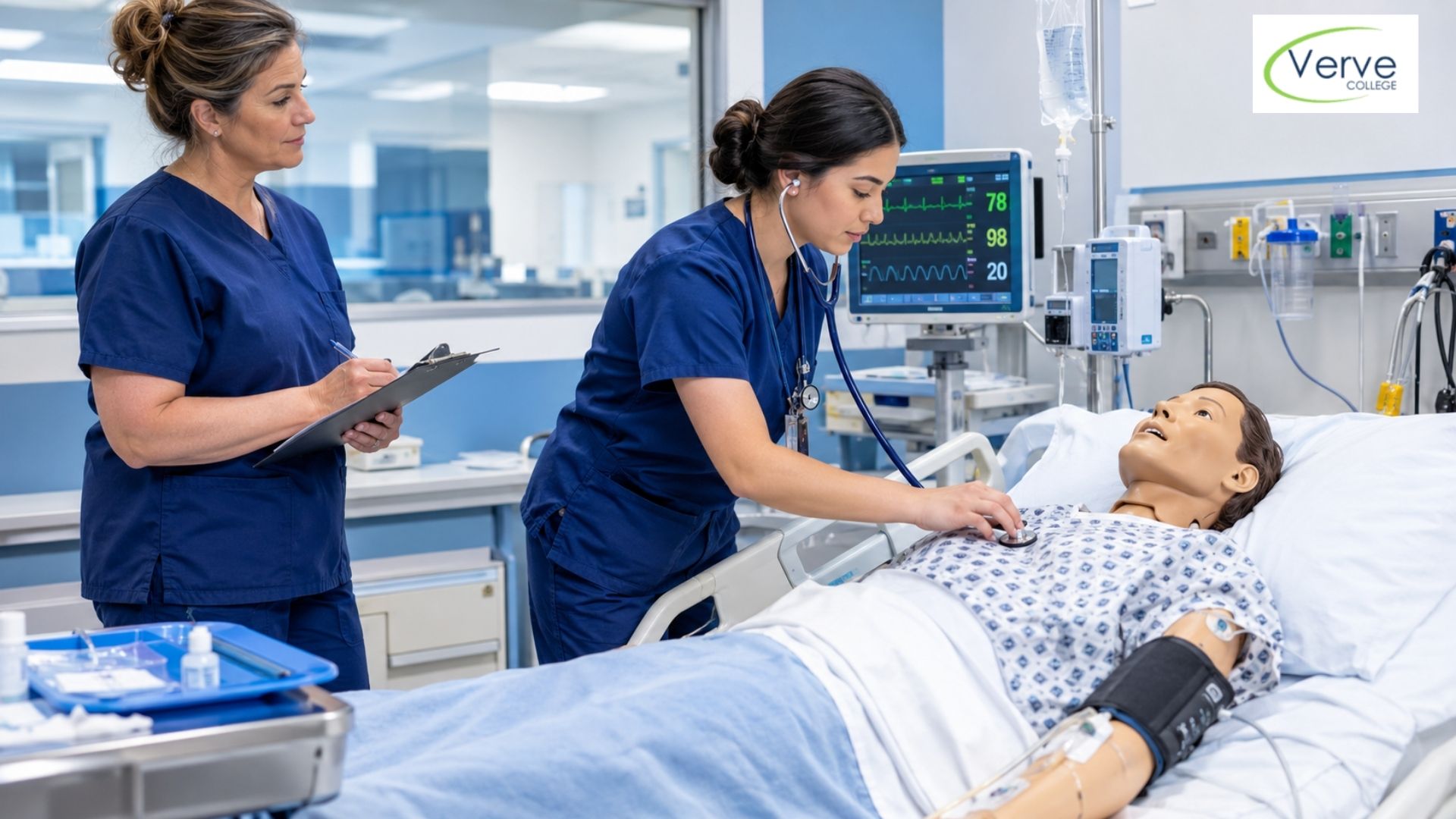
High-Fidelity Simulation in Nursing: How Realistic…
September 24, 2026 Read More
How to Compare Nursing Programs Before…
September 23, 2026 Read More