- Oak Brook:(630) 705-9999
- Chicago:(312) 920-8822
- Email:inquiry@vervecollege.edu
- Make a Payment
 Sign up
 Login
Login
- Home
- Programs
- Admission
- Resources
- ATI Entrance Exam Resources
- New E-Digital Library
- Refer a Friend
- School Newsletter
- Events
- Employers
- Job-Network
- Alpha Beta Kappa Candidates
- Verve College Library
- Graduation and Pinning Ceremony Photo Galleries
- Textbook Information
- Career Services
- Tutoring
- School Catalog
- FAQ
- Constitution Day Program
- Alumni
- Verve College Plans
- Financial Aid
- HEERF Reporting
- Satisfactory Academic Progress
- Apply For Financial Aid
- Net Price Calculator
- Return of Title IV Funds (R2T4)
- Financial Aid Office Code of Conduct
- Contact
- FAQs
- Verification Policy
- Vaccination Policy
- Student Right-to-Know Act
- Misrepresentation
- Information Security Program
- Academic Award Year
- Availability of Employee
- Cost of Attendance
- Health & Safety Exemption Requirement
- Students Rights and Responsibilities
- Leave of Absence
- Pell Formula
- Military Students
- Grants/ Scholarship Policy
- Contact Us
- Testimonials
- Blog
Is a Nursing Career Right For You?
Take The Free Quiz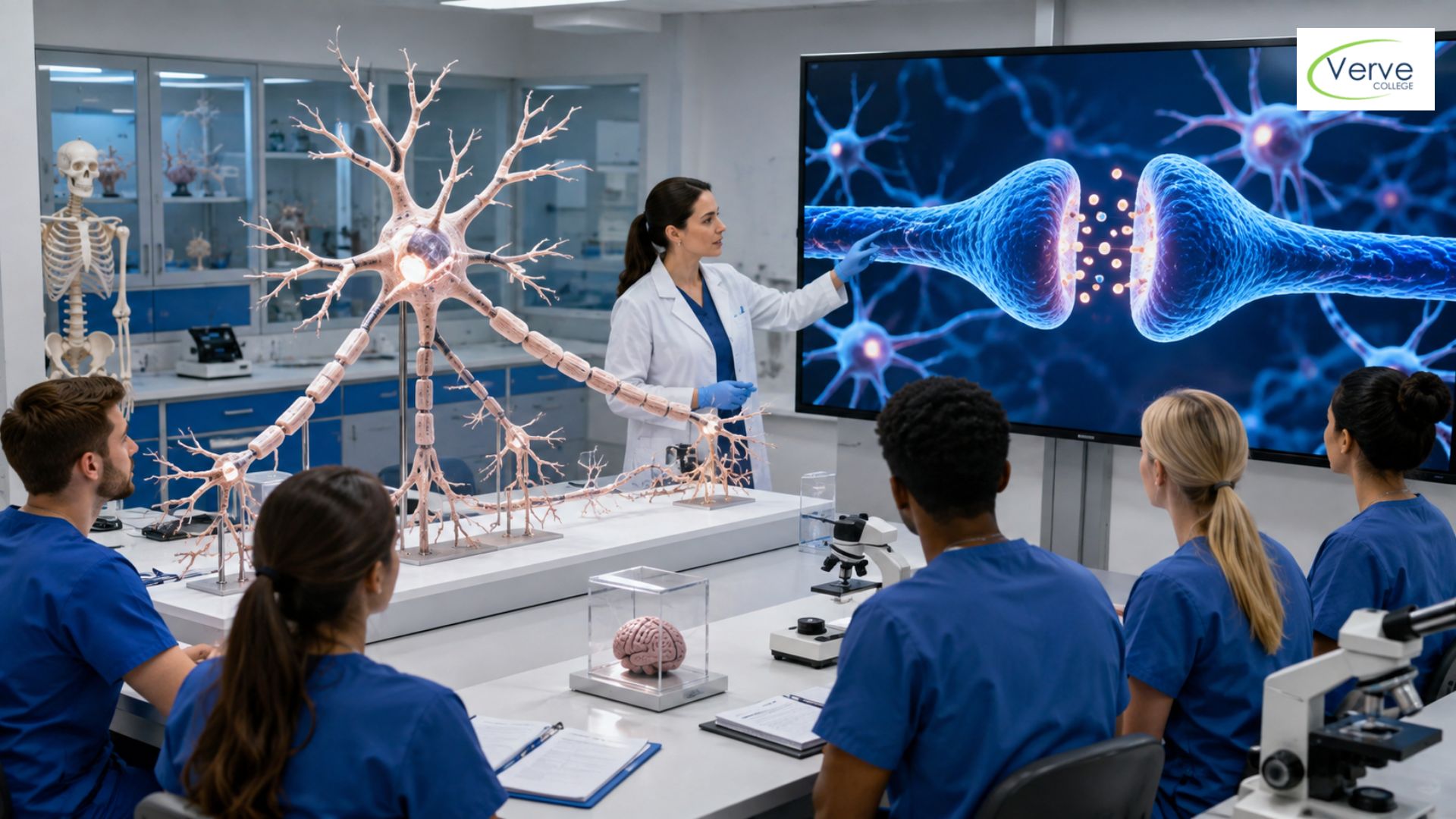
How Synapses Send Signals Through Your Body: A Nursing Student’s Guide
How Synapses Send Signals Through Your Body: A Nursing Student’s Guide
Your brain processes thousands of thoughts, decisions, and sensations every single second. None of that happens without synapses. These tiny connections between neurons are where the real work of your nervous system takes place. Understanding how synapses send signals is one of the most important foundations for nursing and healthcare careers because it explains movement, sensation, memory, learning, and almost everything your nervous system does. In this guide, we’ll break down how synapses work, why they matter in clinical practice, and why every nursing student should master this concept.
Key Takeaways
- Synapses are the communication points between neurons where electrical signals convert into chemical signals that jump across a tiny gap called the synaptic cleft
- The process involves the presynaptic neuron releasing neurotransmitters that bind to receptors on the postsynaptic membrane, creating the foundation for all nerve communication
- Most synapses are chemical synapses, but electrical synapses also exist and work through direct cell-to-cell connections
- Neurotransmitters like acetylcholine, dopamine, serotonin, GABA, and glutamate create either excitatory (activate) or inhibitory (quiet down) responses in the receiving neuron
- Disruptions in synaptic transmission underlie many neurological conditions, making this knowledge critical for understanding patient care
- If you’re exploring anatomy and physiology classes near me, mastering synapses now will strengthen your foundation for advanced nursing courses
What Are Synapses? The Connection Point for Nerve Signals
A synapse is where two neurons meet and communicate. The neuron sending the message is called the presynaptic neuron, and the one receiving it is the postsynaptic neuron. Between them sits a tiny space called the synaptic cleft, usually only about 20 nanometers wide. This gap is where the magic happens: electrical signals from one neuron are converted into chemical signals that cross the gap and trigger a response in the next neuron.
Think of synapses as relay stations in a long-distance communication network. Your nervous system has roughly 100 billion neurons, and each one can connect to thousands of other neurons through synapses. That creates trillions of potential pathways for information to flow through your body.
How Synapses Work: The Step-by-Step Process
Understanding synaptic transmission means following a signal from start to finish. Here’s how it happens:
Step 1: The Action Potential Arrives at the Axon Terminal
When a neuron fires, an electrical impulse called an action potential travels down its axon toward the axon terminal (also called the synaptic terminal or synaptic knob). This is the bulbous end of the presynaptic neuron that sits just before the synaptic cleft. The arrival of the action potential triggers the next step almost instantly.
Step 2: Calcium Channels Open and Calcium Floods In
As the action potential reaches the axon terminal, voltage-gated calcium channels open. Calcium ions rush into the terminal, and this influx is the critical trigger for what happens next. Without this calcium, the whole process stops.
Step 3: Neurotransmitter Release into the Synaptic Cleft
The calcium causes small packages called synaptic vesicles (which contain neurotransmitters) to fuse with the presynaptic membrane and dump their contents into the synaptic cleft. This happens in milliseconds. Neurotransmitters are chemical messengers that will carry the signal across the gap to the waiting postsynaptic neuron.
Step 4: Neurotransmitters Bind to Receptors on the Postsynaptic Membrane
On the postsynaptic side, the receiving neuron has receptors waiting on its membrane. These are like locks, and neurotransmitters are the keys. When a neurotransmitter binds to the right receptor, it opens ion channels and allows ions to flow in or out of the postsynaptic cell.
Step 5: A Response Is Generated in the Receiving Neuron
Depending on which ions flow and which direction they flow, the postsynaptic neuron becomes either more or less likely to fire its own action potential. This creates either an excitatory signal (which encourages firing) or an inhibitory signal (which discourages firing).
Step 6: Neurotransmitter Cleanup
The signal doesn’t last forever. Neurotransmitters are either reabsorbed into the presynaptic terminal (a process called reuptake), broken down by enzymes, or diffuse away from the synapse. This cleanup is essential because it allows the synapse to reset and be ready for the next signal.
Chemical Synapses vs. Electrical Synapses
Most communication in your body happens at chemical synapses, which is what we’ve been describing. But electrical synapses also exist, especially in cardiac muscle and smooth muscle.
Electrical synapses work through gap junctions, which are direct connections between cells that allow ions to flow straight from one cell to the next. There’s no synaptic cleft and no neurotransmitters involved. These synapses are faster than chemical synapses, which is why they’re crucial in the heart. When your heart needs to beat as a coordinated unit, electrical synapses make sure the signal spreads quickly across all the cardiac muscle cells.
Chemical synapses, by contrast, are slower but much more flexible. They can be adjusted and fine-tuned, which is why they’re involved in learning, memory, and the complex processing your brain does.
Excitatory vs. Inhibitory Signals: How Neurons Make Decisions
Every signal a neuron receives from another neuron is either excitatory or inhibitory. These two types of signals work together to control everything your nervous system does.
Excitatory signals make it more likely that the postsynaptic neuron will fire. Common excitatory neurotransmitters include glutamate and acetylcholine. When these bind to their receptors, positively charged ions flow into the cell, depolarizing the membrane and pushing it closer to firing an action potential.
Inhibitory signals do the opposite. They make it less likely the postsynaptic neuron will fire. GABA (gamma-aminobutyric acid) and glycine are the main inhibitory neurotransmitters. When they bind to their receptors, negatively charged ions flow in or positive ions flow out, hyperpolarizing the membrane and moving it further from firing.
In reality, every neuron is receiving dozens, hundreds, or even thousands of signals at once from different synapses. Your brain constantly adds up all the excitatory and inhibitory signals to decide whether that neuron will fire. This process is called summation, and it’s the basis of decision-making in your nervous system.
Key Neurotransmitters: The Chemical Messengers You Need to Know
Different neurotransmitters create different effects, and nurses need to understand how they work because many medications target specific neurotransmitter systems.
Acetylcholine controls muscle movement and is used throughout the autonomic nervous system. It’s essential for learning and memory. Many medications in the operating room and ICU work on acetylcholine, which is why understanding its role is clinically important.
Dopamine is involved in movement, motivation, pleasure, and attention. Problems with dopamine signaling are involved in Parkinson’s disease and depression.
Serotonin regulates mood, sleep, appetite, and pain perception. Most antidepressants work by increasing serotonin levels at synapses.
GABA is the brain’s primary inhibitory neurotransmitter. It’s calming and helps prevent overactivity. Many medications used to reduce anxiety or prevent seizures work by enhancing GABA signaling.
Glutamate is the brain’s primary excitatory neurotransmitter and is involved in learning and memory formation. Too much glutamate activity can actually damage neurons, which is relevant to understanding stroke and traumatic brain injury.
Why Synapses Matter in Real Nursing Practice
Synaptic transmission connects directly to patient care in ways that might not be obvious at first. Reflexes depend on synapses. When you touch a hot stove and pull your hand away instantly, that’s a reflex arc working through synapses in your spinal cord. Movement depends on acetylcholine synapses between nerves and muscles. Sensation of touch, pain, temperature, and position all get processed through synapses in your spinal cord and brain.
Memory and learning happen because repeated activation of synapses actually strengthens those connections. This is called synaptic plasticity, and it’s the basis for how your brain changes and adapts. The autonomic nervous system, which controls heart rate, breathing, digestion, and blood pressure, works through synaptic transmission throughout your body.
When synaptic transmission goes wrong, neurological conditions develop. Depression and anxiety involve imbalances in dopamine, serotonin, and GABA. Parkinson’s disease involves loss of dopamine-producing neurons. Alzheimer’s disease involves problems with acetylcholine synapses and glutamate dysfunction. Seizures involve too much excitatory activity and not enough inhibitory activity at synapses.
Building Your Foundation for Nursing Success
If you’re preparing for a nursing career, understanding synapses gives you a concrete mental model for how the nervous system actually works. It’s not abstract or theoretical. Every medication you’ll administer, every neurological assessment you’ll perform, and every patient symptom you’ll encounter connects back to synaptic transmission in some way.
Many students feel more confident in anatomy and physiology when they have a strong grasp of nervous system basics. If you’re searching for anatomy classes near me, consider that foundational preparation now. The clearer you understand synapses, the easier advanced nursing concepts will become. Whether you’re starting with practical nursing programs in Illinois or planning to pursue further education later, this knowledge will serve you throughout your career.
Conclusion
Synapses are the fundamental communication units of your nervous system. Every thought, movement, sensation, and emotion flows through synaptic transmission. The conversion of electrical signals into chemical signals at the synapse allows billions of neurons to coordinate and create everything your body does for nursing and healthcare students, understanding how synapses work isn’t just academic knowledge. It’s the foundation for understanding patient pathology, medication mechanisms, clinical assessments, and real-world patient care. When you master synapses, you unlock a deeper understanding of your own body and the patients you’ll serve. Take time now to cement this knowledge, because it will strengthen every nursing concept that comes next.
Get Your Nursing Career Training Readiness Score Now!
Frequently Asked Questions
What’s the difference between a synapse and a neuron?
A neuron is a single nerve cell with branches that extend out to connect with other neurons. A synapse is the connection point between two neurons, where communication actually happens. You could think of neurons as the individual telephones, and synapses as the wires that let one telephone call another.
Can a single neuron have multiple synapses?
Absolutely. A single neuron can have thousands of synapses. One neuron might receive synaptic input from hundreds of different neurons, and its axon might form synapses with hundreds of other neurons. This creates the complex networks that allow your brain to process information and make decisions.
Why do I need to understand synapses if I’m becoming a nurse and not a neuroscientist?
Many common medications work by changing how synapses function. Understanding the mechanism behind these medications makes you a better nurse who can explain side effects, interactions, and expected outcomes to patients. Plus, neurological assessments and recognizing signs of nervous system problems all flow back to synaptic function. This knowledge directly impacts patient safety and care quality.
Most Popular Blogs Posts

High-Fidelity Simulation in Nursing: How Realistic…
September 24, 2026 Read More
How to Compare Nursing Programs Before…
September 23, 2026 Read More
Thermoregulation: How the Body Regulates Temperature
September 23, 2026 Read More
Nursing Grants vs Scholarships: What’s the…
September 22, 2026 Read More