- Oak Brook:(630) 705-9999
- Chicago:(312) 920-8822
- Email:inquiry@vervecollege.edu
- Make a Payment
 Sign up
 Login
Login
- Home
- Programs
- Admission
- Resources
- ATI Entrance Exam Resources
- New E-Digital Library
- Refer a Friend
- School Newsletter
- Events
- Employers
- Job-Network
- Alpha Beta Kappa Candidates
- Verve College Library
- Graduation and Pinning Ceremony Photo Galleries
- Textbook Information
- Career Services
- Tutoring
- School Catalog
- FAQ
- Constitution Day Program
- Alumni
- Verve College Plans
- Financial Aid
- HEERF Reporting
- Satisfactory Academic Progress
- Apply For Financial Aid
- Net Price Calculator
- Return of Title IV Funds (R2T4)
- Financial Aid Office Code of Conduct
- Contact
- FAQs
- Verification Policy
- Vaccination Policy
- Student Right-to-Know Act
- Misrepresentation
- Information Security Program
- Academic Award Year
- Availability of Employee
- Cost of Attendance
- Health & Safety Exemption Requirement
- Students Rights and Responsibilities
- Leave of Absence
- Pell Formula
- Military Students
- Grants/ Scholarship Policy
- Contact Us
- Testimonials
- Blog
Is a Nursing Career Right For You?
Take The Free Quiz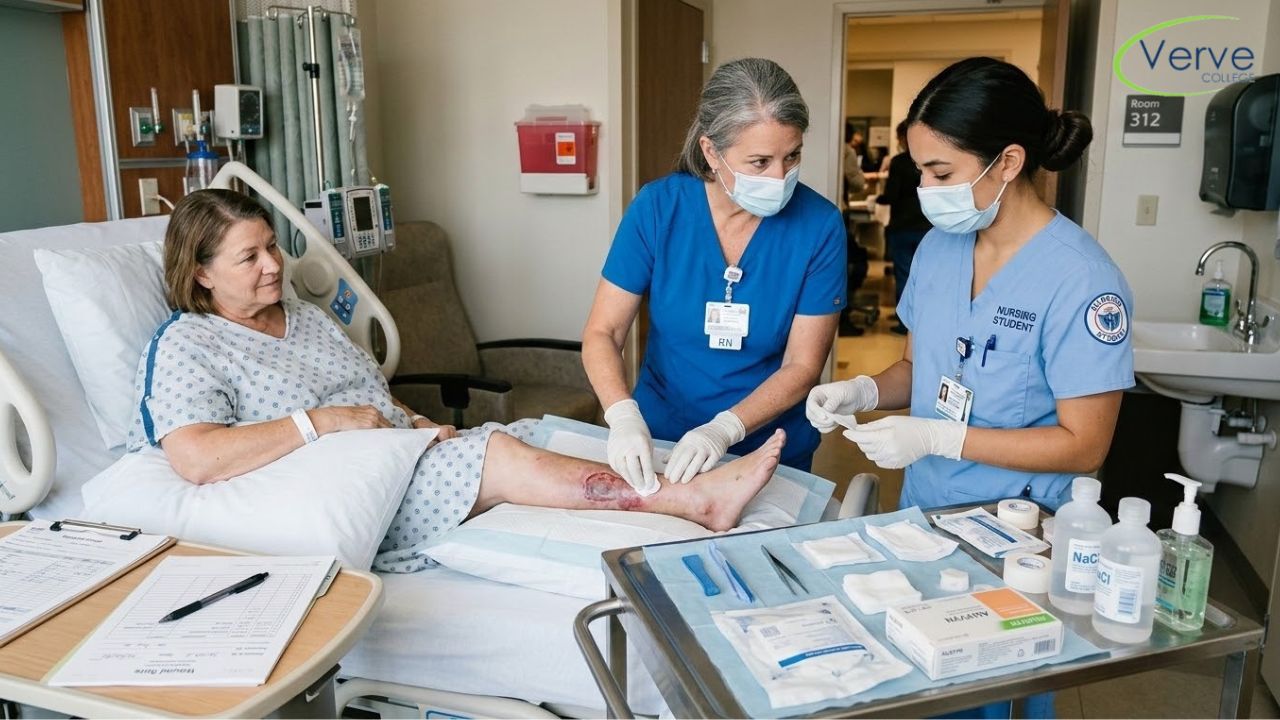
How Future LPNs Can Master Wound Care Nursing Interventions
How Future LPNs Can Master Wound Care Nursing Interventions
Managing physical injuries is a critical skill that directly impacts how fast a patient recovers. As a future nurse, you will treat everything from minor surgical cuts to severe chronic pressure sores. Learning proper wound care nursing interventions ensures you can prevent infections and promote safe, healthy healing. This guide will help you understand the basics of assessing, cleaning, and protecting various types of skin injuries.
Key Takeaways
- Learn how to identify the different stages of tissue healing to track patient progress accurately.
- Understand why detailed wound assessment in nursing is vital for catching early signs of infection.
- Discover the correct wound dressing techniques needed to maintain a sterile and safe clinical environment.
- Find out how mastering foundational knowledge in anatomy and physiology classes prepares you for advanced clinical tasks.
- Recognize the value of practicing these delicate skills in safe simulation labs before treating real patients.
Understanding the Tissue Healing Process
Before you can treat an injury effectively, you must understand how the human body repairs itself. Healing happens in overlapping stages, starting with blood clotting and ending with the rebuilding of new skin tissue. Recognizing these natural phases helps you know if an injury is recovering normally or if it is stalled.
When a wound gets stuck in the inflammatory phase, it often means an infection is brewing beneath the surface. Nurses monitor these stages closely to adjust their daily care plans as needed. Having a strong grasp of bodily systems makes it much easier to predict how a patient will heal over time.
The Basics of Wound Assessment in Nursing
Every successful treatment starts with a thorough and accurate evaluation. When you assess a wound, you will look at its exact size, depth, and the color of the tissue inside. You must also check the surrounding skin for severe redness, unexpected swelling, or unusual warmth.
Evaluating drainage is another crucial step in this daily assessment process. Clear fluid is usually a normal part of healing, but thick or foul smelling discharge is a major red flag for bacterial infection. Documenting these details accurately ensures the entire medical team knows exactly how the patient is progressing.
Effective Wound Dressing Techniques
Applying the right bandage is about much more than just covering a scrape. Modern wound dressing techniques focus on keeping the injured area moist while protecting it from outside bacteria. A balanced, moist environment actually encourages new skin cells to grow back much faster.
Future nurses learn how to use different materials like specialized foams, hydrating gels, and sterile gauze depending on the injury type. In structured practical nursing programs, you will practice these exact methods step by step. This hands on laboratory training ensures you know how to change dressings without causing the patient unnecessary pain.
Advanced Wound Care Nursing Strategies
Some injuries, like diabetic foot ulcers or severe pressure sores, require a much higher level of clinical care. Advanced wound care nursing involves managing these complex, slow healing issues in vulnerable populations. Nurses must often use specialized sterile treatments to encourage new tissue growth and prevent tissue death.
Patients with poor circulation or weakened immune systems are especially at risk for these stubborn wounds. Your job will involve educating these patients on proper nutrition and mobility to help their bodies recover from the inside out. Preventing a wound from getting worse is just as important as treating the initial injury.
A Common Misconception About Healing
Many people mistakenly believe that leaving a wound open to the air is the best way to dry it out and form a hard scab. In medical settings, we know that dry cells die easily and slow down the recovery process. Allowing a wound to dry out completely actually increases the chance of heavy scarring and delays tissue repair.
Clinical protocols now emphasize maintaining a carefully balanced, moist wound bed at all times. This allows healing factors in the body to travel easily across the damaged tissue to rebuild the skin. Understanding the biological science behind this will make you a much more effective caregiver.
Choosing Your Path in Healthcare
Gaining confidence in these medical procedures takes time, structured practice, and expert guidance. If you are passionate about helping vulnerable patients heal, entering the healthcare field is a fantastic career choice. Finding the right educational path is the most important first step you can take toward your new future.
Verve College offers comprehensive licensed practical nurse programs that can be completed in just 12 to 14 months. Whether you attend the Oak Brook or Chicago campus, you will learn these critical skills in state of the art simulation labs before entering clinical rotations. The all inclusive tuition package completely covers your books, uniforms, and learning supplies so there are no hidden fees later.
Get Your Nursing Career Training Readiness Score Now!
Conclusion
Mastering advanced skin and tissue care allows you to protect patients from serious complications and severe infections. By learning proper assessment and sterile dressing skills, you become a vital part of a patient’s recovery journey. Stepping into the nursing profession is a challenging but highly rewarding decision. As an essential part of the medical team, your daily efforts will directly improve the quality of life for vulnerable individuals in your community.
Verve College provides the comprehensive laboratory and clinical training required to build your professional confidence. Our practical nursing diploma can be completed in just 12 to 14 months. We offer flexible day, evening, and weekend schedules so working adults can easily balance their studies. Reach out today to explore your training options at our Oak Brook or Chicago campus and start building your future with confidence.
Frequently Asked Questions
Why is measuring a wound important for practical nurses?
Measuring the exact length, width, and depth of a wound provides a clear clinical baseline. This allows the medical team to see if the injury is shrinking over time. If the wound gets larger or deeper, the nurse knows the current treatment plan needs to be updated immediately.
What should I do if a patient’s wound smells bad during a dressing change?
A foul odor is a strong indicator of a serious bacterial infection. You should finish cleaning and covering the wound safely, then document the odor and drainage color right away. You must report this finding to the supervising physician so they can order antibiotics if needed.
Is a career as a practical nurse a good fit for working adults? If you enjoy hands on work and want to make a direct impact on people’s lives, this is an excellent career path. The comprehensive training at Verve College takes just 12 to 14 months to complete. Many students balance work and school by taking advantage of flexible day, evening, and weekend class schedules.
Most Popular Blogs Posts
What Is Case Management Nursing? A…
September 17, 2026 Read More
What Is the Blood-Brain Barrier? A…
September 16, 2026 Read More
Neonatal Nursing: What Does a NICU…
September 16, 2026 Read More
Oncology Nursing: What Nurses Do in…
September 15, 2026 Read More