- Oak Brook:(630) 705-9999
- Chicago:(312) 920-8822
- Email:inquiry@vervecollege.edu
- Make a Payment
 Sign up
 Login
Login
- Home
- Programs
- Admission
- Resources
- ATI Entrance Exam Resources
- New E-Digital Library
- Refer a Friend
- School Newsletter
- Events
- Employers
- Job-Network
- Alpha Beta Kappa Candidates
- Verve College Library
- Graduation and Pinning Ceremony Photo Galleries
- Textbook Information
- Career Services
- Tutoring
- School Catalog
- FAQ
- Constitution Day Program
- Alumni
- Verve College Plans
- Financial Aid
- HEERF Reporting
- Satisfactory Academic Progress
- Apply For Financial Aid
- Net Price Calculator
- Return of Title IV Funds (R2T4)
- Financial Aid Office Code of Conduct
- Contact
- FAQs
- Verification Policy
- Vaccination Policy
- Student Right-to-Know Act
- Misrepresentation
- Information Security Program
- Academic Award Year
- Availability of Employee
- Cost of Attendance
- Health & Safety Exemption Requirement
- Students Rights and Responsibilities
- Leave of Absence
- Pell Formula
- Military Students
- Grants/ Scholarship Policy
- Contact Us
- Testimonials
- Blog
Is a Nursing Career Right For You?
Take The Free Quiz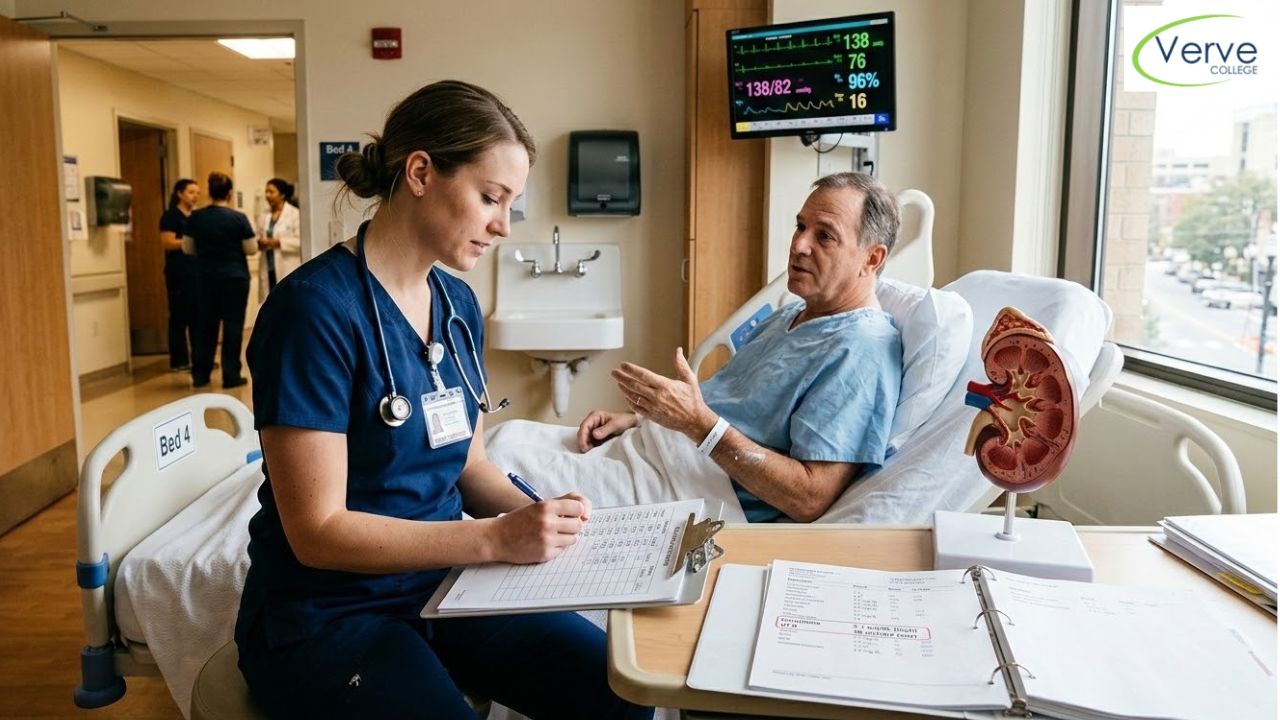
Understanding Renal Function Nursing: A Future LPN’s Guide to Kidney Physiology, Fluid Balance, and Patient Assessment
Understanding Renal Function Nursing: A Future LPN’s Guide to Kidney Physiology, Fluid Balance, and Patient Assessment
If you are studying to become an LPN, the kidneys will show up in almost every unit you cover. Fluid balance, medication clearance, blood pressure, electrolytes — it all connects back to renal function. Understanding renal function in nursing is not just a test topic. It is foundational knowledge you will use at the bedside every single day.
This guide breaks it down in plain language so you can build a strong foundation before clinicals and carry that knowledge into your career.
Key Takeaways
- The kidneys regulate fluid balance, blood pressure, waste removal, and electrolyte levels all at the same time.
- LPNs need to recognize early signs of kidney dysfunction because changes can happen quickly and quietly.
- Fluid balance is one of the most common assessment areas where LPN observations make a real difference in patient outcomes.
- If you want to build this knowledge before entering a nursing program, anatomy and physiology classes give you the foundation to understand renal concepts at a deeper level.
- Knowing how kidneys work helps you understand why so many medications, dosages, and care plans are built around renal health.
- Patient assessment skills tied to kidney function are not advanced topics — they are core LPN competencies.
What the Kidneys Actually Do
Most people know kidneys filter blood and make urine. But the full picture is more interesting than that.
The kidneys are two fist-sized organs sitting just below your rib cage, on either side of your spine. Every single minute, they filter about one liter of blood. Over 24 hours, that adds up to roughly 180 liters of filtered fluid, with only about 1.5 to 2 liters leaving the body as urine.
The rest gets reabsorbed. Nutrients, water, and electrolytes your body still needs are pulled back into the bloodstream. Waste products like urea and creatinine are sent out.
Beyond filtering, the kidneys also:
- Regulate blood pressure through a hormone system called the renin-angiotensin-aldosterone system (RAAS)
- Control the balance of sodium, potassium, and other electrolytes
- Help manage red blood cell production by releasing a hormone called erythropoietin
- Play a role in activating vitamin D, which affects bone health
For an LPN, understanding these functions means you can connect the dots when a patient has a condition that affects the kidneys. It stops being memorization and starts making sense.
The Nephron: The Unit That Does the Work
Each kidney contains about one million tiny structures called nephrons. The nephron is where all the filtering, reabsorbing, and waste-concentrating actually happens.
Here is a simplified version of how it works:
Filtration happens at the glomerulus, a small bundle of capillaries where blood pressure forces fluid out of the blood and into the nephron.
Reabsorption happens in the tubules that follow. Water, glucose, sodium, and other useful substances are pulled back into circulation.
Secretion moves additional waste products from the blood into the tubule to be eliminated.
Excretion is the final step — what is left becomes urine and moves toward the bladder.
You do not need to memorize every segment of the nephron for your LPN board exam, but understanding the general flow helps you reason through clinical questions instead of just guessing.
Fluid Balance and Why It Matters at the Bedside
Fluid balance is one of the most hands-on areas where LPNs make a difference. You are monitoring intake and output, checking for swelling, assessing lung sounds, and reporting changes to the supervising nurse or physician.
When kidney function drops, fluid builds up. That is called fluid overload or hypervolemia. You might see it as swelling in the legs and ankles, weight gain over a short period, or crackling sounds in the lungs during breathing.
When the kidneys push out too much fluid, or when a patient is not taking in enough, dehydration or hypovolemia can result. Dry skin, decreased urine output, low blood pressure, and confusion are signs worth noting.
The kidneys are almost always involved in fluid imbalance. When you understand that, your assessments become more targeted and your documentation becomes more useful to the care team.
Electrolytes, Kidneys, and What Goes Wrong
Electrolytes are minerals in the blood that carry electrical charges. Sodium, potassium, calcium, and phosphorus are the big ones in renal care.
The kidneys control how much of each stays in the body. When kidney function is compromised, those levels shift — and those shifts can be dangerous.
Hyperkalemia (too much potassium) is one of the most serious complications of kidney disease. It can affect the heart rhythm and become life-threatening if not caught early.
Hyponatremia (low sodium) can cause confusion, headaches, and in severe cases, seizures.
As an LPN, you will not be interpreting lab values independently, but you will be drawing blood, monitoring patients, and reporting changes. Knowing what these terms mean and why they matter helps you give a clearer, more useful report to the team.
Patient Assessment Skills Tied to Renal Function
Renal assessment is something LPNs do as part of routine care, often without it being labeled that way. Here is what it looks like in practice:
Monitoring urine output. A healthy adult produces at least 30 milliliters of urine per hour. Anything less is a flag worth reporting.
Checking for edema. Press gently on the lower leg or ankle. If the indentation stays for a few seconds after you lift your finger, that is pitting edema — a potential sign of fluid retention tied to kidney or heart function.
Watching for changes in mental status. The kidneys clear waste from the blood. When that process is impaired, toxins build up and can affect brain function. Confusion or unusual fatigue in a patient with known kidney disease is not something to dismiss.
Reviewing medication lists. Many medications are cleared by the kidneys. When renal function drops, drugs can accumulate to toxic levels. LPNs who understand this are more alert to potential problems during medication administration.
If you are preparing for a licensed practical nurse program and want to feel confident going into these patient care scenarios, building your science foundation early makes a measurable difference.
A Misconception Worth Addressing
A lot of nursing students assume renal content is only relevant for patients with kidney disease. That is not accurate.
Kidney function affects nearly every patient you will care for. It influences which medications can be given safely, how much IV fluid is appropriate, and what lab values mean in context. A patient admitted for pneumonia may also have chronic kidney disease that shapes every part of their care plan.
Understanding the kidneys is not a specialty topic. It is general nursing knowledge, and it shows up constantly in LPN practice.
If you want to see how this kind of foundational science connects to the full scope of LPN training, exploring available LPN programs gives you a clear picture of what the curriculum covers and what you will be prepared to do.
Conclusion
The kidneys do a remarkable amount of work in the background, and as a future LPN, your job is to notice when something is off. Fluid changes, electrolyte shifts, medication buildup — these are the kinds of things you will be watching for on every shift.
Understanding renal function in nursing is not about memorizing anatomy diagrams. It is about building the kind of clinical reasoning that makes you a better observer, a more useful team member, and a safer caregiver.
Start building that foundation now. Your future patients will benefit from it.
Get Your Nursing Career Training Readiness Score Now!
Frequently Asked Questions (FAQs)
- Why is renal function so important for LPN students to understand?
The kidneys affect almost every system in the body, from blood pressure to medication clearance to electrolyte balance. LPNs are at the bedside monitoring these changes, so understanding how the kidneys work helps you recognize problems earlier and report them more clearly to the care team.
- What are the early warning signs of kidney problems I should watch for as an LPN?
Decreased urine output, swelling in the legs or ankles, unusual fatigue, and changes in mental status are common early indicators. Lab values like elevated creatinine or potassium levels are also red flags. You will not always diagnose the cause, but knowing what to look for and report is a core part of your role.
- Do I need to understand kidney physiology before starting an LPN program?
You do not need to be an expert, but having a basic understanding of anatomy and physiology before starting will make nursing coursework feel less overwhelming. Many students find that getting a head start on science fundamentals helps them keep up once the clinical content picks up pace.
Most Popular Blogs Posts

High-Fidelity Simulation in Nursing: How Realistic…
September 24, 2026 Read More
How to Compare Nursing Programs Before…
September 23, 2026 Read More
Thermoregulation: How the Body Regulates Temperature
September 23, 2026 Read More
Nursing Grants vs Scholarships: What’s the…
September 22, 2026 Read More