- Oak Brook:(630) 705-9999
- Chicago:(312) 920-8822
- Email:inquiry@vervecollege.edu
- Make a Payment
 Sign up
 Login
Login
- Home
- Programs
- Admission
- Resources
- ATI Entrance Exam Resources
- New E-Digital Library
- Refer a Friend
- School Newsletter
- Events
- Employers
- Job-Network
- Alpha Beta Kappa Candidates
- Verve College Library
- Graduation and Pinning Ceremony Photo Galleries
- Textbook Information
- Career Services
- Tutoring
- School Catalog
- FAQ
- Constitution Day Program
- Alumni
- Verve College Plans
- Financial Aid
- HEERF Reporting
- Satisfactory Academic Progress
- Apply For Financial Aid
- Net Price Calculator
- Return of Title IV Funds (R2T4)
- Financial Aid Office Code of Conduct
- Contact
- FAQs
- Verification Policy
- Vaccination Policy
- Student Right-to-Know Act
- Misrepresentation
- Information Security Program
- Academic Award Year
- Availability of Employee
- Cost of Attendance
- Health & Safety Exemption Requirement
- Students Rights and Responsibilities
- Leave of Absence
- Pell Formula
- Military Students
- Grants/ Scholarship Policy
- Contact Us
- Testimonials
- Blog
Is a Nursing Career Right For You?
Take The Free Quiz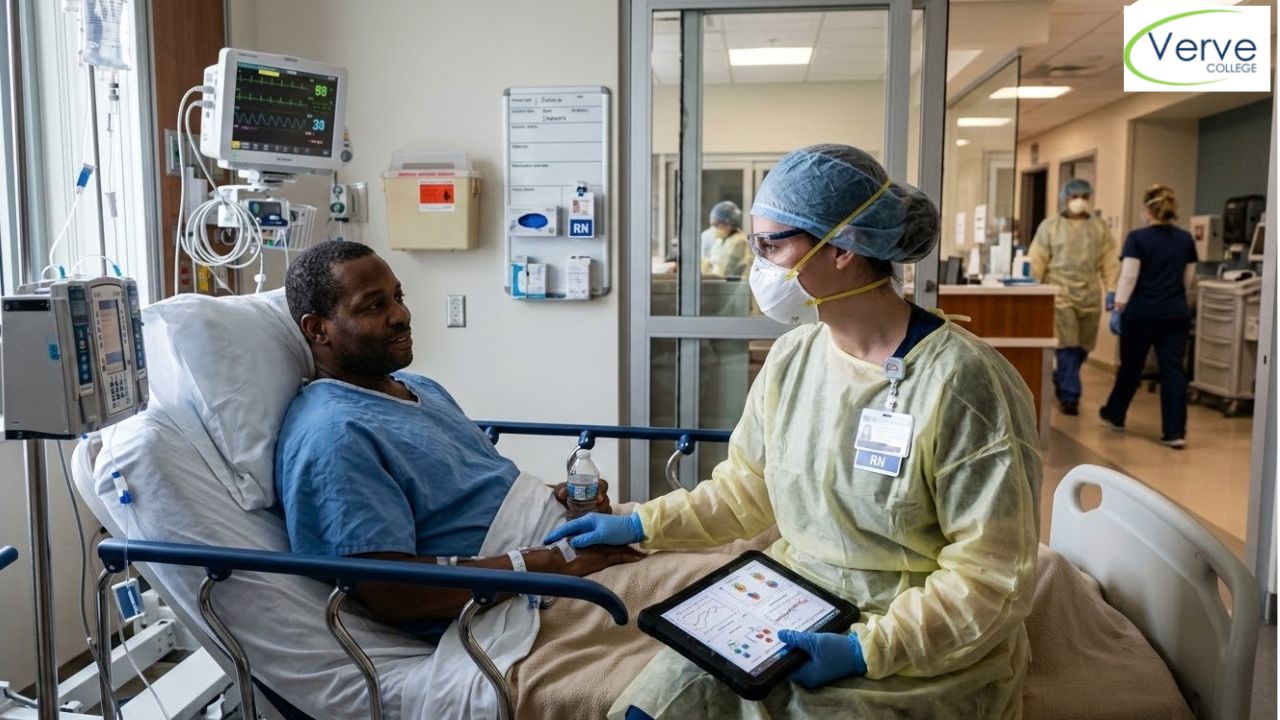
HIV Nursing Care vs. Routine Nursing Care: Why Immune Disorders Are More Complex
HIV Nursing Care vs. Routine Nursing Care: Why Immune Disorders Are More Complex
If you’ve ever wondered why caring for a patient with HIV looks so different from a standard post-surgery case, you’re not alone. Many nursing students are surprised by how much more goes into HIV nursing care than they expected. It’s not just about medication. It’s about understanding how the immune system fails, how the body responds, and how to support a patient on multiple levels at once.
This blog breaks down what makes HIV care different, why immune disorders are harder to manage than routine conditions, and what this means for you as a future nurse.
Key Takeaways
- HIV attacks the immune system directly, which changes how patients respond to treatment and infection
- Nurses caring for HIV patients need to monitor for opportunistic infections, not just the virus itself
- Medication management in HIV care is more layered and time-sensitive than in most routine cases
- Emotional and social support are a major part of HIV nursing care, not an afterthought
- Students enrolled in licensed practical nurse programs will build the clinical foundation needed to understand immune-based conditions
- Routine nursing care focuses on a single condition; HIV care requires whole-body, whole-person thinking
What Makes HIV Different from a Routine Diagnosis
Most routine nursing cases have a clear arc. A patient comes in with a broken bone, infection, or surgical recovery. You follow the care plan, monitor vitals, manage pain, and the body heals.
HIV doesn’t follow that arc.
HIV (Human Immunodeficiency Virus) attacks CD4 cells, which are the white blood cells that help the body fight infection. When those cells drop below a certain level, the immune system can no longer protect the body the way it should. That’s when HIV progresses to AIDS (Acquired Immunodeficiency Syndrome).
For nurses, this means the patient isn’t just fighting one thing. Their body is vulnerable to a wide range of infections and complications that a healthy immune system would normally handle on its own.
Routine Nursing Care vs. HIV Nursing Care: The Core Differences
Monitoring in Routine Care
In a standard nursing scenario, you’re tracking things like blood pressure, wound healing, oxygen levels, and response to one specific treatment. The body is doing most of the work. You’re supporting it.
Monitoring in HIV Nursing Care
With HIV patients, you’re watching for a much wider range of problems at the same time. Nurses regularly monitor:
- CD4 cell counts to understand how well the immune system is functioning
- Viral load, which measures how much of the virus is in the blood
- Signs of opportunistic infections like pneumonia, tuberculosis, or fungal infections
- Medication side effects from antiretroviral therapy (ART), which is the combination of drugs used to slow the virus
One shift in any of these areas can change the entire care plan. That level of monitoring requires a nurse who understands why each number matters, not just what the normal range is.
Medication Management Is a Whole Different Challenge
In routine care, a patient might be on two or three medications. You give them at the right time, watch for reactions, and document the response.
HIV patients are often on antiretroviral therapy, which involves multiple medications taken together in a very specific combination and schedule. Missing doses or taking them out of order can allow the virus to mutate and become resistant to treatment. That resistance can make future treatment much harder.
Nurses play a key role here. They educate patients on why adherence (sticking to the medication schedule) matters, watch for side effects that might make patients skip doses, and flag any changes in the patient’s labs or behavior that could signal a problem.
This is not the same as reminding someone to take a blood pressure pill. The stakes and complexity are different.
Opportunistic Infections: The Hidden Layer of HIV Care
This is the part that surprises many nursing students. When you care for an HIV patient, you’re often managing an infection that their immune system can no longer fight off on its own. These are called opportunistic infections because they take advantage of a weakened immune system.
Common examples include PCP pneumonia, cytomegalovirus (CMV), which is a viral infection that can damage the eyes and organs, and cryptococcal meningitis, which is a fungal infection affecting the brain.
Each of these requires its own treatment plan, and the nurse has to balance that alongside the patient’s HIV medications. Understanding why the immune system allows these infections to happen requires a solid foundation in how the body works at the cellular level. That’s exactly why anatomy and physiology classes are so valuable for nursing students, especially those planning to work with complex or immunocompromised patients.
The Emotional and Social Side of HIV Care
Routine nursing care involves empathy, but the emotional load of HIV care is a separate category entirely.
Many HIV patients carry significant stigma, fear, or trauma connected to their diagnosis. Some are dealing with housing instability, mental health challenges, or lack of family support. These factors directly affect health outcomes.
Nurses working in this space don’t just manage symptoms. They build trust, offer consistent non-judgmental care, and often serve as a key connection point between the patient and the rest of the care team. That kind of relationship-based nursing is something you develop over time, but it starts with understanding why it matters.
What This Means for Aspiring LPN Students
If you’re considering a career in nursing, understanding the difference between routine and complex care helps you know what you’re preparing for. HIV nursing care is one example of how the LPN role goes far beyond basic task management.
You’re building critical thinking skills, clinical judgment, and the ability to see the whole patient rather than just the chart.
Whether you’re just getting started or already planning your next step, exploring lpn online programs illinois can help you find a flexible path that fits your life while preparing you for real clinical situations.
A Common Misconception Worth Clearing Up
A lot of students assume that HIV patients are always in crisis or in a hospital setting. That’s not accurate.
Thanks to modern antiretroviral therapy, many HIV patients live long, stable lives and are seen in outpatient clinics, primary care offices, and community health settings. LPNs in those environments play an ongoing role in monitoring, patient education, and early detection of complications.
Knowing how HIV works and what to watch for is not just useful in a hospital. It’s a skill you’ll apply across many settings throughout your nursing career.
Conclusion
HIV nursing care is more complex than routine nursing because it requires you to think about the immune system, multiple medications, secondary infections, and the whole person at the same time. It’s a strong example of why nursing education has to go deeper than memorizing steps. Understanding the why behind care decisions is what makes a nurse effective. If you’re serious about building that kind of clinical foundation, the right program will make all the difference.
Get Your Nursing Career Training Readiness Score Now!
Frequently Asked Questions (FAQs)
1. What is the main difference between HIV nursing care and routine nursing care?
Routine nursing care typically focuses on a single condition or recovery process. HIV nursing care involves managing the immune system, antiretroviral medications, potential opportunistic infections, and the patient’s mental and social health all at the same time. It requires broader clinical thinking and consistent monitoring across multiple systems.
2. What if I’m not good at science? Can I still become an LPN who handles complex patients?
Yes, but you’ll want to build a strong foundation first. Many students who struggle with science early on find that they do much better once they study it in a structured, practical way. Starting with foundational coursework helps you understand how conditions like HIV affect the body so that clinical skills make more sense when you get there.
3. How do I know if LPN training will prepare me to handle immune-related conditions like HIV?
Look for programs that cover clinical skills, pharmacology, and patient care in real-world settings. A strong LPN program will not just teach you procedures but also how to assess patients, interpret basic lab findings, and support complex care plans. Verve College’s practical nursing program is built around exactly this kind of hands-on, career-ready preparation.
Most Popular Blogs Posts

What Is Operant Conditioning? Behavior and…
September 14, 2026 Read More
What Is Classical Conditioning? Guide for…
September 14, 2026 Read More
Nursing Certification: What Is It and…
September 10, 2026 Read More
Nursing Resume Skills: What Employers Look…
September 9, 2026 Read More