- Oak Brook:(630) 705-9999
- Chicago:(312) 920-8822
- Email:inquiry@vervecollege.edu
- Make a Payment
 Sign up
 Login
Login
- Home
- Programs
- Admission
- Resources
- ATI Entrance Exam Resources
- New E-Digital Library
- Refer a Friend
- School Newsletter
- Events
- Employers
- Job-Network
- Alpha Beta Kappa Candidates
- Verve College Library
- Graduation and Pinning Ceremony Photo Galleries
- Textbook Information
- Career Services
- Tutoring
- School Catalog
- FAQ
- Constitution Day Program
- Alumni
- Verve College Plans
- Financial Aid
- HEERF Reporting
- Satisfactory Academic Progress
- Apply For Financial Aid
- Net Price Calculator
- Return of Title IV Funds (R2T4)
- Financial Aid Office Code of Conduct
- Contact
- FAQs
- Verification Policy
- Vaccination Policy
- Student Right-to-Know Act
- Misrepresentation
- Information Security Program
- Academic Award Year
- Availability of Employee
- Cost of Attendance
- Health & Safety Exemption Requirement
- Students Rights and Responsibilities
- Leave of Absence
- Pell Formula
- Military Students
- Grants/ Scholarship Policy
- Contact Us
- Testimonials
- Blog
Is a Nursing Career Right For You?
Take The Free Quiz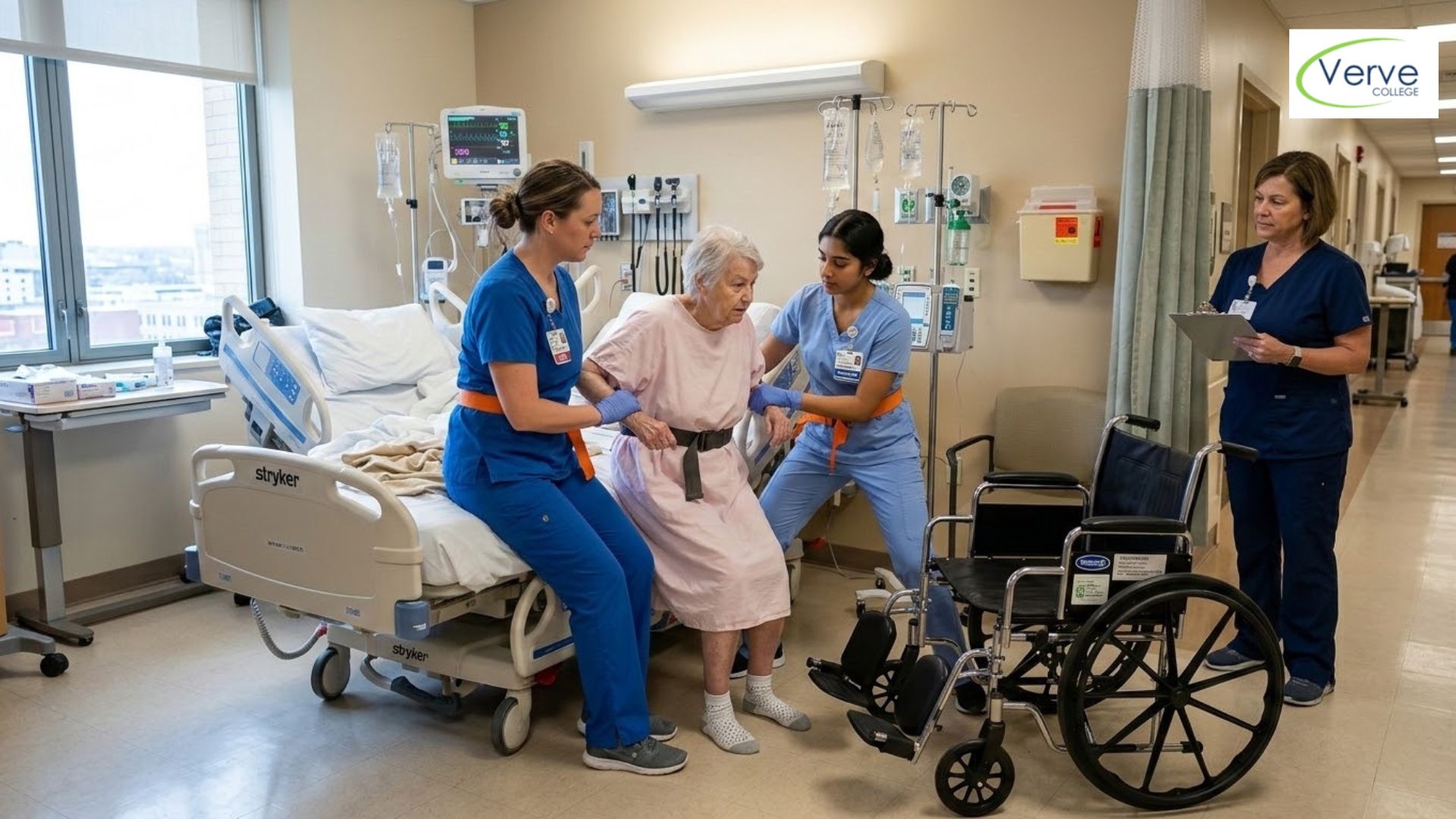
How Practical Nurses Protect Their Spines During Patient Transfers
How Practical Nurses Protect Their Spines During Patient Transfers
Back injuries are one of the leading reasons nurses leave the profession early. In fact, healthcare workers suffer more musculoskeletal injuries than almost any other occupation. If you’re training to become a nurse, learning the right techniques now can protect your career for decades.
This blog breaks down how practical nurses use safety and body mechanics nursing principles to move patients safely, avoid injury, and stay physically strong on the job.
Key Takeaways
- Improper lifting and patient transfers are a top cause of back injuries in nursing
- Using correct body mechanics reduces your injury risk significantly
- Nurses use specific stances, grips, and equipment to transfer patients safely
- These skills are taught in clinical training, not learned on the job by trial and error
- If you’re exploring lpn programs, body mechanics is a core part of what you’ll study
- Understanding these techniques early gives you a real advantage before clinicals begin
Why Back Injuries Are So Common in Nursing
Nurses spend most of their shift on their feet. They lift, reposition, and transfer patients who may be unable to move on their own. Without the right technique, all of that load falls on the spine.
The lower back is especially vulnerable. When you bend forward and twist at the same time while holding weight, the discs in your spine are under serious pressure. Do that dozens of times a day, and it adds up fast.
New nurses are at the highest risk. They’re eager to help, often in a hurry, and haven’t yet built the muscle memory for safe movement. That’s exactly why body mechanics training belongs early in nursing education.
What “Body Mechanics” Actually Means
Body mechanics is the way you position and move your body to use your muscles most efficiently and safely. Think of it as the posture and movement habits that protect you while you work.
Good body mechanics in nursing means:
- Keeping your spine in a neutral position (not hunched or overextended)
- Bending at the hips and knees, not the waist
- Keeping heavy loads close to your body
- Avoiding twisting while carrying or supporting weight
- Using a wide base of support by spreading your feet shoulder-width apart
These aren’t complicated moves. But they have to become automatic, and that takes practice.
The Core Techniques Nurses Use During Patient Transfers
Assessing Before You Move
Before any transfer, nurses assess the patient. Can the patient bear any weight? Do they have IV lines or tubes that could be disrupted? Is there enough room to move safely?
Skipping this step is one of the most common causes of both patient falls and nurse injuries. A two-second assessment can prevent a serious problem.
The Squat-Lift Technique
When lifting from a low surface, nurses lower themselves by bending at the knees and hips, keeping their back straight. The lift comes from the legs, not the back.
This is the same form used in weightlifting. Your leg muscles are far stronger than your back muscles. When you lift with your legs, you’re using the right tools for the job.
Pivoting Instead of Twisting
Twisting the spine under load is one of the fastest ways to get hurt. Instead of twisting, nurses pivot their entire body by moving their feet. Turn your feet first, then your body follows.
This habit protects the lumbar discs, which are the cushions between your vertebrae. Once those discs are damaged, recovery takes time and the injury can become chronic.
The Log Roll
For patients who cannot get up on their own, nurses often use the log roll technique to reposition them in bed. This involves rolling the patient as a single unit, keeping the head, spine, and hips aligned.
Two nurses usually perform this together. Coordination matters here, and clear communication before the move prevents accidents.
Using Transfer Equipment
Nurses don’t always rely on manual technique alone. Many facilities use:
- Gait belts – a sturdy belt placed around the patient’s waist for a safe, firm grip
- Transfer boards – smooth boards that help slide patients from bed to wheelchair
- Mechanical lifts – for patients who cannot bear any weight, a sling-based lift does the heavy work
Knowing how to use this equipment correctly is just as important as learning the manual techniques. Licensed practical nurse programs that include clinical rotations give students hands-on time with these tools before they graduate.
What Happens When Body Mechanics Are Ignored
This isn’t just about personal health. Poor technique puts patients at risk too. A nurse who loses their footing during a transfer can drop or injure the patient.
Common injuries from poor body mechanics include:
- Herniated or bulging discs
- Muscle strains in the lower back and shoulders
- Rotator cuff injuries from awkward lifting angles
- Chronic pain that affects quality of life and job performance
Many nurses with long-term back injuries report that the problem started with one bad lift. One moment of not thinking about form.
How This Gets Taught in Nursing Programs
Safety and body mechanics nursing content is not something you pick up informally. It’s taught through demonstration, practice, and feedback in a clinical lab setting.
Students practice on mannequins and with lab partners. They get corrected in real time. They repeat the movements until the habits are built in. By the time they enter clinicals, the techniques feel natural.
If you’re looking at practical nursing programs in Chicago, look for programs that include structured lab time where these skills are practiced hands-on. Reading about a pivot technique is not the same as doing it correctly under supervision.
A Common Misconception Worth Addressing
Many students assume body mechanics only matters when lifting heavy patients. That’s not true.
Even repositioning a patient’s pillow or adjusting their position in bed can strain your back if your posture is off. The weight doesn’t have to be significant for the technique to matter. Over time, small repeated movements with poor form add up to the same kind of injury as a single heavy lift done wrong.
The goal is to make safe movement a habit, not something you think about only with heavy patients.
Conclusion
Your spine is one of your most important career assets as a nurse. Learning safety and body mechanics nursing techniques early means you’ll protect yourself throughout your career, not just avoid injury in week one of clinicals.
The nurses who last in this profession aren’t just clinically skilled. They also know how to move safely, use the right equipment, and ask for help when they need it. These habits start in training. The sooner you learn them, the better positioned you’ll be for a long, healthy nursing career.
Get Your Nursing Career Training Readiness Score Now!
Frequently Asked Questions (FAQs)
1. What is meant by body mechanics in nursing?
Body mechanics in nursing refers to the correct way to position and move your body while performing physical tasks like lifting, transferring, or repositioning patients. The goal is to use your muscles efficiently while protecting your spine and joints from injury.
2. What if a patient is too heavy for one nurse to move safely?
Nurses should never attempt a transfer alone if there’s a risk of injury to themselves or the patient. Most facilities have protocols requiring two nurses for heavier patients, and mechanical lift equipment is available for patients who cannot bear their own weight. Asking for help is not a weakness; it’s a safety standard.
3. How do I know if a nursing program teaches these skills properly?
Look for programs that include hands-on clinical lab time where students practice patient transfers and movement techniques with supervision. A program that only covers these topics in textbooks is not giving you the full picture. Ask directly about lab hours and what equipment students practice on before entering clinicals.
Most Popular Blogs Posts

High-Fidelity Simulation in Nursing: How Realistic…
September 24, 2026 Read More
How to Compare Nursing Programs Before…
September 23, 2026 Read More
Thermoregulation: How the Body Regulates Temperature
September 23, 2026 Read More
Nursing Grants vs Scholarships: What’s the…
September 22, 2026 Read More