- Oak Brook:(630) 705-9999
- Chicago:(312) 920-8822
- Email:inquiry@vervecollege.edu
- Make a Payment
 Sign up
 Login
Login
- Home
- Programs
- Admission
- Resources
- ATI Entrance Exam Resources
- New E-Digital Library
- Refer a Friend
- School Newsletter
- Events
- Employers
- Job-Network
- Alpha Beta Kappa Candidates
- Verve College Library
- Graduation and Pinning Ceremony Photo Galleries
- Textbook Information
- Career Services
- Tutoring
- School Catalog
- FAQ
- Constitution Day Program
- Alumni
- Verve College Plans
- Financial Aid
- HEERF Reporting
- Satisfactory Academic Progress
- Apply For Financial Aid
- Net Price Calculator
- Return of Title IV Funds (R2T4)
- Financial Aid Office Code of Conduct
- Contact
- FAQs
- Verification Policy
- Vaccination Policy
- Student Right-to-Know Act
- Misrepresentation
- Information Security Program
- Academic Award Year
- Availability of Employee
- Cost of Attendance
- Health & Safety Exemption Requirement
- Students Rights and Responsibilities
- Leave of Absence
- Pell Formula
- Military Students
- Grants/ Scholarship Policy
- Contact Us
- Testimonials
- Blog
Is a Nursing Career Right For You?
Take The Free Quiz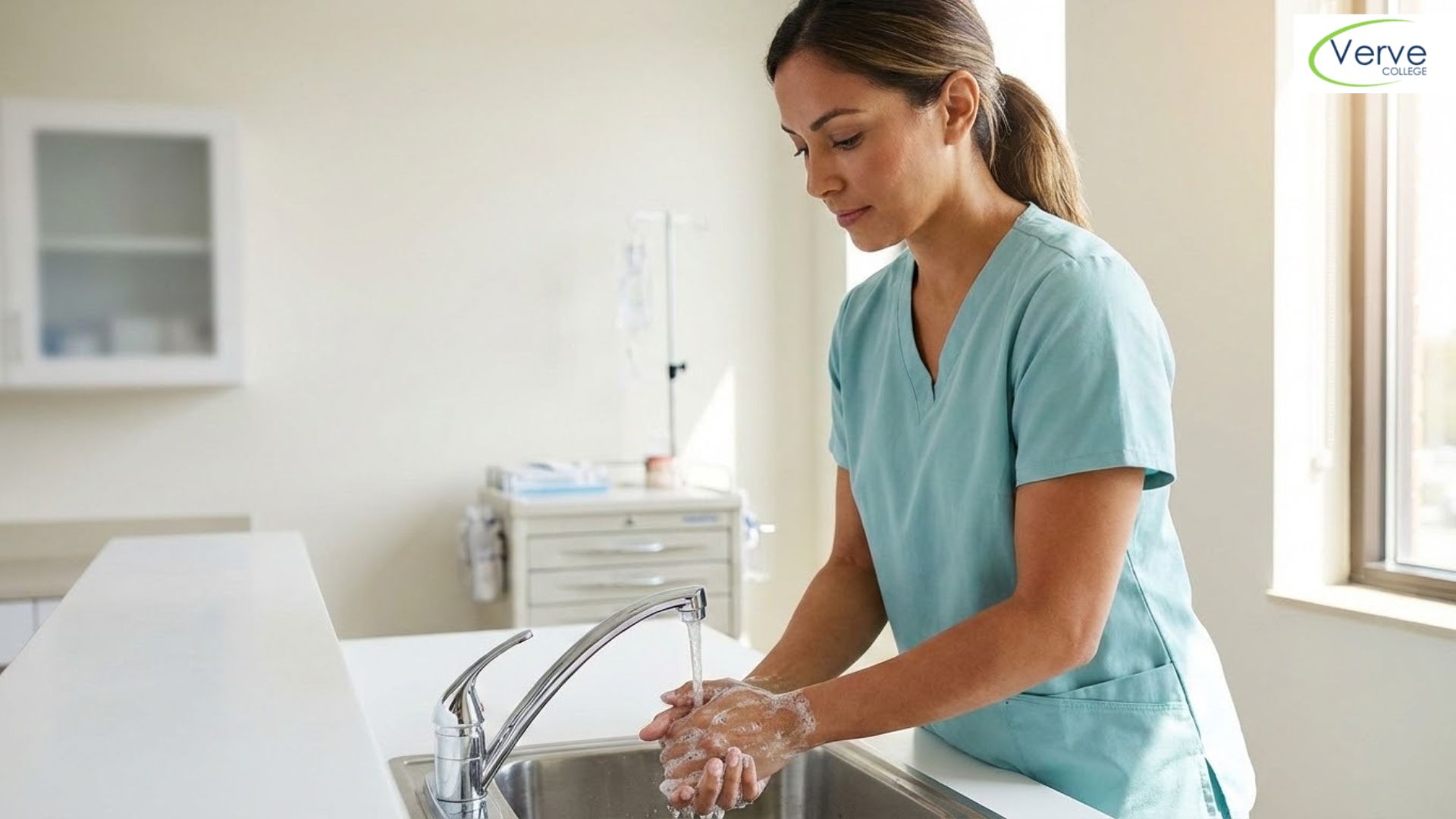
Infection Control Practices Every Nurse Should Know
Infection Control Practices Every Nurse Should Know
Every year, millions of patients develop infections they didn’t have when they first walked into a healthcare facility. Many of these infections are preventable, and nurses are the first line of defense.
Understanding infection control in nursing isn’t just a box to check during training. It’s a core skill you’ll use every single shift, in every care setting you work in.
This guide breaks down the most essential infection control practices — what they are, why they matter, and how you’ll apply them as a nurse.
Key Takeaways
- Infection control in nursing starts with understanding how infections spread — and how to interrupt that process
- Hand hygiene is the single most effective infection prevention tool available to nurses
- Standard precautions apply to every patient — not just those with known infections
- Nurses who understand body systems and disease pathways (covered in an A&P Class) are better equipped to recognize and prevent infections early
- PPE, aseptic technique, and isolation protocols are all part of a nurse’s daily toolkit
- Students entering licensed practical nursing schools learn these practices through hands-on lab training and clinical rotations
1. Understand How Infections Spread
Before you can stop an infection, you need to know how it travels.
Infections spread through what’s called the “chain of infection.” This chain has six links: the infectious agent (the germ), a reservoir (where it lives), a way out of the reservoir, a mode of transmission, a way in to the new host, and a susceptible host.
As a nurse, your job is to break that chain at as many points as possible.
Transmission can happen through direct contact (touching an infected patient), droplets (from coughing or sneezing), airborne particles, contaminated surfaces, or bloodborne exposure. Knowing the route helps you choose the right precaution.
2. Hand Hygiene — Still the Most Powerful Tool
This one sounds simple. It isn’t.
Hand hygiene is the most studied, most proven intervention in infection prevention — and also one of the most inconsistently practiced. Research from the CDC consistently shows that proper handwashing dramatically reduces the spread of healthcare-associated infections (HAIs).
When to wash your hands:
- Before and after touching a patient
- Before performing any procedure
- After contact with bodily fluids or contaminated surfaces
- After removing gloves
Use soap and water when hands are visibly soiled. Alcohol-based hand rub is effective for routine decontamination between patient contacts.
Don’t rush it. Proper technique takes 20–30 seconds.
3. Standard Precautions Apply to Every Patient
Standard precautions are the baseline level of infection control applied to every patient, every time — regardless of their diagnosis.
These include:
- Hand hygiene (see above)
- Gloves — when touching blood, bodily fluids, or broken skin
- Gowns — when there’s risk of clothing contamination
- Masks and eye protection — when splashing or spraying is possible
- Safe handling of sharps — needles, scalpels, and lancets require careful disposal in sharps containers
- Respiratory hygiene — teach patients to cover their coughs; offer masks when appropriate
The word “standard” doesn’t mean minimal — it means universal. You follow these with every patient because you can’t always know who is infectious.
4. Transmission-Based Precautions — Going a Step Further
Some infections require additional precautions beyond the standard set. These are called transmission-based precautions, and they fall into three categories:
Contact Precautions
Used for infections spread by touching — like MRSA (a drug-resistant staph infection) or C. difficile (a bacterial infection that causes severe diarrhea). You’ll wear gloves and a gown for every patient interaction and use dedicated equipment.
Droplet Precautions
Used for infections spread through respiratory droplets — like influenza or whooping cough. You’ll wear a surgical mask when within three feet of the patient.
Airborne Precautions
Used for infections that travel through tiny particles that stay suspended in the air — like tuberculosis (TB) or measles. This requires an N95 respirator (a tight-fitting mask) and a special negative-pressure room that prevents contaminated air from escaping.
5. Aseptic Technique — Keeping Things Clean When It Matters Most
Aseptic technique means using specific practices to prevent contamination during procedures. Think of it as creating a “clean zone” around a wound, a catheter, or an IV line.
It’s used during wound care, urinary catheter insertion, IV placement, and surgical procedures.
The principle is straightforward: anything that enters a sterile field must be sterile. But executing it requires focus and practice — especially when you’re managing a patient who is moving, anxious, or in pain.
Nursing students practice aseptic technique extensively in simulation labs before ever working on a real patient.
6. Personal Protective Equipment (PPE) — Know What to Use and When
PPE is not one-size-fits-all. Using the right PPE for the right situation is part of infection control in nursing — and using wrong or inadequate PPE can give false confidence while leaving you or your patient exposed.
Basic PPE hierarchy:
- Gloves → always when touching non-intact skin or body fluids
- Masks → when there’s droplet or airborne risk
- Gowns → when there’s risk of contamination to clothing or skin
- Eye protection (goggles or face shield) → when there’s splatter risk
Donning (putting on) and doffing (taking off) PPE in the correct sequence is critical. Most contamination events happen during removal — taking off gloves carelessly can transfer whatever was on them to your hands or face.
7. Environmental Cleaning and Waste Disposal
Infection control doesn’t stop with the patient. The environment around them matters too.
High-touch surfaces — bed rails, call buttons, IV poles, doorknobs — can harbor bacteria and viruses for hours or days. Regular disinfection of these surfaces is a nursing responsibility, not just a housekeeping task.
Medical waste, especially sharps, must be disposed of properly. Never recap a used needle by hand. Always use puncture-resistant sharps containers, and never overfill them.
Soiled linens and contaminated materials follow specific handling protocols — usually double-bagged and labeled before removal from the room.
Why This Knowledge Starts in the Classroom
Infection control practices aren’t instinctive — they’re learned, repeated, and eventually become second nature.
Students who build a strong foundation in anatomy and physiology understand why infection control works at a biological level. When you know how pathogens interact with the immune system, the reasons behind each precaution make much more sense.
That’s why programs at licensed practical nursing schools like Verve College integrate infection control into both classroom instruction and hands-on lab training — not as a standalone topic, but woven throughout clinical coursework.
For students balancing work or family, Verve College also offers lpn weekend classes — a flexible path to building these skills without putting your life on hold.
Get Your Nursing Career Training Readiness Score Now!
Conclusion
Infection control in nursing is one of those foundational skills that shapes everything else you do as a nurse. Every patient interaction, every procedure, every shift — these practices are running in the background, protecting both the people in your care and you.
The nurses who take this seriously aren’t just following rules. They’re the ones patients trust most — and the ones who build long, respected careers.
If you’re ready to start learning these skills with real hands-on training and expert instructors, Verve College is a great place to begin.
FAQs
Q1: What does infection control in nursing actually involve day-to-day?
It involves hand hygiene before and after patient contact, using appropriate PPE, following isolation protocols for specific infections, maintaining a clean care environment, and disposing of medical waste safely. These aren’t occasional tasks — they happen throughout every shift.
Q2: I’m new to healthcare. Is infection control something I can learn quickly?
Yes — and you’ll learn it progressively. Nursing programs introduce infection control early and reinforce it throughout clinical training. The concepts aren’t complicated, but applying them consistently under real patient-care conditions takes practice. That’s why simulation labs and supervised clinicals matter so much.
Q3: How do I know if a nursing program actually teaches infection control well?
Look for programs that include hands-on lab training, clinical rotations in real healthcare settings, and curriculum that covers CDC-standard precautions. Accredited programs — like those approved by ABHES and the Illinois State Board of Education — are held to specific curriculum standards that include infection prevention training.
Most Popular Blogs Posts

What Is Case Management Nursing? A…
September 17, 2026 Read More
What Is the Blood-Brain Barrier? A…
September 16, 2026 Read More
Neonatal Nursing: What Does a NICU…
September 16, 2026 Read More
Oncology Nursing: What Nurses Do in…
September 15, 2026 Read More